COMAC disrupts aviation with its 19-seat electric plane: the CE-25A that could revolutionize short-haul flights
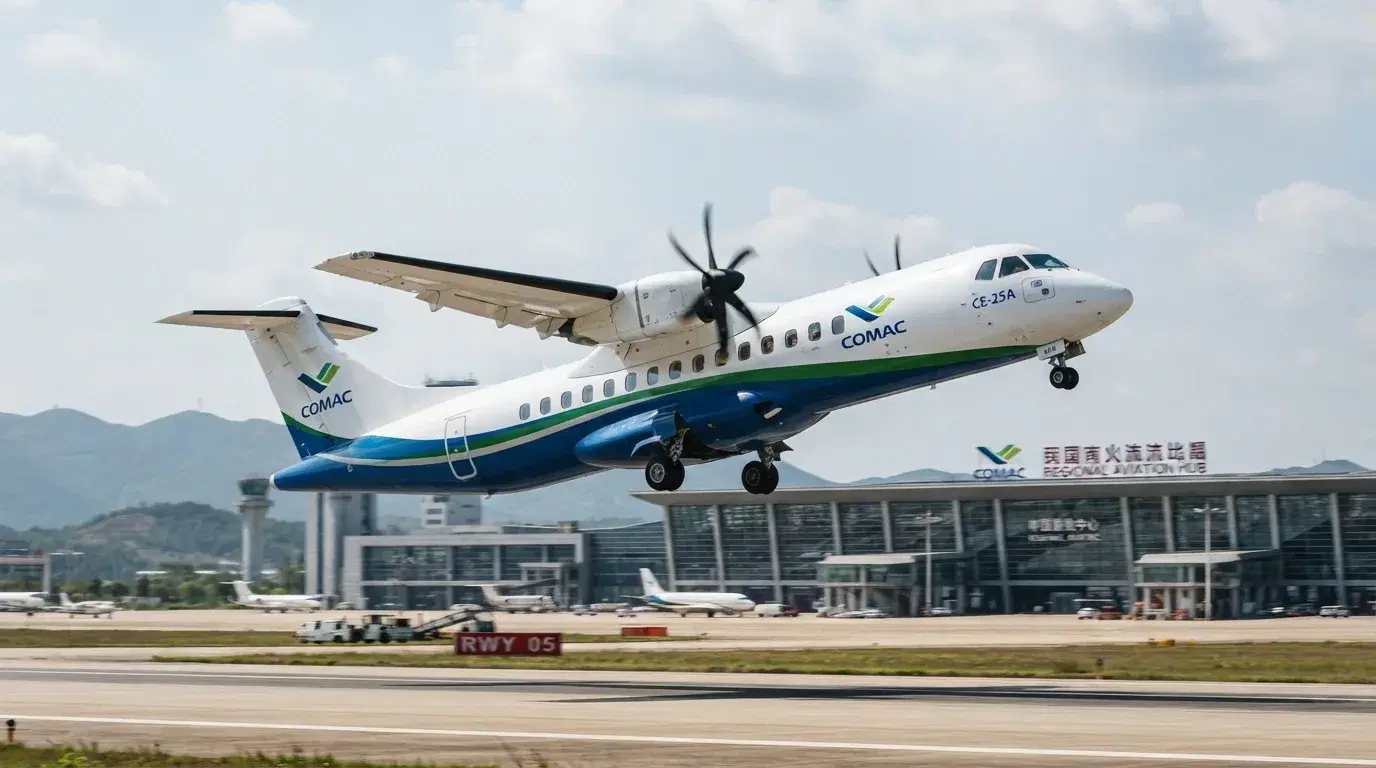
Chinese manufacturer COMAC has achieved a major milestone in aviation history with the first crewed flight of its CE-25A, a fully electric aircraft designed to carry 19 passengers on short-haul routes. Conducted on November 14, 2026, in Binzhou, Shandong province, this test flight marks a significant step forward in the development of electric propulsion in commercial air transport.
The CE-25A remained airborne for 16 minutes and 38 seconds, carrying two pilots and a test engineer, covering a distance of 60.4 kilometers before landing. The entire test sequence, including ground operations, lasted 57 minutes and 46 seconds. According to information released by COMAC, the aircraft operated normally, and all performance indicators met expectations. This inaugural crewed flight confirms the technological maturity of the project, following 19 autonomous test flights conducted since February 2026.
The CE-25A stands out for its distributed electric propulsion system: ten ducted propellers, with five on each wing, replace the traditional two-engine architecture. This innovative configuration promises quieter takeoffs and landings, optimized energy consumption, and simplified maintenance compared to thermal aircraft. With a maximum takeoff weight of ten tonnes, a cruising speed of 300 km/h, and a claimed range of 400 kilometers, the aircraft targets intercity and regional routes where distance and flight frequency make electrification viable.
A bold industrial partnership for aeronautical batteries
The development of the CE-25A relies on close collaboration between COMAC, battery manufacturer CATL, Shanghai Jiao Tong University, and other Chinese partners. CATL, a recognized specialist in high-energy-density batteries, unveiled in 2023 a "solid-state" battery technology capable of achieving an energy density of 500 Wh/kg. This innovation is central to the project, enabling sufficient range for commercial flights while meeting the safety margins required by aviation standards.
This partnership underscores China’s ambition to become a major player in electric aviation, a rapidly emerging segment. In 2024, CATL also announced an investment in AutoFlight, a Chinese developer of electric vertical takeoff and landing (eVTOL) aircraft, further confirming its strategy to diversify across green aviation sectors.
The application for a type certificate has been accepted by the Civil Aviation Administration of China (CAAC), marking an important regulatory milestone. However, this acceptance does not constitute a certificate issuance or permission to carry paying passengers. The certification process must be completed before commercial operations can begin, and no precise timeline has been announced following this inaugural flight.
Commercial prospects that could redefine regional transport
The CE-25A targets the intercity market, where the average distance between cities typically ranges from 200 to 500 kilometers. With a range of 400 kilometers, the aircraft could cover much of these routes nonstop while significantly reducing CO₂ emissions compared to thermal aircraft. This innovation arrives at a time when several countries, particularly in Europe and North America, are accelerating investments in green aviation technologies.
The environmental benefits of the CE-25A are substantial: no direct greenhouse gas emissions during flight, a drastic reduction in ground noise, and significantly lower energy consumption compared to jet or turboprop aircraft over the same distances. These features could appeal to local authorities, transport operators, and eco-conscious travelers.
Early industry reactions suggest strong interest in this technology. Several airlines, particularly in Asia and Europe, are closely monitoring the CE-25A’s development, with potential future orders in mind. The 19-seat capacity, tailored to the needs of small regional hubs, could also enable the operation of routes currently unprofitable with larger, fuel-intensive aircraft.
Regulatory and industrial challenges ahead
Despite the enthusiasm surrounding this innovation, several challenges must be overcome before commercial entry into service. The first is certification, which must ensure the aircraft’s safety and reliability throughout its lifecycle. The Chinese authority will need to validate not only the CE-25A’s technical performance but also maintenance procedures, crew training, and emergency protocols specific to electric aircraft.
Another challenge is the availability of suitable charging infrastructure. Airports will need to install high-power charging stations capable of rapidly replenishing the CE-25A’s batteries between flights. This infrastructure adaptation could represent a significant cost for some airports, particularly in less developed regions.
Finally, the issue of battery lifespan and recycling must be addressed. COMAC and CATL will need to demonstrate that the batteries used in the CE-25A comply with the strictest environmental standards to avoid creating new long-term ecological problems.
A giant leap for electric aviation, but not yet a revolution
The CE-25A’s flight is undoubtedly a major advance for electric aviation, but it does not yet herald a revolution in air transport. Several obstacles remain before such aircraft become commonplace in the skies. Range limitations, the 19-seat capacity, and operating costs remain significant barriers to widespread adoption.
Nevertheless, this project illustrates China’s determination to play a leading role in the aviation of tomorrow. With massive investments in green technologies and an ambitious industrial strategy, the country could well become a leader in the electric aviation sector in the coming years.
The next steps for COMAC will involve finalizing the CE-25A’s certification, conducting more real-world tests, and collaborating closely with regulators and operators to prepare for commercial entry into service. If these goals are achieved, the CE-25A could pave the way for a new era of cleaner, more sustainable regional air transport.
In the meantime, the aviation industry is watching this innovation closely, aware that the CE-25A could represent the future of short-haul flights at a time when pressure to reduce the environmental impact of air transport has never been greater.
Be the first to comment on this article
On the same topic
- Lufthansa and Airbus Celebrate 700th Delivery: A Centennial-Colored A350-1000 Joins the Fleet
- Atlantic Airways updates its fleet for a greener future: Why the Faroe Islands are turning their back on A320ceo for good
- Boeing 737 MAX 10: Alaska Airlines Bets on the Future with Imminent FAA Certification
- Turkish Airlines makes bold move: 150 Boeing 737 MAX ordered, a daring bet to reshape European skies
- Istanbul Airport’s New East-West Runway Revolutionizes Global Air Traffic
- Lufthansa Challenges Boeing with Shark Skin on A330: A Green Revolution Reshaping Air Travel