Istanbul Airport’s New East-West Runway Revolutionizes Global Air Traffic
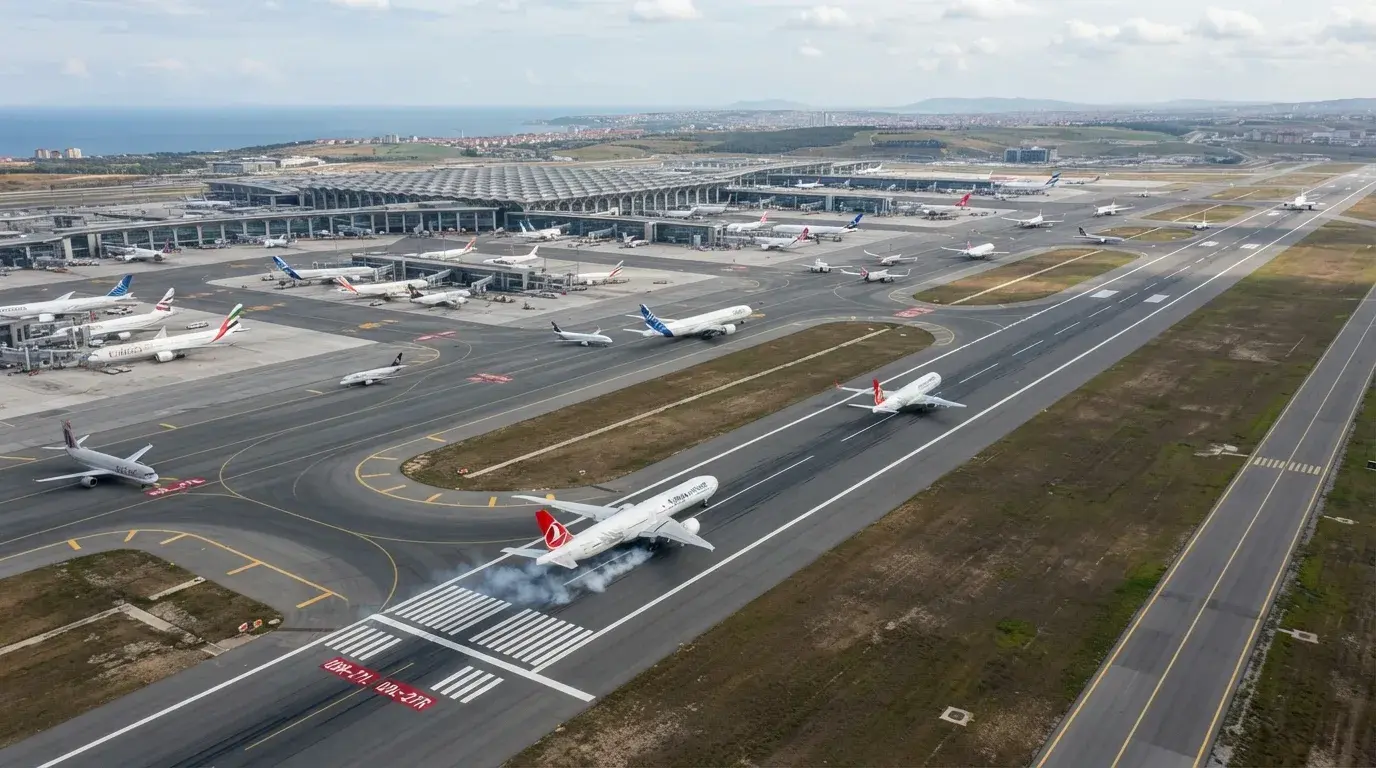
With the inauguration of its fourth main east-west runway, Istanbul Airport enters a new era. Since September 18, 2026, this 2,820-meter-long infrastructure, equipped with cutting-edge systems, reduces taxi times, improves punctuality, and strengthens the capacity of Turkey’s hub, already recognized as the world’s most connected. A major advancement for air traffic between Europe, the Middle East, Africa, and Asia.
This fourth runway, built for an investment of €890 million, marks a key milestone in Istanbul Airport’s development strategy. It joins the six existing runways, including two auxiliary ones, and becomes the first runway at the airport to align on an east-west axis. Until now, all Istanbul runways were oriented north-south, a configuration that limited takeoff efficiency in certain directions. Now, aircraft can take off eastbound without unnecessary detours, reducing fuel consumption and CO₂ emissions from ground operations.
The first flight to use this new infrastructure was operated by Turkish Airlines to Helsinki. The runway is designed to handle part of domestic traffic and routes to Anatolia, Central Asia, and the Arabian Peninsula. Its proximity to maintenance zones also accelerates general aviation operations, benefiting airlines and passengers alike.
“This fourth main runway, along with complementary investments, will significantly contribute to our airport, the world leader in connectivity,” declared Turkish President Recep Tayyip Erdoğan during the inauguration. A statement that carries weight, especially since Istanbul Airport became the world’s most connected hub in 2026 according to OAG’s Megahubs Index.
The Turkish airport has indeed dethroned London-Heathrow, boasting a connectivity index of 265.4, ahead of its British competitor (246.2). With 337 international destinations served by over 110 airlines across more than 140 countries, Istanbul offers 89,456 potential connections. A performance largely driven by the dominance of Turkish Airlines, which accounts for 80% of the airport’s capacity.
The new runway is also designed to enhance Istanbul Airport’s operational flexibility. In adverse weather conditions, particularly crosswinds, the east-west configuration reduces the risk of disruptions. Turkish authorities hope to preserve takeoff and landing safety margins while improving departure regularity.
Istanbul Airport is not stopping there. IGA (Istanbul Grand Airport) has already announced plans to increase the airport’s annual capacity to 90 million passengers, with a long-term goal of 200 million. To achieve this, the development of a full-fledged “airport city” is underway, including a dedicated business aviation terminal, a 485-room Hilton hotel, and the nearby Florentia Village shopping complex.
This new infrastructure is part of Istanbul Airport’s uninterrupted growth momentum. Since its inauguration in 2018 and full operational status in April 2019, the airport has continuously expanded to become a key player in global air transport. With this fourth runway, it takes another step toward solidifying its leadership position.
Unprecedented Operational Capacity
Simultaneous operation of four main runways is a first in Europe. Istanbul Airport has become the first European airport capable of independent operations on four parallel runways—a major technological and logistical achievement. This capacity not only absorbs traffic growth but also reduces saturation risks, a growing challenge for major international hubs.
According to Turkish authorities, this configuration should also help reduce CO₂ emissions from ground operations. By avoiding detours and unnecessary taxi times, aircraft consume less fuel, translating into lower greenhouse gas emissions. A significant step forward in an era where aviation faces increasing scrutiny over its environmental impact.
“The new east-west runway allows some aircraft to take off eastbound without additional detours or turns after departure,” explains an IGA spokesperson. “This reduces flight times and CO₂ emissions while improving punctuality.” Expected fuel and flight time savings could reach several percentage points, a notable economic and ecological advantage for airlines.
A Hub in Full Expansion
Istanbul Airport now aims for 90 million annual passengers, an ambitious but realistic goal given recent growth. The development plan includes up to nine runways—six main and three auxiliary. Once fully completed, the airport’s theoretical annual capacity could reach 200 million passengers, up from 90 million in its current configuration.
This expansion is accompanied by enhanced commercial and logistics infrastructure. The Jetex IGA Terminal for business aviation, along with the Florentia Village complex, aims to attract international clientele and strengthen the airport’s appeal. These projects position Istanbul Airport as a key player in tourism and business across Europe and beyond.
International airlines, including Turkish Airlines, Emirates, Qatar Airways, and Lufthansa, have already praised this milestone. For them, Istanbul represents a strategic crossroads between Europe, the Middle East, Africa, and Asia—an ideal geographic position to expand their networks.
With this new runway, Istanbul Airport reaffirms its status as an indispensable hub. An advancement set to enhance its attractiveness for travelers and airlines while consolidating its position as a global connectivity leader.
Learn more about Istanbul Airport
How This New Infrastructure Changes the Game for Travelers
For passengers, the inauguration of Istanbul Airport’s fourth east-west runway brings several tangible benefits. First, improved flight punctuality thanks to more flexible traffic management. Second, reduced travel times between terminals and runways, minimizing delays and cancellations. And third, better accessibility for long-haul connections—a specialty of Istanbul Airport.
Transit passengers benefit particularly from this new configuration. With over 89,000 potential connections, Istanbul has become an ideal platform for linking Europe to Asia, Africa, or the Middle East. Waiting times between flights should decrease, enhancing the overall passenger experience.
“Istanbul Airport has become an indispensable crossroads for international travelers,” explains a sector expert. “With this new runway, the airport gains in efficiency and appeal, reinforcing its role as a global hub.”
For airlines, the advantages are twofold. On one hand, increased capacity allows for more flights and passengers. On the other, optimized runway management reduces operational costs, particularly in fuel. These savings can translate into lower ticket prices—a compelling argument in a highly competitive industry.
Finally, for the environment, this new infrastructure represents a significant step forward. By reducing taxi times and detours, it lowers fuel consumption and CO₂ emissions. Another step toward a more sustainable aviation industry, even as other levers—such as sustainable aviation fuels—remain in development.
A Model to Follow for Other Global Airports
Istanbul Airport’s experience could inspire other major international hubs facing sustained traffic growth. With its fourth east-west runway, the Turkish airport demonstrates that it is possible to enhance capacity and operational efficiency without compromising punctuality or safety.
Other airports, such as Dubai or Doha, may draw inspiration from this approach to develop their own infrastructure. By adopting runways oriented in multiple directions, they could optimize operations and reduce their environmental footprint.
“Istanbul Airport shows that innovation and investment in infrastructure can transform a hub into a key player in global transport,” notes a sector analyst. “A lesson for all airports facing exponential growth.”
With this new runway, Istanbul Airport confirms its place among the world’s great airports. An advancement set to strengthen its appeal for travelers and airlines while solidifying its status as a connectivity leader.
Be the first to comment on this article
On the same topic
- Singapore Airlines Tops 2026 Airline Rankings: Air France Wins Best First Class
- Istanbul overtakes Heathrow in July: Why Turkey is becoming the new star of air travel
- Turkish Airlines Revives Premium Economy in 2028: What Travelers Need to Know
- Turkish Airlines Suspends 18 Destinations Amid Soaring Jet Fuel Prices