Turkish Airlines Suspends 18 Destinations Amid Soaring Jet Fuel Prices
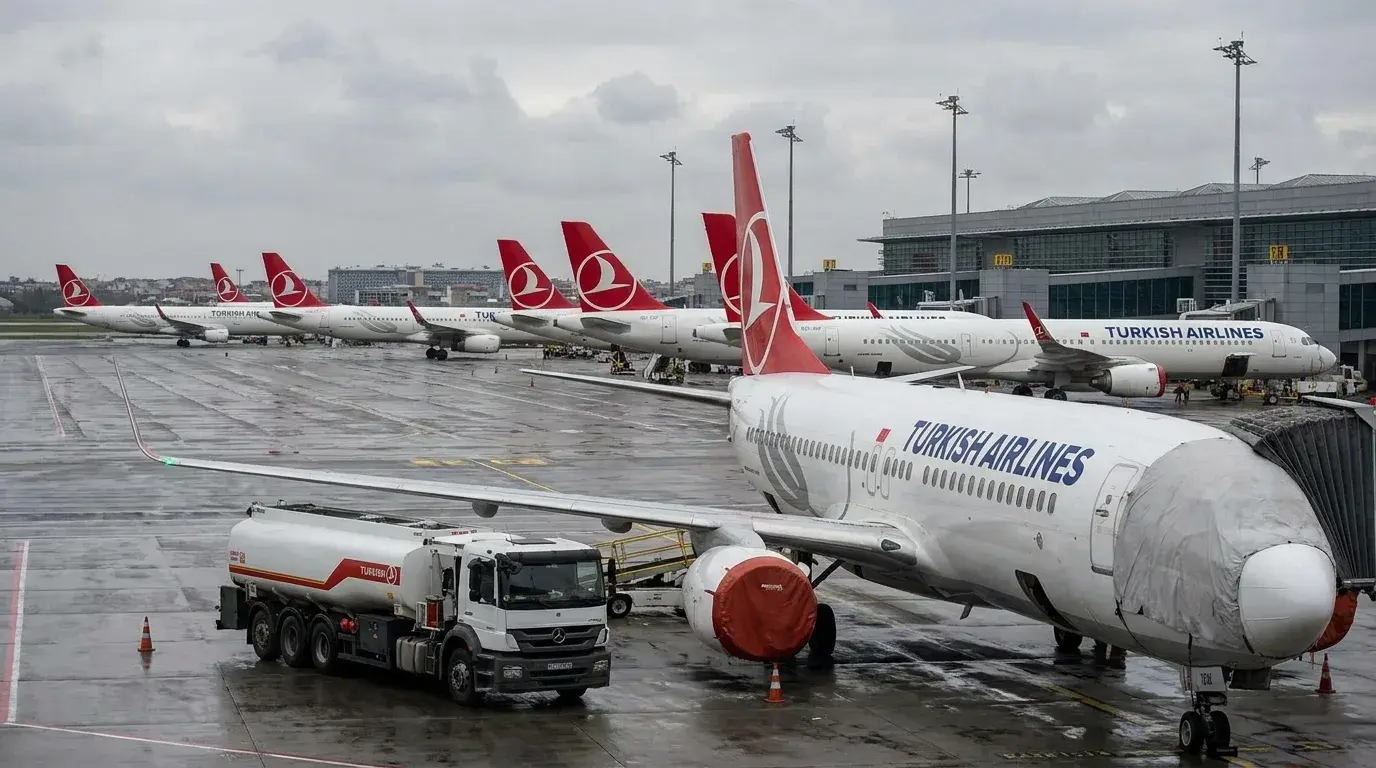
Turkish Airlines is implementing a rare network adjustment, suspending 18 international destinations between May and June 2026, with some routes affected until the following winter. The decision comes amid a sharp rise in fuel costs and persistent geopolitical tensions in the Middle East and Iran.
The airline’s message is clear: when jet fuel prices surge, even the densest networks must be reassessed. At Istanbul, the group’s central hub, the economic viability of certain routes no longer holds. Turkish Airlines, which serves a vast number of countries, is now balancing profitability, operational stability, and exposure to crisis zones.
According to planning data reported by the specialized site AeroRoutes, the first suspensions are set to begin on May 1, 2026, with Billund, followed by a staggered rollout throughout spring and early summer. While the airline has not officially declared a long-term strategic shift, the published schedules indicate a clear refocusing on its most robust routes.
A Network Under Pressure After Years of Expansion
Turkish Airlines has built its reputation on regularly launching new routes from its Istanbul hub. The airline has long maintained that once a destination is launched, it would remain in service. The current changes weigh more heavily than a simple seasonal adjustment: they mark a halt in a nearly continuous expansion strategy.
The market context has shifted dramatically since the end of winter. Jet fuel prices have risen to levels that force carriers to reassess the profitability of their least robust routes. At the same time, regional tensions are complicating operations on several air corridors, particularly to Iran and parts of the Middle East.
For Turkish Airlines, this combination leaves little room for maneuver. On such an extensive network, routes with low load factors, long-haul flights, and politically sensitive markets are the first to be sacrificed in capacity adjustments.
Destinations Affected by Suspensions
The cuts span multiple regions. In Europe, Billund in Denmark will be suspended as early as May 1, while Leipzig/Halle in Germany will be removed from the summer schedule. Ferghana in Uzbekistan will also be withdrawn, with suspensions effective in early June. Aqaba in Jordan will see its resumption canceled.
In the Middle East, the situation is even more severe. Najaf and Kirkuk in Iraq are postponed with no scheduled return for the summer. In Iran, flights to Isfahan, Mashhad, Shiraz, and Tabriz will remain suspended at least until the end of October 2026. The resumption of Tehran, announced for June 1, is presented as provisional.
The retreat is also evident in Africa. Hurghada in Egypt will be served for the last time on June 2. Juba in South Sudan remains frozen, as does Bissau in Guinea-Bissau, now pushed back to spring 2027. Freetown and Monrovia are also removed from the schedule during this period. In Central and Southern Africa, the end of the Istanbul–Luanda–Kinshasa triangular flights will result in the suspension of Kinshasa and Luanda, while Lusaka, Libreville, and Pointe-Noire are also removed from the program.
In Central Asia, Turkistan in Kazakhstan will be suspended for the entire summer season and beyond. In Latin America, Havana will remain frozen until October 24, 2026, effectively erasing the route from the summer IATA schedule.
Jet Fuel as the Decisive Factor
The surge in fuel prices is the primary driver behind this contraction. According to estimates reported by the Turkish press, aviation jet fuel prices have risen from around $90 to $185 per barrel. In such an environment, airlines must act quickly: either raise fares, reduce capacity, or do both.
Turkish Airlines’ model, built on a strong hub and a finely meshed global network, is particularly exposed. The more extensive the network, the more marginal routes become vulnerable when costs rise. The most distant, complex, or politically sensitive routes become unsustainable if load factors fail to offset increased expenses.
The cost war extends beyond the price per liter of fuel. It also impacts overflight fees, diversions, flight times, and aircraft availability. For Turkish Airlines, this pressure is compounded by the risk of overflight restrictions over certain regions.
Iran and Cuba: Two Symbolic Cases
Iran exemplifies the direct impact of geopolitical risk on flight schedules. Turkish Airlines maintained a broader presence there than most foreign carriers, serving several cities beyond Tehran. Now, this footprint is shrinking significantly, with prolonged suspensions for multiple airports until at least the end of October 2026.
Havana represents a different but equally telling case. The route had already been weakened by fuel supply challenges in Cuba. The latest adjustments now indicate a suspension long enough to neutralize the long-haul route for the entire summer. It’s a concrete example of how local constraints can disrupt the balance of a long-haul route.
In both cases, Turkish Airlines is not only acting on volumes. It is also protecting the operational continuity of its core network by concentrating aircraft and crews on markets deemed more predictable.
A Signal for the Entire Air Transport Sector
Turkish Airlines’ decision aligns with a broader trend observed among several carriers. When fuel costs rise rapidly, networks contract, frequencies drop, and secondary routes are reviewed. Airlines are not just cutting routes to reduce costs; they are preserving the lines that generate the most connecting traffic and revenue per seat.
This logic is even more pronounced among hub carriers, whose profitability depends on the strength of connecting waves. If a destination does not sufficiently feed traffic into the rest of the network, it becomes a natural exit point when conditions deteriorate. The 18 announced suspensions show that Turkish Airlines is now applying this triage far more strictly.
In the short term, the challenge will be to determine whether this reduction remains temporary or signals a more lasting repositioning. The suspended destinations could return if fuel prices ease and regional tensions stabilize. For now, however, the airline is prioritizing the preservation of its financial structure over maximum network coverage.
The message to the market is clear: even a carrier accustomed to expanding its global footprint may be forced to scale back its ambitions when economic and geopolitical factors align against it. For Turkish Airlines, spring 2026 looks less like a phase of conquest and more like a period of tactical retreat, dictated by the price of jet fuel and the realities of exposed routes.
Be the first to comment on this article
On the same topic
- How Delta Air Lines’ refinery strategy is reshaping airline fuel costs and ticket prices
- Fuel surcharges on already-purchased tickets: What Brussels really prohibits airlines from doing
- Spirit Airlines halts operations: What the U.S. low-cost carrier’s bankruptcy means for travelers
- Jet fuel: Why Europe now depends on the US to keep its planes flying
- Rising Fuel Costs: Delta Air Lines Posts Loss, Cuts Capacity, and Raises Fares