Air Antilles liquidated: the end of a costly relaunch attempt in the French Antilles
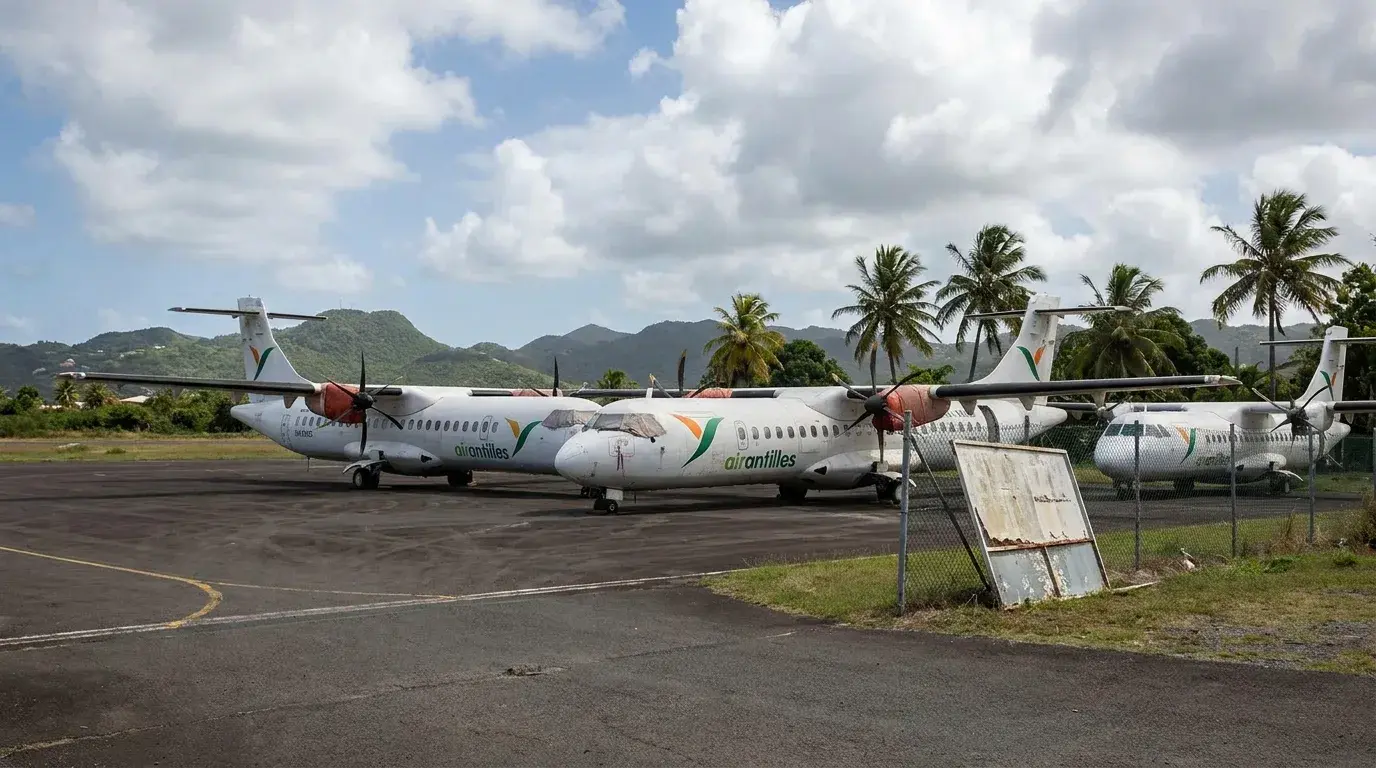
Air Antilles will no longer operate. The court-ordered liquidation handed down by the Pointe-à-Pitre Commercial Court on Monday, April 27, brings an abrupt end to the relaunch attempt initiated in the summer of 2024, closing a closely watched case in the French Antilles. The decision comes with an immediate cessation of operations due to the lack of a takeover offer deemed sufficiently credible to ensure business continuity and preserve jobs.
The case extends beyond the mere collapse of a struggling regional airline. It directly impacts inter-island connectivity, territorial continuity, and travel conditions between Guadeloupe, Martinique, Saint-Martin, and Saint-Barthélemy. In a region where air travel often remains the fastest solution, the shutdown of Air Antilles disrupts the market balance and raises numerous questions about future routes.
The airline had already been grounded since December 2025 after France’s civil aviation authority (DGAC) revoked its air transport certificate. It was subsequently placed under receivership on February 2, 2026. The conversion to liquidation had been a likely scenario, but the court’s decision underscores the depth of the difficulties accumulated over several months. The liabilities, estimated at over €56 million, weighed heavily in the judges’ assessment, as did the absence of revenue since the flight ban.
A 2024 relaunch that failed to endure
Air Antilles had been relaunched in June 2024 with substantial political and financial backing. The Collectivity of Saint-Martin became the majority shareholder in the name of territorial continuity, in an effort to save a tool deemed essential for serving the French islands of the Caribbean. Around €20 million was mobilized to restore operations and restart a fleet of ATR aircraft on regional routes.
This recovery followed a previous deep crisis after the liquidation of the CAIRE Group, Air Antilles’ former parent company, in August 2023. At the time, the court had authorized a provisional continuation of operations before a new structure was established. The relaunch was intended to provide a healthier foundation. Instead, it revealed the fragility of the economic model and the difficulty of sustaining a short-haul network in an insular environment heavily dependent on fixed costs.
In 2025, the airline transported over 121,000 passengers and reported revenue of around €18 million. Real figures, but insufficient to absorb an operational shock as severe as a total flight ban. The data shows that Air Antilles remained a small-scale operator exposed to the slightest cash flow disruption or regulatory compliance failure.
The turning point: air safety
The decisive moment came in December 2025, when the DGAC revoked the airline’s air transport certificate. The authority cited significant dysfunctions in safety processes, deemed incompatible with the continuation of commercial flights. In an industry where operations cannot tolerate any compromise, this decision immediately halted activity and froze revenue.
For a regional airline, the suspension of an air transport certificate is typically a major red flag. In Air Antilles’ case, it triggered a chain reaction: fleet immobilization, cash flow collapse, inability to maintain routes, and ultimately the inability to present a credible continuation plan. The liquidation thus sanctions a safety crisis as much as a financial one.
The court ruled out the possibility of building a realistic recovery plan due to the level of liabilities and persistent operating losses. In short, the airline no longer had a sufficient economic base to return to normal operations. This assessment aligns with the conclusions drawn by management itself in January, which acknowledged that financial resources were lacking to cover current expenses.
Takeover offers too weak to save the airline
The observation period had raised hopes for a partial solution, but the court rejected all takeover bids. The most advanced proposal came from the Guadeloupean consortium Pewen, linked to the Air Kalinago project led by entrepreneur Pierre Sainte-Luce. It was the only offer covering the entire operation, but it included a very limited workforce retention plan—just 13 employees out of 116, rising to 14 after a formal commitment made in court.
The court deemed this level of job preservation grossly insufficient in light of the legal obligation to safeguard employment. Another bid targeted only a single aircraft, with no staff retention, and was also dismissed. The jurisdiction refused to validate a piecemeal sale that would have left most of the activity and nearly all employees behind.
The issue is therefore not simply the disappearance of an operator. It also highlights the limitations of emergency-driven takeovers when the industrial tool is already weakened, regulatory trust has been eroded, and the financial structure no longer allows for the time needed to relaunch operations. In such a tight market, a bid must be more than just a project: it must guarantee a minimum level of operations, immediate cash flow, and the ability to return aircraft to service without further disruption.
116 jobs lost as operations grind to a halt
The liquidation of Air Antilles results in the loss of all 116 jobs at the airline. For the workforce, the decision ends months of uncertainty but also a particularly grueling professional chapter. A union representative quoted by AFP described a sense of relief after the wait, while acknowledging the difficult period faced by employees.
In such procedures, social measures and potential redeployments are handled under the legal framework of liquidation. But the immediate reality is clear: the company has ceased operations, and the fleet remains grounded. For passengers, this also means the loss of an operator that served essential regional routes in the French Antilles.
The volume of traffic may explain part of the fragility, but not all of it. Inter-island transport relies on regular frequencies, high operating costs, and extreme sensitivity to cash flow events. As soon as a regulatory incident cuts off sales, maintaining balance becomes nearly impossible. Air Antilles provides yet another illustration of this.
A regional market now dominated by a single player
With the demise of Air Antilles, Air Caraïbes has effectively become the sole airline regularly connecting the French territories of the Antilles. The Dubreuil Group already boasts a strong regional network and long-haul routes from Paris-Orly to Guadeloupe, Martinique, French Guiana, and several Caribbean destinations. The absence of a second operator immediately reshapes the competitive structure of the market.
For travelers, this raises several concrete challenges. The first is pricing, where the presence of a competitor typically acts as a restraint. The second concerns network resilience, as a single-operator market is more vulnerable to operational constraints, fleet decisions, and commercial trade-offs. The third relates to territorial continuity, particularly on the least dense or most seasonal routes.
Local authorities will now need to secure priority routes, relying on Air Caraïbes or potential new entrants. But the Air Antilles saga shows that a regional air transport project cannot be built on political support or good intentions alone. It requires a stable financial structure, robust operational compliance, and the ability to weather downturns without service interruptions.
The skies over the Antilles are once again reorganized around a dominant player, in an environment where demand remains indispensable but margins remain slim. For residents, businesses, and visitors, the pressing question now is how proximity routes will be maintained in the coming months—and what economic model, if any, will succeed that of Air Antilles.
Be the first to comment on this article