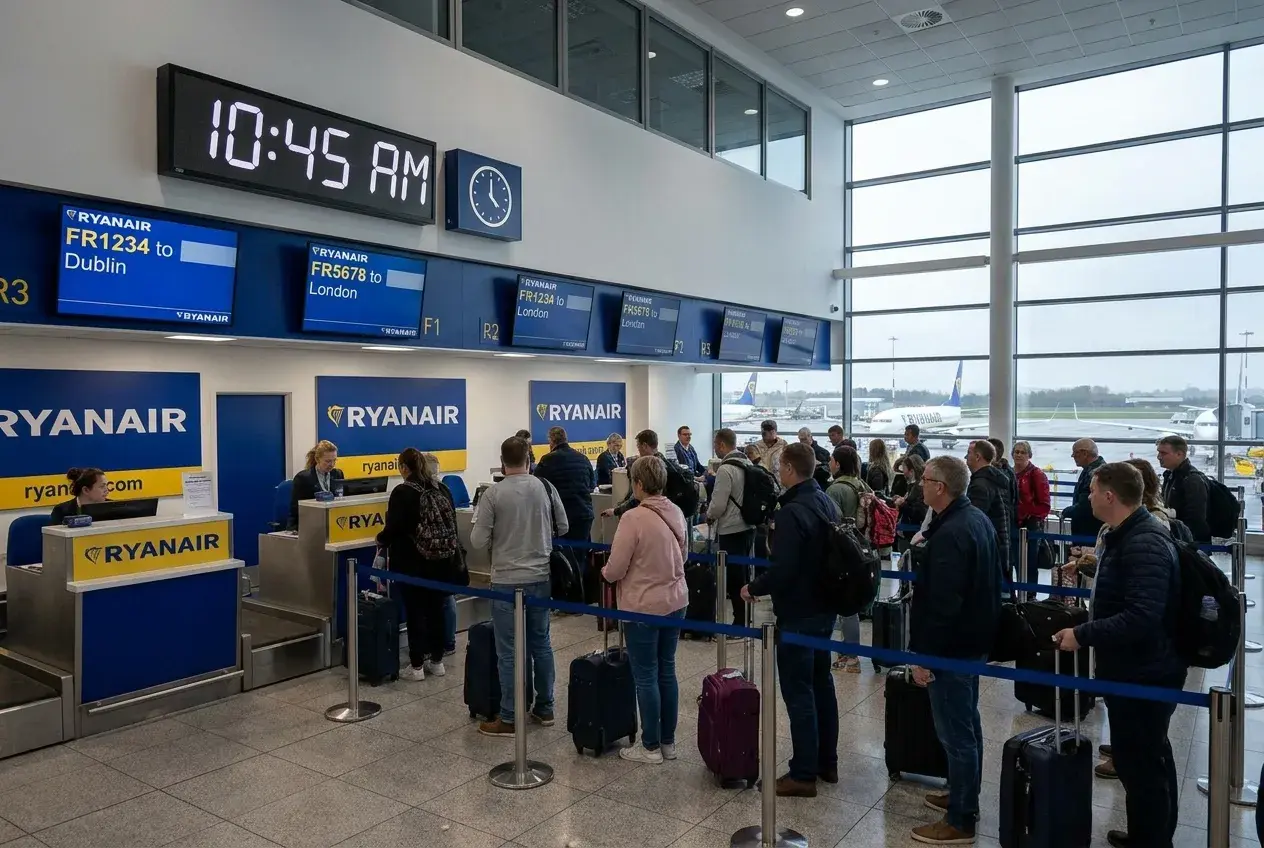
Ryanair is making a concrete change for passengers: starting 10 November 2026, check-in and bag drop counters will close 60 minutes before departure, up from the current 40 minutes. The adjustment will apply across the airline’s entire network, which transports over 200 million passengers annually across Europe. Behind this seemingly technical tweak, the Irish low-cost carrier aims to reduce delays caused by queuing and further secure its punctuality.
The measure primarily affects passengers checking in hold luggage—roughly 20% of Ryanair’s customers. For these travelers, the new deadline demands stricter planning, especially in major airports where security checks, border controls, and terminal transit times can quickly eat into the available buffer.
In contrast, the vast majority of passengers—those traveling with only carry-on luggage and checking in online—will be largely unaffected by this change. Ryanair emphasizes that digital check-in remains available well before departure, continuing its push toward passenger autonomy. The airline is also accelerating its transition to more automated airport processes.
Addressing queues and processing delays
In its communications, Ryanair frames this change as a way to give passengers more time to clear security and passport control. The rationale is clear: since traffic resumed post-pandemic, several European airports have faced longer queues and capacity constraints. A low-cost flight, sold on tight margins and rapid aircraft turnarounds, cannot afford last-minute delays.
Ryanair stresses that this is an operational adjustment, not an additional access restriction. The goal is to reduce the number of passengers missing flights after waiting too long at security or passport control. The airline also reminds travelers that it already advises arriving at least two hours before departure for short-haul flights—providing a comfortable window for formalities, provided passengers do not leave it until the last minute.
This new rule aligns with the airline’s commercial strategy. Low fares go hand in hand with a tightly controlled ground operations flow, from ticket purchase to boarding. In this model, time lost at the airport quickly impacts punctuality, connections, and fleet productivity.
Enhanced automation at airports
The new check-in deadline is not an isolated change. Ryanair is also accelerating the rollout of self-service bag drop kiosks across its network. The airline plans to equip over 95% of served airports by October, with a clear objective: to reduce queues at counters and streamline the passage of checked-in passengers.
The process is now well-established. Passengers scan their boarding pass, print baggage tags, and drop their luggage onto the conveyor belt themselves. This evolution reduces human intervention at a critical stage of the passenger journey, especially during peak traffic. In an environment where every minute counts, it also helps absorb fluctuations in passenger volume without creating bottlenecks.
The airline has already implemented other significant changes in its customer journey. Since late 2025, paper boarding passes printed at the airport have been phased out in favor of digital versions via the app. Ryanair is thus pursuing a strategy of gradual digitalization, with less flexibility at the counter but a more standardized processing chain.
What this means for travelers
For passengers, the first adjustment will be to revise their airport arrival schedule. A Ryanair flight with checked baggage will now require an earlier arrival before counters close. In highly trafficked hubs, this detail could be the difference between a smooth boarding process and a rushed dash to the gate.
This change also reflects a tighter control over passenger flows. Low-cost carriers aim to minimize situations where an aircraft ready for departure is delayed by a few late travelers. In Ryanair’s case, the model relies on speed, standardized operations, and high aircraft utilization. Any unexpected increase in ground time quickly becomes costly.
The message to passengers is direct: those traveling light and checking in online will see little difference, but customers with checked baggage must plan ahead. The change does not affect ticket prices or in-flight conditions but alters how passengers present themselves at the airport and organize their journey to the gate.
An adjustment in line with industry trends
This type of evolution is not unique in the aviation sector. For years, airlines have sought to reduce time spent at counters and shift as many operations as possible to digital or self-service channels. This approach helps better allocate resources, reduce queues, and mitigate risks tied to staffing shortages or traffic peaks.
At Ryanair, this logic is particularly visible because it is central to the brand’s commercial positioning. Paid options, ancillary services, and precise ground processing times are pillars of the model. The new check-in deadline follows the same principle: more discipline on the ground, fewer exceptions, and an operational chain designed to handle high volumes.
For airports, the measure may also have a limited mechanical effect by smoothing the final wave of passengers and reducing last-minute crowds. While it does not solve structural issues like undercapacity or security bottlenecks, it at least eases some of the pressure in the check-in area.
Ryanair has framed this change as a simple adjustment, but the signal is clear: in a high-density network, punctuality begins long before boarding. For travelers, this means one very practical thing: arriving earlier, especially if checking in hold luggage.
The new schedule takes effect on 10 November 2026, and in the meantime, the airline will continue rolling out its digital tools and bag drop kiosks across its network. The Ryanair passenger journey is becoming slightly more rigid—but also more predictable for those who adhere to the new timelines.
Be the first to comment on this article