IAG entrusts Iberia with the core of its LEAP engine maintenance in Europe
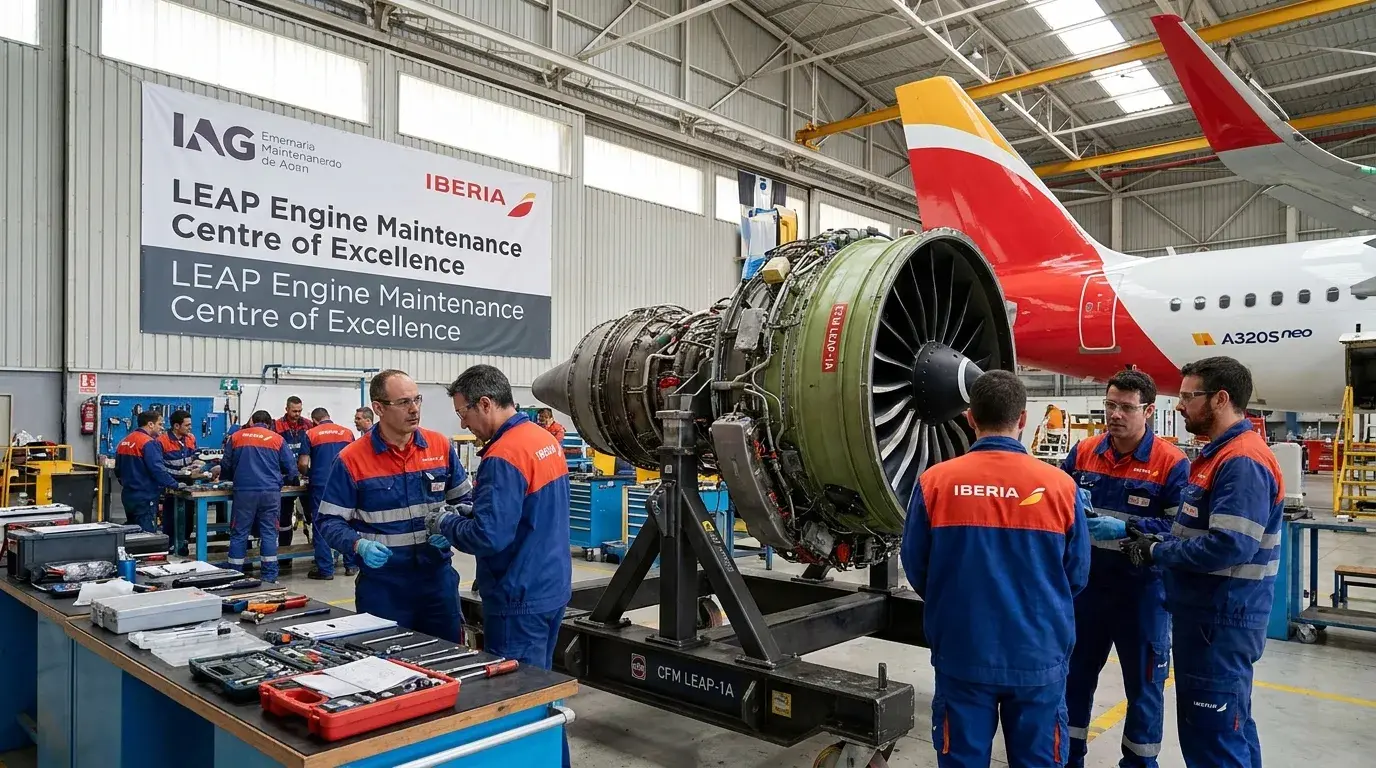
Iberia is set to become a key hub for LEAP engine maintenance in Europe under IAG’s CFM LEAP Premier MRO license. The La Muñoza facility near Madrid-Barajas will play a pivotal role in a tightening engine repair market, driven by the growth of fleets equipped with A320neo and 737 MAX aircraft.
For the airline industry, engine availability is critical. It directly impacts aircraft operations, flight schedules, turnaround times, and ultimately a carrier’s ability to maintain its program. With next-generation single-aisle aircraft dominating orders, mastering engine maintenance has become both an industrial and commercial priority.
IAG is not merely expanding an existing facility—it is structuring a long-term engine maintenance strategy around one of the market’s most widely adopted powerplants. This positions Iberia beyond its role as an airline operator, embedding the Spanish carrier deeper into the global MRO ecosystem by leveraging one of the world’s most widely deployed engine programs.
La Muñoza expands its role in the MRO chain
The La Muñoza site is no newcomer. Located near Madrid-Barajas Airport and boasting over 50 years of experience, it has steadily grown into a reference industrial site for Iberia. The new CFM International license grants it a broader mandate, covering the LEAP-1A and LEAP-1B engines powering the Airbus A320neo and Boeing 737 MAX families, respectively.
The first engines are expected to arrive in Q1 2027, with ramp-up rates aligning with the anticipated surge in workshop visits by the end of the decade. CFM forecasts a sharp rise in maintenance demand as the in-service fleet expands and engines accumulate flight cycles.
The CFM LEAP Premier MRO license is far from a symbolic credential. It provides Iberia and IAG with advanced training, technical support, and access to proprietary repair and overhaul technologies. For the Madrid workshop, this translates into enhanced capabilities and heightened responsibility for maintaining the highest operational and quality standards set by the engine manufacturer.
A market driven by A320neo and 737 MAX fleets
Iberia’s selection is rooted in market logic. The LEAP engines, developed by CFM International, have become the benchmark in the single-aisle segment. They power the majority of Airbus A320neo aircraft, the entire Boeing 737 MAX family, and the COMAC C919. This widespread adoption ensures a steady flow of maintenance activity in the years ahead.
For airlines, this standardization offers clear operational advantages but also increases reliance on a capable MRO network to handle volume. Certified workshops become strategic links—not only for carriers operating these fleets but also for the engine manufacturer, which must secure its support base.
CFM reports that over 4,600 aircraft are now equipped with LEAP engines. The growing in-service fleet naturally drives demand for overhauls, inspections, and repairs. Iberia aims to capitalize on this trend, positioning its workshop to service IAG’s engines and eventually third-party clients.
An investment aligned with Flight Plan 2030
This expansion aligns with Iberia’s Flight Plan 2030 strategic initiative, which earmarks over €6 billion in investments over the decade. The goal is to transform the airline, enhance operational resilience, and develop higher-value activities—with engine maintenance at the forefront.
Marco Sansavini, Iberia’s CEO, frames the project as a growth and profitability lever. Securing CFM LEAP Premier MRO status places IAG and Iberia in a strategic position to tap into a high-potential segment. The initiative is not just a technical upgrade but an industrial axis integrated into the group’s broader strategy.
At La Muñoza, future industrial development is also tied to the Ciudad Iberia project—aero innovation hub where multiple group activities will converge. This reflects a broader ambition: Iberia is not just improving engine maintenance; it is consolidating a competence center around Madrid.
Addressing pressure on MRO capacity
The timing of the announcement is significant. The airline industry has faced persistent MRO capacity constraints, exacerbated by post-pandemic traffic recovery, supply chain complexity, and the rise of new-generation fleets. Airlines are seeking greater control over maintenance slots, downtime, and turnaround costs.
In this context, owning a CFM-certified workshop in Europe is a strategic asset. It reduces reliance on external providers, shortens logistics chains, and better absorbs peak activity. For IAG—home to Iberia, Vueling, British Airways, Aer Lingus, and Level—the stakes are high, as multiple group brands operate recent single-aisle aircraft.
The economics of engine maintenance hinge on a demanding equation: certified quality, reliable throughput, and cycle time control. Iberia aims to elevate its performance on all fronts. While the airline has long experience in industrial operations, the LEAP program represents a new scale, touching a massive and still-growing fleet.
The LEAP: a benchmark engine under close scrutiny
The LEAP remains a highly efficient engine in terms of fuel consumption, but its large-scale deployment demands rigorous maintenance discipline. Like any modern architecture, it must balance performance, durability, and availability. The MRO network’s role is to minimize downtime and secure daily airline operations.
CFM is prepared to support this growth. The company views Iberia’s entry into its Premier MRO ecosystem as a logical expansion of its global network, which already includes partner workshops in North America, Asia, and the Middle East. This European addition strengthens the engine maker’s ability to cover high-density fleet regions.
For Iberia, the opportunity lies in capturing value from this maintenance demand. As LEAP engines approach major overhaul milestones, certified workshops will face increasing workloads. The Spanish group aims to position itself early, before capacity pressures peak.
This move reflects a broader trend in commercial aviation: airlines are no longer content to simply purchase and operate aircraft. They are seeking greater control over downstream industrial activities—from maintenance and spare parts to associated services. By entrusting Iberia with this role, IAG assigns Madrid a more prominent place in this evolving landscape with the LEAP engine as the backbone of the project.
Come 2027, the first engines will arrive at La Muñoza. The coming months will reveal whether the projected ramp-up meets expectations in a market where engine maintenance demand continues to rise unabated.
Be the first to comment on this article