Motu Link Airline revolutionizes air freight in French Polynesia with its ATR 72 cargo fleet
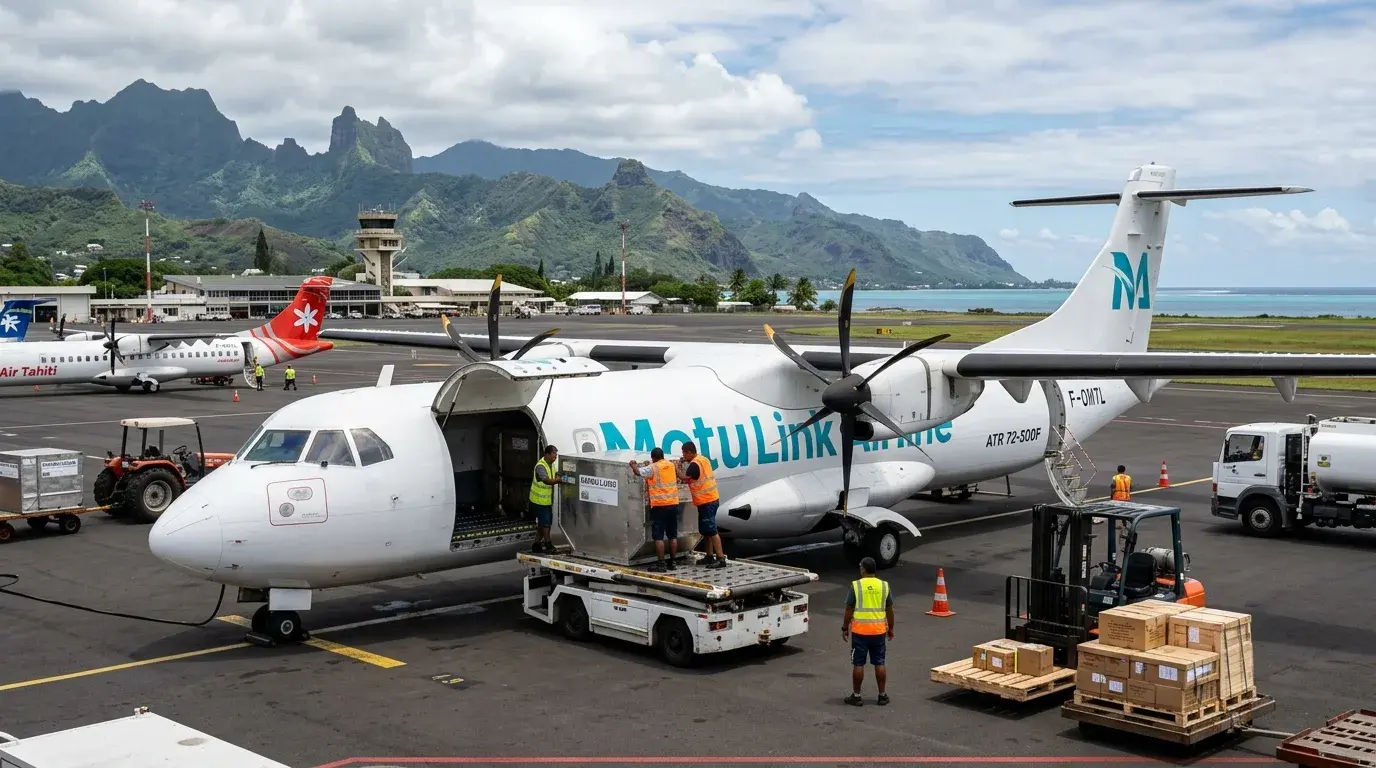
The skies of French Polynesia are witnessing the emergence of a new player that could transform the archipelago’s logistics. Motu Link Airline, a domestic French carrier based in Tahiti, has just taken a major step by launching its first regular inter-island air cargo rotations. An initiative that fills a glaring gap in a territory where maritime links, though dominant, are no longer sufficient to meet the growing demand for rapid goods transport.
With the recent acquisition of its Air Operator Certificate (AOC), issued by the DGAC, Motu Link Airline has officially begun commercial operations. This certification, obtained on May 14, 2026, after a rigorous process of technical compliance and safety management, now allows it to transport goods between Tahiti and surrounding archipelagos. A first milestone that marks the culmination of five years of preparation since the airline’s establishment in 2021.
The stakes are high for French Polynesia. The archipelagos, scattered over a maritime area equivalent to that of Europe, currently rely primarily on cargo ships for freight transport. Yet this mode of transport presents major limitations: delivery times often exceeding a week, frequent transshipment delays, and virtually no responsiveness for urgent or perishable shipments. Motu Link Airline is changing the game by offering a dedicated air solution capable of connecting Tahiti to islands like Bora Bora, Rangiroa, or Nuku Hiva in just a few hours.
To achieve this, the airline has opted for a fleet of ATR 72 cargo turboprop aircraft, a proven regional workhorse particularly suited to island constraints. The aircraft, named “Te Hono” in its cargo version, offers a payload capacity of around 7 to 8 tonnes, ideal for the typical freight volumes of Polynesia’s smaller and medium-sized islands. Its range allows it to serve destinations as far as the Marquesas Islands while respecting the often-limited runway lengths in these territories.
A logistics solution finally tailored to Polynesian realities
Motu Link Airline’s first regular flights connect Tahiti to Raiatea, Rangiroa, Bora Bora, Tubuai, Fakarava, Nuku Hiva, and Arutua. A network that covers the bulk of Polynesia’s logistical needs while leaving room for future expansions. The airline also offers on-demand flights and full charters, a flexibility essential for tourism professionals, local producers, or businesses with occasional needs.
According to data from Outremers360, Motu Link Airline positions itself as the first airline exclusively dedicated to inter-island air freight in French Polynesia. An exclusivity that responds to a market seeking reliability and speed. Fresh produce, medical packages, or spare parts for local infrastructure will no longer have to wait days or even weeks to reach their destination.
French Polynesia, with its 118 islands spread across five archipelagos, is among the most isolated territories in the world. Yet its economy relies heavily on activities requiring regular supplies: pearl farming, fishing, cruise tourism, and now, projects to develop remote islands. Motu Link Airline could thus play a key role in the economic development of these territories by reducing logistics costs and improving the resilience of supply chains.
A viable business model despite island challenges
The launch of Motu Link Airline comes at a time when French Polynesia is seeking to diversify its revenue sources and reduce its dependence on state subsidies. Air freight represents an opportunity to create local jobs, support small businesses, and boost trade between islands. For now, the airline is focused solely on cargo, though it may eventually consider passenger services—though this is not an immediate priority.
The challenges remain substantial. Operating costs in French Polynesia are among the highest in the world due to geographic remoteness, local taxes, and infrastructure complexity. Additionally, the seasonality of freight—linked to peaks in pearl production or cruise tourism—requires rigorous capacity management. Motu Link Airline will need to navigate these realities while maintaining competitive rates to attract shippers.
Yet early feedback is encouraging. The airline has already received charter requests for varied freight volumes, from luxury goods to medical equipment. Its model, based on regular rotations supplemented by on-demand flights, allows it to adapt quickly to demand. A flexibility that could prove decisive in an environment as unpredictable as that of the Pacific Islands.
Toward a more connected and autonomous French Polynesia
The arrival of Motu Link Airline is a strong signal for the future of French Polynesia. By offering a credible alternative to maritime transport, the airline helps reduce the islands’ dependence on imports and strengthens their autonomy. A crucial issue in a context of climate change, where the risks of maritime route disruptions are increasingly frequent.
Local authorities and industry professionals are hailing this initiative. For them, Motu Link Airline represents a pragmatic solution to the endemic problems of Polynesian logistics: slowness, high costs, and unreliability. In the medium term, the airline could even play a role in the archipelago’s ecological transition projects, enabling the transport of materials for sustainable infrastructure construction or renewable energy equipment.
As the first ATR 72 cargo aircraft already crisscross the Polynesian skies, Motu Link Airline sends a clear message: French Polynesia is no longer a territory doomed to logistical isolation. With this new airline, the archipelago is taking a decisive step toward greater autonomy and connectivity finally tailored to its real needs.
For travelers and professionals who depend on these islands, this is excellent news. No more lost freight in ports, no more packages stuck for weeks—and above all, a French Polynesia that is more accessible and resilient. Motu Link Airline is not just an airline: it is a key player in territorial development, whose impact could well extend beyond the simple framework of goods transport.
Be the first to comment on this article