Lufthansa invests $5 billion in retrofitting 100 aircraft: How First Class becomes accessible to all
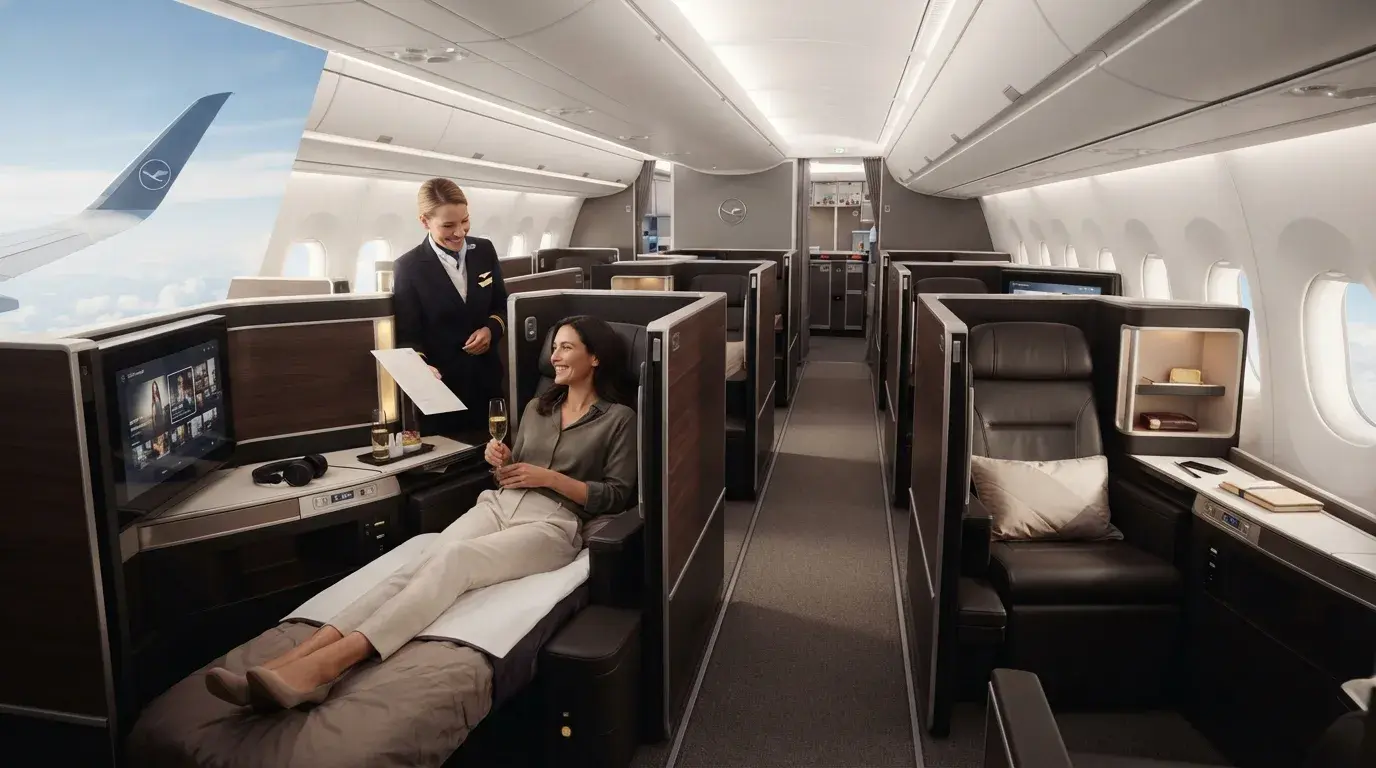
Lufthansa is taking a decisive step in its modernization strategy with the complete retrofit of 100 aircraft, including the recently delivered first centenary Airbus A350‑1000. A colossal investment of $5 billion that goes beyond refreshing cabins, entirely reimagining the Premium Economy experience and democratizing access to premium classes for millions of European travelers.
Between 2022 and late 2026, the German group will have fully renovated 47 Airbus A380s and 53 Boeing 777s—an unprecedented industrial operation carried out in-house by its own teams. Over 400 engineers and technicians will have spent 4.4 million hours dismantling, reconfiguring, and reassembling each aircraft, with a target of just 21 days for an A380 and 18 days for a 777. A logistical feat that positions Lufthansa among the world leaders in aircraft retrofitting, far ahead of industry standards.
First Class accessible to 300 passengers per flight
The real game-changer lies in the massive introduction of Premium Economy on aircraft that previously lacked it. Until now reserved for Airbus A350‑900 and Boeing 787‑9 aircraft, this intermediate class—combining space and reasonable pricing—now extends to nearly the entire group’s long-haul fleet. On a Boeing 777‑300ER, for example, the cabin will now feature three classes: First, Business, and Premium Economy, compared to two previously.
« Our goal is clear: to offer a premium experience to a wider audience without sacrificing comfort or service quality, » explains Jens Ritter, CEO of Lufthansa Airlines. Each retrofitted aircraft now accommodates over 300 passengers, with a Premium Economy cabin redesigned to rival the best offerings on the market, particularly those from Gulf carriers.
Seats that transform the flying experience
In First Class, the new Collins Elevation seats in a « reverse herringbone » (zigzag) configuration offer direct aisle access and full recline. Each seat features a sliding door for enhanced privacy, an 18-inch OLED screen with Bluetooth connectivity, and USB‑C ports. The seat pitch reaches 43 inches, comparable to the best business-class cabins on the market.
In Premium Economy, the ergonomic ZIM seats now include adjustable armrests, a 13-inch touchscreen with Bluetooth audio, and 35 inches of pitch for « Stretch » rows. Lufthansa is also leveraging modularity: some aircraft retain Skycouch rows—economy seats convertible into a bench for families or travelers wanting to lie down. An innovation particularly popular on transatlantic routes, where comfort is a key decision factor.
A bet on the future: greener, more connected aircraft
Beyond comfort, Lufthansa is integrating sustainable innovations into its retrofits. Materials recovered from old cabins—leather, fabrics, plastics—are transformed into luxury items under the Aircrafted by Lufthansa brand. Over 50,000 kg of materials are expected to be recycled by 2028, with some destined for charitable causes, such as backpacks distributed to children in European schools.
Connectivity is also part of the modernization. By October 2026, every retrofitted aircraft will be equipped with Starlink Wi‑Fi, enabling passengers to enjoy high-speed broadband in flight—a still rare service in the sector. A major evolution for a company betting on the digitalization of the travel experience.
A homogeneous fleet for a seamless experience
One of the strengths of this large-scale retrofit is the standardization of cabins across the entire fleet. Whether you board an Airbus A380 in Frankfurt, a Boeing 777 in Munich, or a centenary A350‑1000, the experience will be consistent: the same seats, the same services, the same level of comfort. A consistency that strengthens customer loyalty and simplifies maintenance for the airline.
« We want our passengers to know exactly what to expect, no matter which aircraft they choose, » says Jens Ritter. This approach aligns with a strong brand strategy, where every detail matters—from seat design to the quality of meals served on board.
With this program, Lufthansa isn’t just modernizing its fleet; it’s redefining the standards of air travel in Europe. By making First Class and Premium Economy accessible to a broader clientele, the German carrier is banking on a winning strategy where quality goes hand in hand with profitability.
The first retrofitted aircraft are already in service, and by the end of 2026, most of Lufthansa’s long-haul fleet will offer a premium experience. A bold wager that could well inspire other industry players in the years to come.
What this means for travelers
For passengers, the benefits are numerous:
• Enhanced comfort: more space, innovative seats, high-speed connectivity.
• Better access to premium classes: Premium Economy, once reserved for Gulf carriers, is now an affordable option for Europeans.
• A consistent experience: no need to adapt to different configurations depending on the aircraft or destination.
• A sustainable commitment: material recycling, reduced carbon footprint, and a fleet optimized for long-haul flights.
With this retrofit, Lufthansa proves that modernization goes hand in hand with innovation—and that air travel can combine economic performance with a premium experience. A model worth following for the industry.
Be the first to comment on this article