Air Caraïbes deploys Airbus A350-900 to Saint-Martin in a highly regulated operational test at Juliana
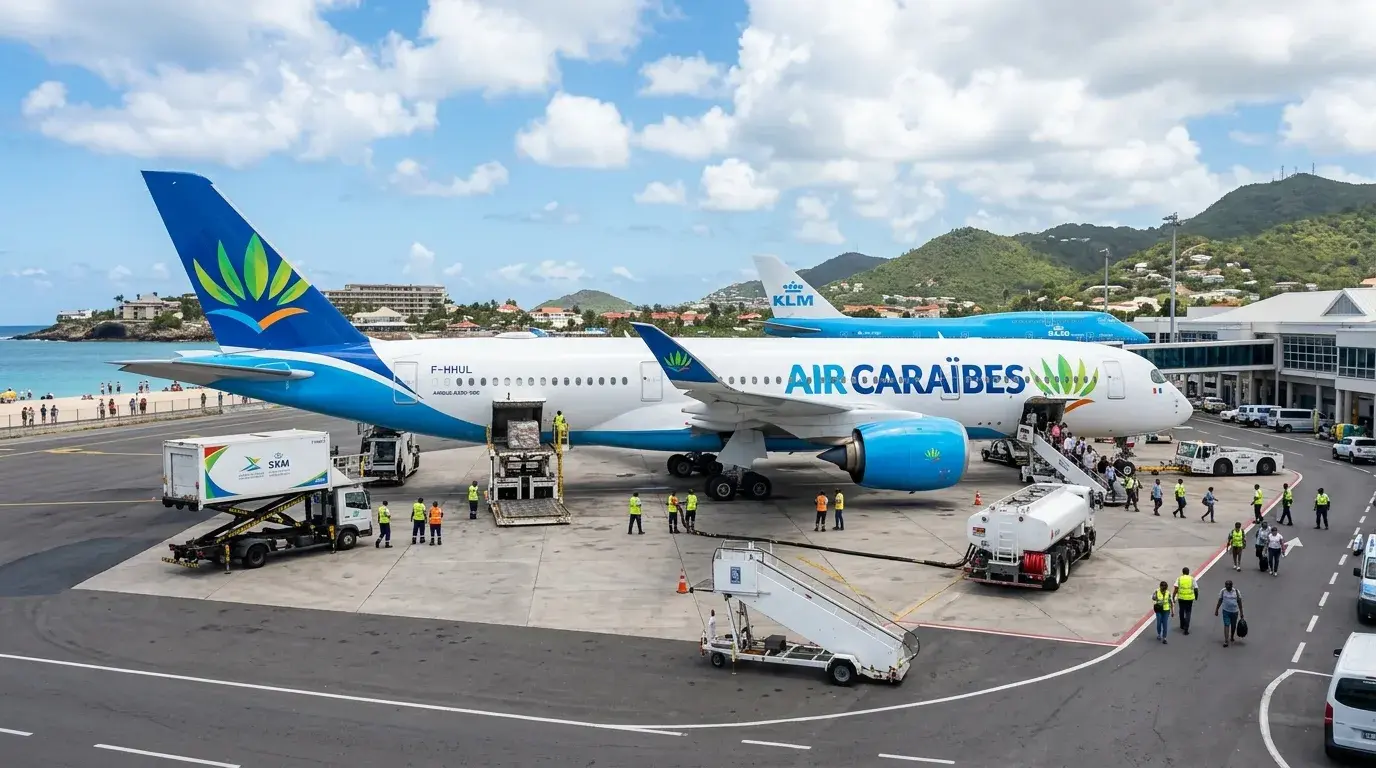
Air Caraïbes has taken a significant step by operating its Airbus A350-900 on Saint-Martin Juliana’s runway. The exercise is far from trivial: this airport’s operational constraints are stricter than most long-haul destinations in the Caribbean, with a relatively short runway, nearby terrain, and reduced margins for takeoff and landing, all of which required specific preparation.
The May 4, 2026 flight also sends a clear commercial signal. Air Caraïbes is gradually replacing its A330-200 with a newer, more efficient aircraft better suited to the airline’s long-haul strategy. This change directly affects the Paris-Orly – Saint-Martin route, with a scheduled resumption on October 15, 2026, after the summer break, still operated with the A350-900.
For passengers, this shift goes beyond fleet image. The airline now aligns this service with its highest product standards, featuring a three-class cabin and operations leveraging higher performance. The case is also noteworthy for the aviation sector, as it demonstrates how an Airbus A350-900 can be certified for an airport known for its demanding conditions, provided there is a precise operational framework.
A long-haul service changing format
Air Caraïbes has served Saint-Martin since 2009 and considers this destination strategic within its Caribbean network. Until now, the route was operated with the A330-200, an aircraft already well-suited to transatlantic routes but less modern in technical terms. With the arrival of the A350-900, the airline is transitioning to a generation of aircraft that is more fuel-efficient and cost-effective to operate.
The change also has a direct impact on the commercial offering. The Madras cabin features full-flat seats, while the Caraïbes and Soleil classes cater to distinct customer profiles, from business travelers to leisure passengers. For the upcoming high season, Air Caraïbes is offering a one-way Paris-Orly – Saint-Martin ticket starting at €350 TTC in the Soleil class, a pricing level that allows the airline to remain competitive on this destination while enhancing the cabin product.
Industrially, the stakes are broader than a simple aircraft replacement. The airline now operates a fleet of three A350-900s, four A350-1000s, and two A330-300s, with the last A330-200 retired. Saint-Martin thus becomes a demonstration site for the Airbus A350-900 in an environment more complex than major European or North American airports.
Juliana, an airport with its own rules
Princess Juliana is no ordinary airport for a long-haul aircraft of this size. The runway is approximately 2,000 meters long, but length is just one of many factors to consider. Surrounding obstacles, topography, and wind direction impose specific procedures. In most cases, takeoffs are performed facing the sea. If the tailwind exceeds acceptable limits, crews must consider a takeoff in the opposite direction, facing the mountain, along a tightly regulated trajectory.
This configuration demands strict operational discipline. At this airport, margins are tighter, and every phase of flight—from taxiing to the initial turn—must be meticulously planned. This is precisely why the arrival of the A350-900 at Juliana is of interest to aviation observers: cabin capacity and range alone are not enough; the aircraft must also prove it can be operated within an adapted framework.
Air Caraïbes and Airbus have worked for months on this issue, in coordination with the DGAC. The goal was to define a specific procedure to enable the operation of the widebody on this short, constrained runway without modifying the aircraft itself. The principle is straightforward: the aircraft remains standard, but its operational procedures are tailored to the site.
A dedicated procedure validated with Airbus and the DGAC
To deploy the Airbus A350-900 on Saint-Martin Juliana, Air Caraïbes developed an operational procedure specific to this runway, with support from Airbus and the regulatory authority. This procedure aims to optimize takeoff performance, particularly in the event of a departure facing the mountain and an engine failure during takeoff—a critical scenario in commercial operations.
In the event of an engine failure, pilots must follow a very precise profile to maintain safety margins relative to the terrain. This requires targeted training for A350 crews and full regulatory validation. The airline emphasizes one key point: no technical modifications were made to the aircraft. Everything relies on operational manuals, approved trajectories, and crew preparation.
This logic is important for understanding how airlines open new operational possibilities with modern aircraft. The A350-900 is not only high-performing in cruise flight; with the right procedures, it can also be used at airports where it might not initially have been expected.
A schedule dictated by safety and crew qualification
The schedule was extended for one simple reason: safety takes precedence. Air Caraïbes notes that operational approval depended on multiple layers of validation, including DGAC clearance, Airbus validation, and crew qualification. The procedure could not be finalized by December 2025, when the Paris-Orly – Saint-Martin route resumed, pushing back the entry into service of the new aircraft on this route.
This delay highlights the complexity of such projects. On paper, replacing an A330-200 with an Airbus A350-900 seems like a straightforward fleet evolution. In practice, a demanding runway requires rethinking trajectories, departure conditions, wind limits, engine-failure scenarios, and pilot training. This is invisible work for passengers but central to the operator’s success.
Air Caraïbes presents this milestone as a structuring step in its Caribbean strategy. The airline also hopes to strengthen its position against other operators interested in the A350-900 for Juliana. By advancing on this front, the company gains a timing and experience advantage, becoming the first to operate this type of aircraft to Saint-Martin.
What this means for passengers on the Paris-Orly – Saint-Martin route
For travelers, the benefits are most visible on board. The three-class cabin allows for better segmentation of the offering, with a clearer business class and intermediate products targeting different customer segments. The upgrade does not necessarily mean a price hike but rather improved efficiency on long flights where comfort matters most.
The second benefit is operational. The Airbus A350-900 consumes less than the A330-200 at comparable capacity, improving the route’s profitability and reducing fuel consumption per passenger. In an era where jet fuel costs remain closely monitored by airlines, such differences influence fleet decisions. Air Caraïbes highlights this as a performance and environmental footprint gain.
Finally, the resumption schedule on October 15, 2026, with two weekly frequencies on Mondays and Thursdays, confirms that the route remains structured around regular, predictable traffic. Connections to Saint-Barthélemy via Winair and St Barth Commuter complement the service. In this market, operational performance, punctuality, and aircraft reliability matter as much as ticket prices.
Saint-Martin becomes a case study for the A350-900
The Juliana case demonstrates that the Airbus A350-900 is not limited to the simplest airports to operate. With a short runway, a tightly regulated approach, and trained crews, it can also integrate into more sensitive destinations. For Air Caraïbes, this success marks a new phase in fleet management and how Saint-Martin is treated as a full-fledged long-haul destination.
In practice, the airline has shown that deploying a modern aircraft is not just about the manufacturer’s performance or aircraft availability. It also requires securing regulatory approval, defining an adapted operational method, and training crews for highly specific situations—including engine-failure scenarios during takeoff. This framework is what makes commercial operation of the Airbus A350-900 possible on a runway like Saint-Martin Juliana’s.
Be the first to comment on this article