Spirit Airlines halts operations: What the U.S. low-cost carrier’s bankruptcy means for travelers
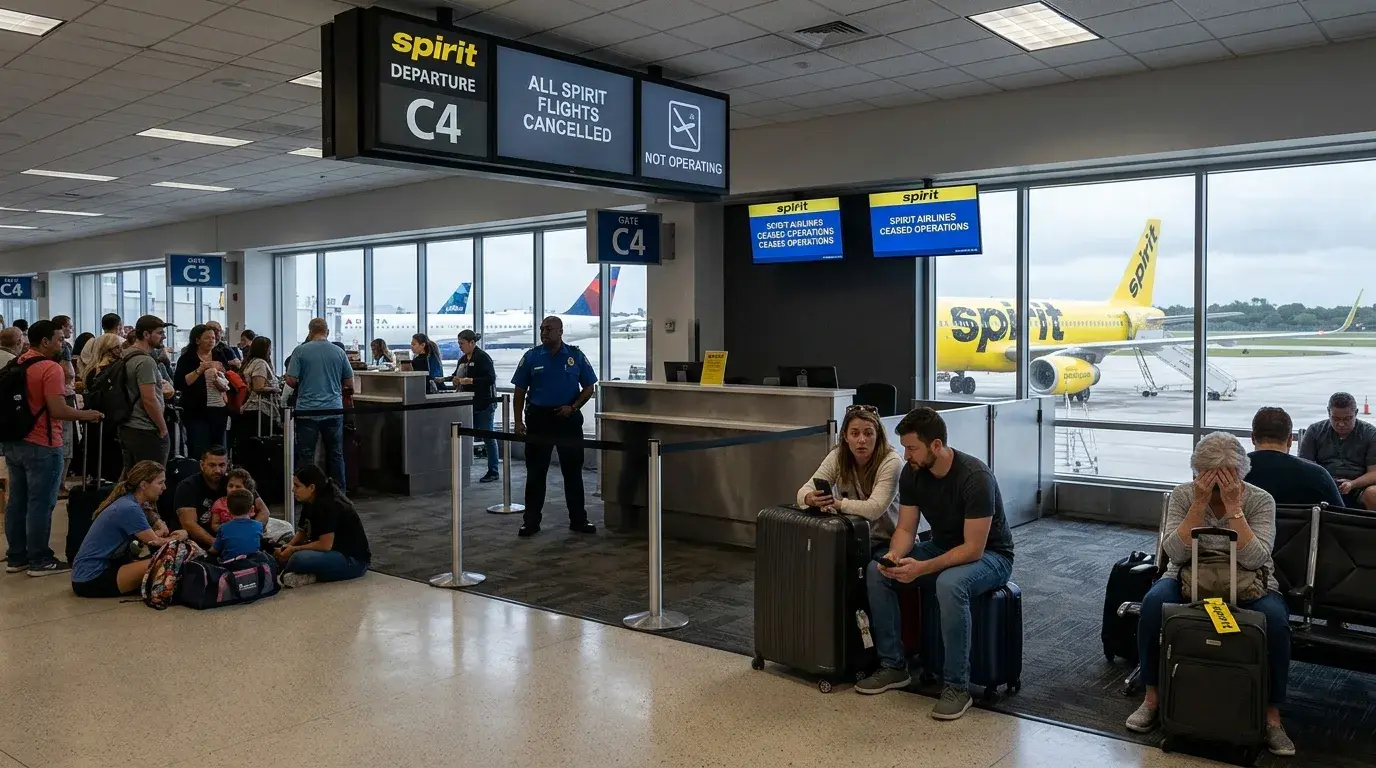
Spirit Airlines has suspended all flights and instructed passengers not to travel to airports. The announcement, made on May 2, 2026, marks the immediate collapse of a key player in U.S. air transport, built on a simple model: ultra-low fares, optional services, and a standardized fleet. For travelers, the impact is immediate, as all tickets are canceled and refunds fall under bankruptcy proceedings.
This closure follows two bankruptcy filings in less than a year and the culmination of financial deterioration that proved difficult to reverse. The rapid rise in fuel prices played a central role in the outcome, but Spirit’s situation was already fragile before this shock. The airline had accumulated operational difficulties, aircraft groundings, and failed merger attempts with other carriers.
In the air transport landscape, the end of Spirit Airlines is more than an accounting announcement. It removes an operator that served many secondary cities, helping to keep prices low on several domestic and leisure routes. The case is therefore of interest not only to passengers but also to competitors, airports, and U.S. authorities.
Immediate cessation of operations
According to a statement from Spirit Aviation Holdings, the airline has initiated a gradual and orderly wind-down of operations with immediate effect. All flights have been canceled, and customers have been instructed not to report to check-in counters or boarding gates. The immediate priority is processing refunds for tickets purchased directly from the airline.
Spirit Airlines’ website states that tickets paid for with credit or debit cards will receive an automatic credit to the original payment method. For bookings made through a travel agency, passengers should contact their intermediary. Cases paid for with vouchers, travel credits, or Free Spirit loyalty program points fall under bankruptcy proceedings and will be addressed later.
This process is typical in liquidations but rarely leaves travelers in a comfortable position in the short term. Between the loss of flights and refund delays, travel continuity now depends on other airlines’ ability to absorb demand, particularly on major leisure routes in the southern U.S., Florida, and the Caribbean.
Why Spirit Airlines couldn’t survive
Spirit Airlines had already filed for bankruptcy twice, first in 2024 and again in 2025. The company had barely emerged from restructuring when surging fuel prices closed the window for recovery. Management cited a significant increase in oil prices and other operational pressures as key factors. Fuel costs have more than doubled since late February, making the ultra-low-cost model far harder to sustain.
The problem wasn’t just fuel. For years, Spirit had faced operational fragility, including delays, grounded aircraft, and cost pressures. Its ultra-low-cost positioning made it highly sensitive to even minor revenue shortfalls or expense increases, as ancillary revenue margins were limited when demand softened.
The airline had also attempted consolidation through mergers. A proposed deal with Frontier was explored, followed by another with JetBlue, but both failed. The JetBlue merger was blocked by U.S. authorities on competition grounds, eliminating a potential lifeline. After these setbacks, Spirit’s path became increasingly narrow.
The failed political rescue plan
Before operations ceased, the Trump administration had considered a $500 million bailout in exchange for a majority stake. The plan aimed to inject cash in return for greater state control over the airline. President Donald Trump had publicly emphasized protecting the 14,000 jobs tied to Spirit, while the Department of Transportation also sought a potential buyer.
The proposal did not materialize. Creditors rejected the financial terms, and the plan was ultimately abandoned. Spirit then proceeded with an orderly liquidation rather than continuing operations on life support. This decision closes a chapter illustrating the limits of public bailouts when debt levels and fuel costs exceed a carrier’s recovery capacity.
For the U.S. market, Spirit’s collapse removes significant capacity, estimated at around 5% of domestic flights before its downfall. Competitors will likely absorb some of the demand, but not immediately under the same pricing conditions. The loss of an aggressive low-cost player could mechanically raise average fares on certain routes.
What this means for passengers
For customers, the immediate challenge is rebooking. Travelers with one-way or round-trip tickets will need to find alternatives in a market suddenly absorbing thousands of displaced reservations. On leisure routes, this loss of capacity could create short-term pressure, especially around Florida, Las Vegas, parts of the East Coast, and Caribbean destinations.
The refund process remains a critical issue. Spirit states that direct card payments will be automatically credited, but other cases depend on the progress of bankruptcy proceedings. Travelers who purchased options or used travel credits must follow the company’s instructions and, if necessary, contact their agency. In such procedures, delays often exceed expectations.
Beyond individual cases, Spirit’s disappearance reshapes an entire segment of the U.S. market. The airline had long imposed sustained pricing pressure on major carriers, pushing the industry toward more competitive base fares. While competitors like JetBlue and Frontier may benefit from some of the freed-up traffic, they will also face stronger demand on already competitive routes.
A low-cost pioneer that shaped U.S. aviation
Spirit Airlines long symbolized the ultra-low-cost model in the U.S. Its largely homogeneous fleet, centered on Airbus aircraft, and its segmented pricing policy made it a clear model for the market. The airline grew by targeting secondary cities and vacation destinations, prioritizing price over cabin comfort.
This model had a tangible impact on the industry. By offering rock-bottom fares, Spirit forced competitors to adapt their offerings and revise pricing structures. But this strategy only works in favorable conditions—low fuel prices, stable demand, and controlled operational costs. When any of these factors deteriorates, the equation becomes far more precarious.
The Spirit case also highlights the vulnerability of airlines most exposed to external shocks. Rising fuel prices, geopolitical tensions, and cash flow tightening can be enough to tip an already weakened carrier into collapse. In this context, the U.S. market loses an actor that helped structure competition in short- and medium-haul domestic travel.
At affected airports, authorities will now need to adapt to canceled flights, reassigned slots, and passengers seeking alternative solutions. For competing airlines, this is a commercial opportunity. For travelers, it’s the end of a reliable source of ultra-low fares on several high-traffic routes.
Be the first to comment on this article
On the same topic
- How Delta Air Lines’ refinery strategy is reshaping airline fuel costs and ticket prices
- Fuel surcharges on already-purchased tickets: What Brussels really prohibits airlines from doing
- Turkish Airlines Suspends 18 Destinations Amid Soaring Jet Fuel Prices
- Jet fuel: Why Europe now depends on the US to keep its planes flying
- Rising Fuel Costs: Delta Air Lines Posts Loss, Cuts Capacity, and Raises Fares