Jet fuel: Why Europe now depends on the US to keep its planes flying
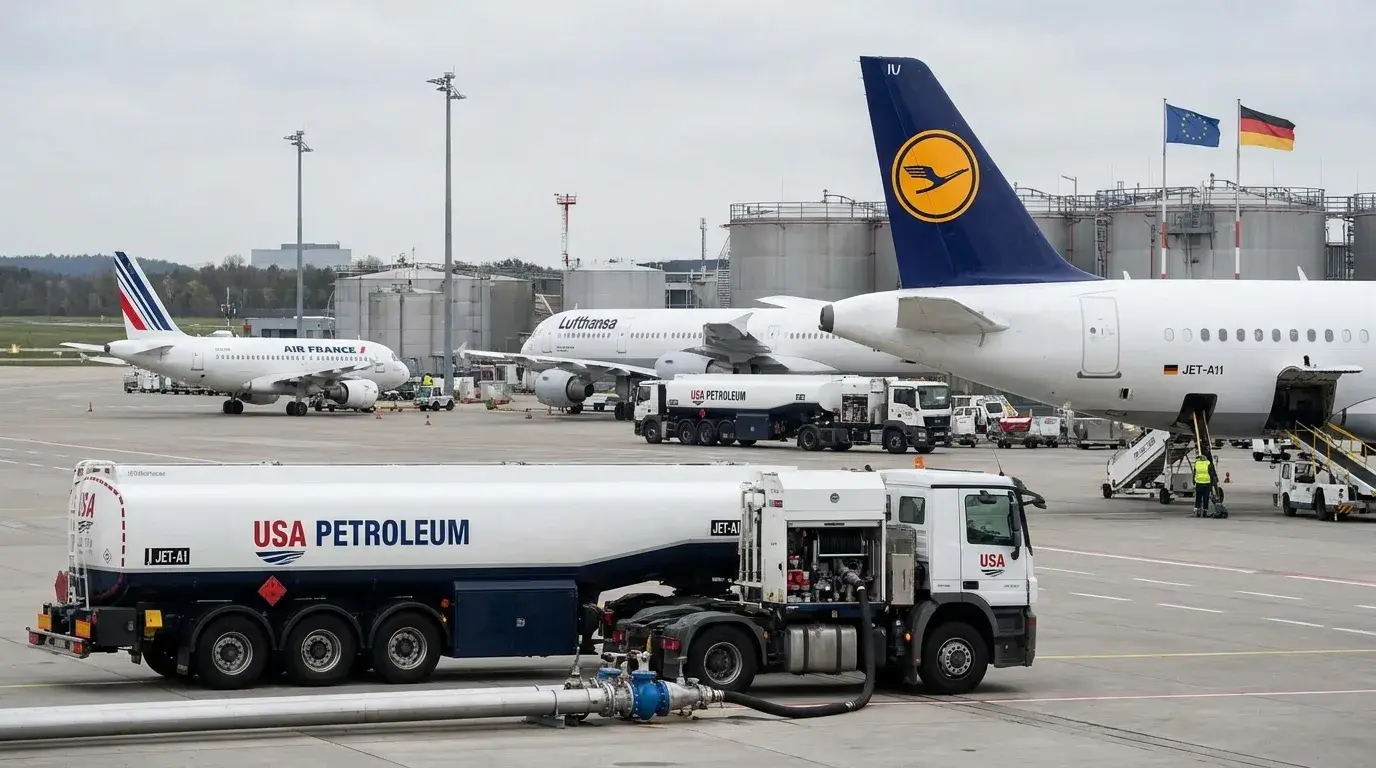
Europe’s aviation fuel bill is shifting under pressure from geopolitical tensions. With the war in Iran and the blockade of the Strait of Hormuz—main transit route for Gulf oil exports—airlines and airports across the continent face a very real risk: running short of aviation kerosene in the short term or paying far more to secure it. According to the International Energy Agency, Europe may have only a few weeks of buffer if supply flows do not recover.
The issue goes beyond price volatility. It directly impacts the aviation fuel supply chain, from refineries to airport storage. And it places the United States in an unexpected role: that of a temporary shock absorber for Europe’s jet fuel market. Imports from the US have surged, filling part of the gap left by the Middle East.
For airlines, the challenge extends beyond fuel line items in their financial statements. Now, they must secure supply, adjust flight schedules, and anticipate a market that can tighten rapidly. In aviation, even a few days less visibility can shift commercial decisions. This crisis highlights how central energy dependence remains for European aviation.
An alert from the IEA and European airports
In an interview with the Associated Press, Fatih Birol, Executive Director of the International Energy Agency, summed up the situation bluntly. He estimates that Europe may have only about six weeks of jet fuel left if supply flows remain disrupted. ACI Europe, the organization representing the continent’s airports, has separately warned Brussels of a potential kerosene shortage if passage through Hormuz remains blocked.
The message is clear: Europe’s aviation fuel market operates with limited safety margins. When the main logistics channel seizes up, stocks deplete quickly. Some hubs have only a few days of reserves, forcing them to closely monitor deliveries and prioritize needs. Not all major airports are equally exposed, but dependence on maritime flows remains a structural weakness.
The near-complete closure of the Strait of Hormuz to commercial traffic has reshuffled the deck. Until now, a significant share of Europe’s imported jet fuel came from the Gulf, with key roles played by refineries in Kuwait, the United Arab Emirates, Saudi Arabia, and Bahrain. This model is now under strain, and there is no sign of a quick return to normal.
The US steps in as Europe’s jet fuel supplier
In this context, the United States is filling the gap. Its share in Europe’s aviation fuel imports surged in April, reaching levels far above the two-year average. This rise is not just a commercial opportunity—it’s a market necessity at a time when Gulf shipments are no longer flowing as before.
The shift is stark: US refineries now cover a significant portion of Europe’s needs, whereas they previously served only as a limited supplement. This increased reliance on the US does not solve the underlying problem but prevents an immediate supply disruption. Without this relief valve, several European countries would already face stricter restrictions.
This rebalancing comes at a cost. First, transatlantic shipping adds logistical complexity. Second, global demand is pushing up wholesale jet fuel prices. The crack spread—closely watched by market players—has tightened to levels comparable to past energy crises. For airlines, this means immediate pressure on profitability.
A market more fragile than it appears
European aviation consumes about 1.6 million barrels of kerosene per day. Only a portion is produced locally. The rest must be imported, directly exposing airlines to geopolitics and maritime route disruptions.
Why Europe’s dependence remains so high
Europe’s reliance on imported aviation fuel is not new—it’s rooted in an incomplete industrial balance. Not all countries have the same refining capacity, and jet fuel is not produced everywhere in sufficient quantities to meet air traffic demand. Spain, for example, is better positioned than others thanks to its refineries. The UK, however, remains heavily dependent on imports.
The problem is both geographical and industrial. While some economies can rely on a network of refineries and more comfortable stockpiles, others remain vulnerable to maritime disruptions. Airports, in particular, operate with reserves often limited to just a few days. When deliveries slow, they struggle to absorb the shock alone.
This fragility explains the response from industry federations. ACI Europe is calling for better monitoring of supply flows, detailed mapping of stocks, and, in the longer term, coordinated purchasing mechanisms. The idea of joint jet fuel procurement—already tested in other energy segments—is back on the table. The sector also wants more flexible rules to boost European kerosene production and secure distribution chains.
Airlines under dual pressure
For carriers, the impact is twofold. On one side, rising fuel costs increase operating expenses. Fuel is often the first or second-largest expense for airlines, depending on their network. On the other, uncertainty over deliveries complicates planning. It’s no longer enough to forecast a price—airlines must also know if the volume will be available, on time, and at the right hub.
This uncertainty is pushing carriers to revise capacity scenarios. Some are already considering targeted frequency cuts, fleet adjustments, or gradual fare hikes. The risk is not necessarily a sudden paralysis but a gradual erosion of service levels. Long-haul and strategic routes would likely take priority in any rationing, at the expense of some marginal services.
The issue also arises at a time when the sector must finance its energy transition. Airlines are investing in more efficient aircraft, next-generation engines, and sustainable aviation fuels. But in the short term, the market still depends on conventional jet fuel. Until this transition reaches a new industrial stage, the equation will remain sensitive to external shocks.
A risk of sustained price pressure
Europe’s aviation fuel market could remain under strain for months. Even as the US absorbs part of the shortfall left by the Gulf, this solution does not address the structural imbalance. It merely shifts the imbalance to other supply sources while keeping prices highly volatile. Sector analysts are closely tracking import trends and stock levels at major European hubs.
The risk for passengers is real, even if it does not manifest uniformly. A sustained rise in jet fuel prices eventually trickles down to fares, surcharges, or capacity policies. In an airline market already squeezed by competition and fleet costs, even minor fuel tensions can alter carriers’ strategic choices.
So far, European authorities have not announced any large-scale emergency measures. But the issue has entered public debate as a stress test for aviation. Dependence on imported jet fuel, long seen as a technical matter, is now a question of logistics sovereignty. And as long as the Strait of Hormuz remains unstable, Europe’s aviation market will continue looking to US refineries to keep its planes in the sky.
Be the first to comment on this article
On the same topic
- Qatar Airways revolutionizes mid-haul travel with A321LR: 16 convertible business suites by 2027
- Etihad revolutionizes Europe-Asia travel with First Class suites on narrowbody from Luxembourg
- Air China bypasses Cuba's jet fuel shortage with Bahamas detour
- Boeing 737 MAX 10 Certification Nears: A Milestone for Global Aviation
- Airbus A350-2000 and A220-500: End of Twin-Aisle Monopoly?
- Emirates reinvents its fleet: Why the 777X could replace 35 Dreamliners