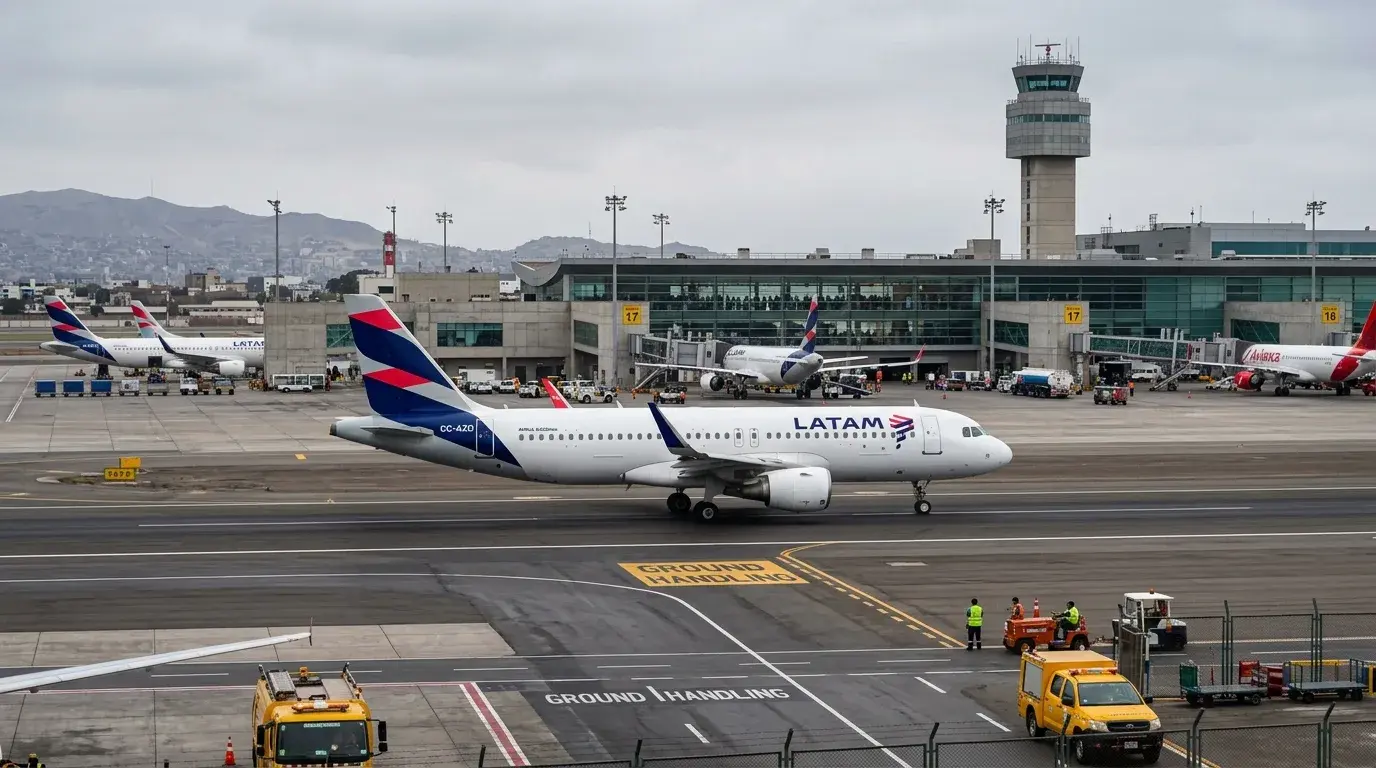
The introduction of a transit passenger fee in Lima is already reshaping LATAM Airlines' plans. The South American carrier, which had planned to use the Peruvian capital as a hub for its future A321XLR flights, is now looking more closely at Brazil as a base for these aircraft starting in 2027.
The case goes beyond Peru. It highlights how an airport tax can alter fleet deployment, especially when it directly impacts transit passengers. In a market where hubs compete fiercely for connecting traffic, Lima’s decision could have lasting effects on LATAM’s strategy—and on the attractiveness of Jorge Chávez Airport.
LATAM does not question Lima’s commercial appeal as a connecting hub. However, the addition of a specific fee for international transit passengers undermines the hub’s competitive edge. For an airline building part of its growth on long-haul narrowbody flights, every extra euro in the sales chain matters.
A transit fee reshuffles the deck
In Peru, the new fee takes the form of an Airport Use Fee applied to international transit passengers. It is added to the ticket price and applies to travelers merely passing through Lima to reach another destination. According to Flywest, the fee is around $10, though the IATA estimates it could be higher, warning that the measure could penalize the country’s main airport.
The mechanism is simple on paper but more complex in practice. Lima Airport Partners, the airport’s concessionaire, presents the fee as compensation for services already provided, including access to departure lounges, baggage inspection, security, and medical assistance. In reality, transit passengers now face an additional cost that did not exist in the same form before.
For LATAM, the issue is not just about cost. It touches on the very model of a hub. A connecting airport is judged not only on its location or technical capacity but also on the smoothness of the transit experience. As soon as a targeted fee is introduced, airlines immediately compare it with competing regional hubs.
LATAM rethinks its A321XLR deployment
LATAM’s response has been swift. CEO Roberto Alvo explained that the airline had initially planned to deploy its future A321XLR aircraft in Lima but is now considering other bases, particularly in Brazil. The group believes the transit fee significantly alters the equation, justifying a full reassessment of the project.
This shift is far from trivial. The A321XLR is not a stopgap aircraft but a central tool in LATAM’s fleet strategy. The airline has ordered 13 of these aircraft, with deliveries expected from 2027. Capable of covering around 4,700 nautical miles, the A321XLR enables transcontinental routes at a lower cost than a traditional widebody.
In the group’s architecture, these long-range narrowbodies are designed to more efficiently connect South American cities with destinations in North America and Southern Europe. The choice of base is therefore strategic. A transit fee applied in Lima is enough to tip the balance toward another hub offering more favorable economic conditions.
Brasilia and Fortaleza gain ground
Facing Peru’s decision, LATAM is now exploring a shift to Brasília and Fortaleza. Both airports appear as credible options for hosting the group’s first A321XLR aircraft. Brazil offers a larger domestic base, a dense domestic market, and international potential already exploited by several of the group’s subsidiaries.
Brasília provides a central location, ideal for feeding routes to North America. Fortaleza, meanwhile, remains particularly attractive for Europe-bound flights due to its Atlantic position. By choosing one of these hubs, LATAM could mitigate the impact of a local fee while maintaining a coherent network strategy.
This potential shift also highlights the flexibility offered by the A321XLR. Unlike a widebody, which imposes heavier cost structures, this narrowbody allows airlines to test markets with greater precision. It becomes easier to relocate an operational base if fiscal or regulatory conditions change.
The Lima hub faces a risk of decline
For Lima, the stakes go beyond the LATAM case. The Peruvian airport has spent years trying to consolidate its role as a South American connecting hub. However, the new fee could weaken this ambition by pushing airlines to favor hubs where international transit is less costly.
In a competitive regional context, Bogotá and Panama City are already seen as serious alternatives. If Lima increases the cost of transit, it becomes harder to defend its positioning. Airlines quickly arbitrate when choosing where to base a fleet designed to operate both profitable and flexible routes.
Lima Airport Partners insists the transit fee is not a tax but a fee for specific services. The sticking point remains the same: passengers pay it directly, without it being systematically included in the ticket price. For a transit traveler, this complicates the journey and increases the perceived total cost of travel.
A decision that reveals much about the narrowbody long-haul market
The LATAM case also underscores the growing importance of the A321XLR segment in network strategies. Designed for thinner routes than widebodies, this aircraft opens new possibilities for airlines looking to connect intermediate markets without oversizing capacity.
For LATAM, this logic fits into a broader fleet development plan, with a target of around 410 aircraft in the long term. The group aims to use its long-range narrowbodies to complement its widebodies on routes where demand is too limited for a traditional long-haul aircraft but strong enough to justify a direct flight.
The airline has already discussed configurations with lie-flat business class seats on these aircraft, positioning them on overnight flights to improve profitability. In this context, the choice of departure hub becomes a financial lever as important as the route itself. Even a modest transit fee can tip the scales.
In Peru, authorities and the airport operator defend a vision focused on recovering part of operating costs. But the market’s response is immediate. LATAM, which must optimize every fleet base, is already looking elsewhere. The case could set a precedent for other airlines facing similar measures in hubs where international transit represents a significant volume.
The debate remains open between airport attractiveness, local taxation, and industrial strategy. In Lima, the transit fee is not just a matter of principle. It is pushing a major airline to relocate part of its future A321XLR fleet to Brazil, potentially rebalancing flows in South America.
Be the first to comment on this article
On the same topic
- Azores Airlines soon to change hands: five bidders vie for privatization
- Turkish Airlines makes bold move: 150 Boeing 737 MAX ordered, a daring bet to reshape European skies
- Emirates Weighs Swapping Boeing 787s for 777Xs: A Strategic Shift That Could Transform Long-Haul Travel
- Athens emerges as the new US gateway to Greece: Why this hub is winning over travelers
- Royal Air Maroc's 737 MAX-8 boosts Casablanca hub ahead of 2030 World Cup
- Wizz Air invests $100 million in Brașov: The A321neo set to revolutionize travel in Eastern Europe