Rising Fuel Costs: Delta Air Lines Posts Loss, Cuts Capacity, and Raises Fares
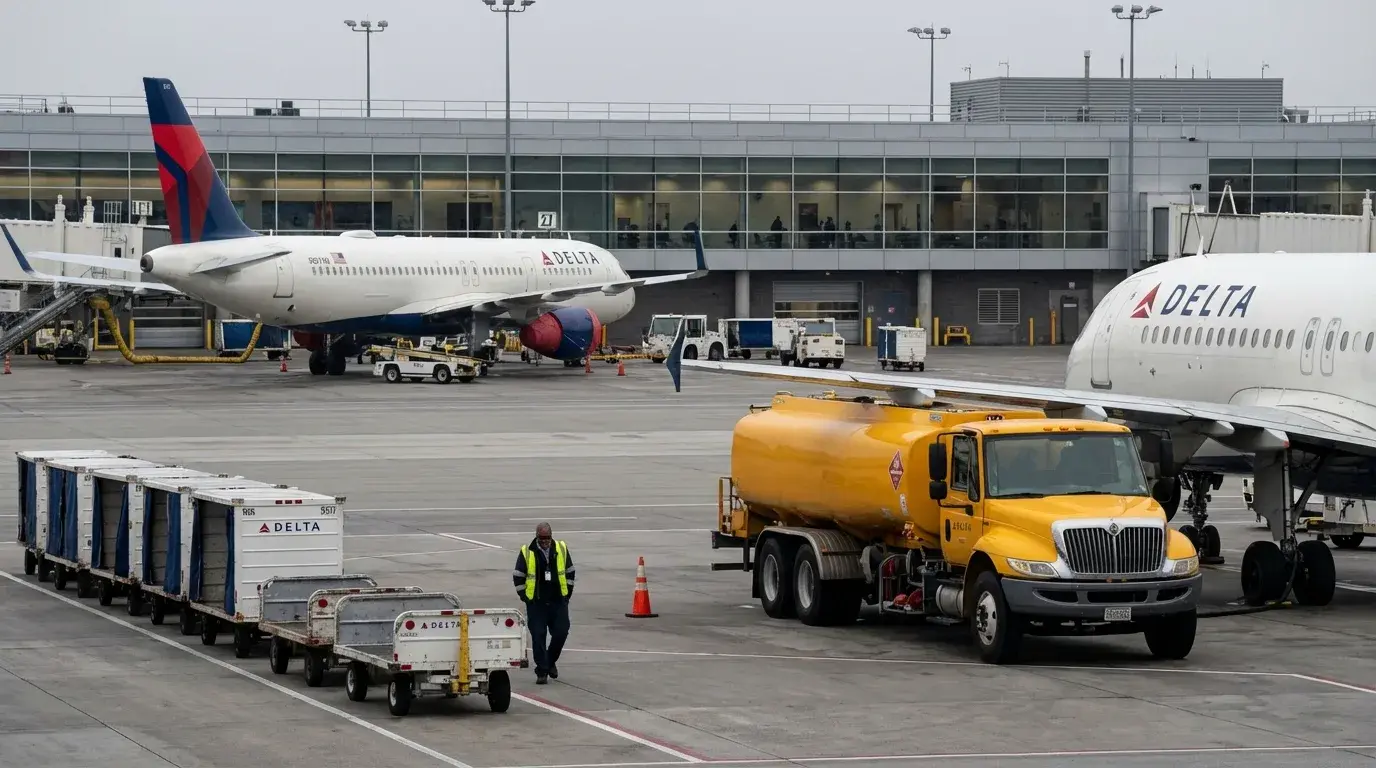
Delta Air Lines reported a $289 million net loss in the first quarter of 2026, compared to a $240 million net profit a year earlier. The decline was primarily driven by a sharp increase in jet fuel prices, linked to ongoing tensions in the Middle East.
Revenue, however, rose to $15.9 billion, up 13% year-over-year. Premium, corporate, and loyalty segments performed particularly well. Adjusted earnings per share reached $0.64, exceeding analyst expectations of $0.57. Adjusted operating revenue totaled $14.2 billion, a 9.4% increase.
Fuel costs surged by 8%, reaching approximately $2.6 billion. Delta Air Lines faced an additional $400 million in fuel expenses in March alone. CEO Ed Bastian acknowledged the pressure: “While the recent fuel spike is weighing on our results today, I remain confident that this environment ultimately strengthens Delta’s leadership and accelerates its long-term earnings power.”
Delta Slows Growth, Raises Fares
In response, Delta Air Lines has scrapped all planned capacity growth for the second quarter, reducing supply by about 3.5 percentage points from its original plan. The U.S. carrier also announced plans to increase baggage fees and other surcharges to recover 40-50% of the cost surge.
For Q2, Delta anticipates pre-tax earnings of around $1 billion, despite fuel costs exceeding last year’s by over $2 billion. The average jet fuel price is expected to hit $4.30 per gallon. Bastian warned: “At this level of fuel prices, it’s hard to call anything temporary.” He remains optimistic about demand, which is growing in the double digits. Delta benefits from a unique advantage: its own refinery in Pennsylvania, expected to provide a $300 million benefit in Q2.
Comparison with Other U.S. Airlines
Delta Air Lines is not alone in facing fuel price pressures. United Airlines had already flagged a “significant” impact in Q1, with potential annualized fuel cost increases of $11 billion. American Airlines also reported an additional $400 million in fuel costs for Q1, while slightly raising its revenue forecasts due to strong demand.
Southwest, JetBlue, and Alaska Airlines are also grappling with similar challenges. Several carriers, including United and JetBlue, have already raised baggage fees. The industry has broadly scaled back domestic capacity growth since mid-March.
Despite the accounting loss, analysts highlight the resilience of Delta’s business model, driven by its premium offerings. The sector is facing its first major post-pandemic test amid a “higher-for-longer” fuel environment. Bastian summed up the stakes: “This will separate the winners and force weaker players to take significant action.” For now, Delta is maintaining its annual guidance, but uncertainty remains high as long as oil prices fail to stabilize. Travelers should brace for higher fares and surcharges in the coming months.
Be the first to comment on this article
On the same topic
- Air France-KLM struggles amid fuel shock: How the airline withstands a 71% profit plunge
- Flybondi: March Salaries Unpaid as Argentine Low-Cost Airline Faces Pressure
- Copa Airlines unveils its 2026 ambitions: 420 daily flights and 88 destinations
- The double life of the King of the Netherlands: co-pilot with KLM for almost 30 years
- Alaska Airlines revolutionizes its business class for long-haul flights
- British Airways deploys Starlink Wi-Fi for ultra-fast in-flight connectivity