Luxair Accelerates Network Expansion in 2026 with Nine New Destinations and a Modernized Fleet
Luxair closed 2025 with solid traffic growth, reinforcing its position in the leisure travel market from Luxembourg. Despite high operating costs and intense competition, the airline transported over 2.6 million passengers—a stable volume compared to 2024, even with fewer flights operated. The message is clear: aircraft load factors improved, and demand remained strong on key summer routes.
This momentum is driven primarily by southern European destinations. Portugal and the Balearic Islands accounted for a significant share of bookings, according to Luxair’s management. Luxembourg-Findel Airport remains the backbone of this activity, with a network focused on vacation travel, short stays, and easy-to-organize departures. The airline now aims to turn this foundation into a growth driver for 2026.
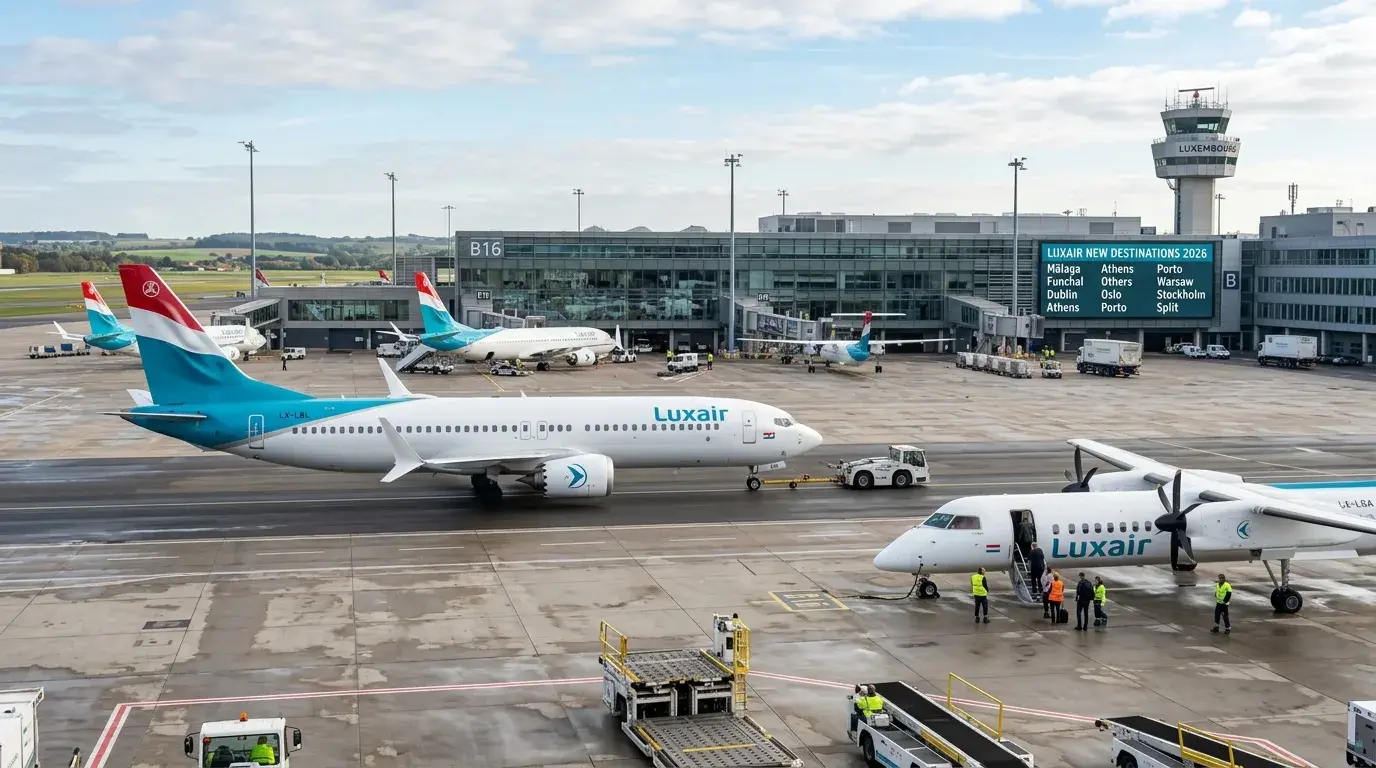
The carrier’s 2026 program reflects this ambition. Luxair will operate its largest-ever network, with 101 destinations year-round and 97 during the summer season alone. Starting March 29, 2026, nine new or relaunched routes will be added to the summer schedule. The strategy is clear: strengthen connections to high-demand markets while introducing a few new destinations to attract different traveler profiles.
A Wider 2026 Network, But Tightly Aligned with Demand
Luxair is not merely aiming for a record number of destinations. The airline emphasizes gradual, demand-driven growth, allowing it to adjust frequencies and aircraft sizes—a critical factor in an industry where profitability hinges on load factors.
The 2026 program remains focused on leisure travel. Alicante, relaunched on April 1 with two weekly flights, fits this strategy. Girona, a new route starting June 2, will be served with two weekly frequencies during peak season. Bilbao will return on July 16, also with two weekly flights. Porto Santo will launch on March 31 with a weekly service, while Tunis will resume on July 4 with two weekly flights.
The airline is also expanding into northern Europe. Helsinki, announced for July 2, and Edinburgh, scheduled for July 3, reflect a push to diversify beyond Mediterranean beach destinations. This shift allows Luxair to tap into new markets, from cultural city breaks to targeted short stays. A combined service to Zakynthos and Araxos, planned for summer, further broadens its leisure-focused offering.
Price Pressure Remains a Key Challenge
While expanding its network, Luxair is committed to avoiding sharp fare increases. Management stresses a closely monitored pricing policy in an environment where low-cost carriers exert strong competitive pressure and fuel costs remain volatile. Rising kerosene prices, linked to Middle Eastern tensions, add further complexity.
The airline aims to offer an expanded network without significant price hikes—a critical factor for its price-sensitive leisure clientele. To achieve this, Luxair is leveraging a classic but effective strategy: maintaining accessible fares while preserving the service quality that defines its reputation in the Luxembourg market.
Revenue management per seat has become a finely tuned exercise. Between fuel costs, labor expenses, and heightened competition across European markets, each new route must be carefully calibrated. Luxair understands this well: the goal is not just to fill the destination list but to do so without compromising profitability.
A Modernized Fleet to Support Growth
This network expansion is backed by a fleet renewal plan. Luxair took delivery of its first Embraer E195-E2 in late 2025, having ordered six firm aircraft with options for three more. This next-generation single-aisle jet, configured in a 2-2 layout without middle seats, will gradually replace the Dash 8-Q400s by 2028.
The E195-E2’s selection is strategic. With around 136 seats, the aircraft offers an intermediate capacity well-suited to European routes where load factors must be carefully managed. For Luxair, it’s a useful transitional tool: more modern, fuel-efficient, and better aligned with passenger expectations than older turboprops.
The airline is complementing this with Boeing 737 MAX aircraft. Two 737 MAX 8s have been ordered, with the first delivery expected in 2026, while two similar leased aircraft will support capacity growth on high-demand routes this summer. Luxair has also ordered 737 MAX 10s, with options for two additional units. The idea is straightforward: build a more flexible fleet capable of handling seasonal peaks without escalating fixed costs.
Southern Europe Remains the Growth Engine
The 2026 program confirms a trend already visible in 2025: travelers from Luxembourg respond strongly to sun destinations. Portugal and the Balearic Islands dominate demand, and the new routes align with this preference. Porto Santo, Alicante, Bilbao, and Tunis are all routes tailored to leisure travelers seeking direct, convenient, and easy-to-book connections.
Luxair is not limiting itself to this beach-focused logic. With Helsinki and Edinburgh, the airline is testing another market segment—short stays and urban getaways. This diversification could help smooth out seasonality while maintaining a clear identity: a proximity carrier offering a clear, European network without chasing volume for volume’s sake.
In its communications, management emphasizes responsible growth. While the phrase may sound cautious, it reflects a real-world context. In a market where costs remain volatile and profitability often hinges on a few percentage points of load factor, adding destinations must be paired with precise operational monitoring. Luxair appears determined to proceed within this framework, without deviating from the model that helped it sustain traffic in 2025.
The launch schedule further illustrates this measured approach. Porto Santo on March 31, Alicante on April 1, Girona on June 2, Helsinki and Edinburgh in early July, followed by Bilbao and Tunis in mid-July. This phased rollout gives the airline time to adjust operations based on bookings and observed results. In commercial aviation, timing matters as much as the number of destinations on offer.
With 101 destinations announced for the year and a modernizing fleet, Luxair enters 2026 with a more ambitious roadmap than in previous years. The challenge now will be to absorb this growth without compromising reliability, in a market where pricing decisions remain tight and passenger loyalty is built route by route.
Be the first to comment on this article
On the same topic
- Aegean Airlines to Take Control of Volotea: What It Means for Your European Travels
- Syrian Airlines relaunches its network: Damascus bets on Europe and the Middle East to rebuild air traffic
- Emirates Relaunches Strategic Offensive in Africa and the Middle East: Baghdad, Algiers and Basra in Sights
- easyJet soon in Apollo’s hands? What the fund battle means for your European flights
- AirAsia Group Transforms into a Global Low-Cost Giant: How the Malaysian Airline Challenges Aviation Titans
- Air France-KLM Bets on Fee-Free Changeable Tickets: A Winning Strategy Against Fuel Price Fears This Summer