EasyJet Opens First African Base in Marrakech, Accelerates Growth in Morocco
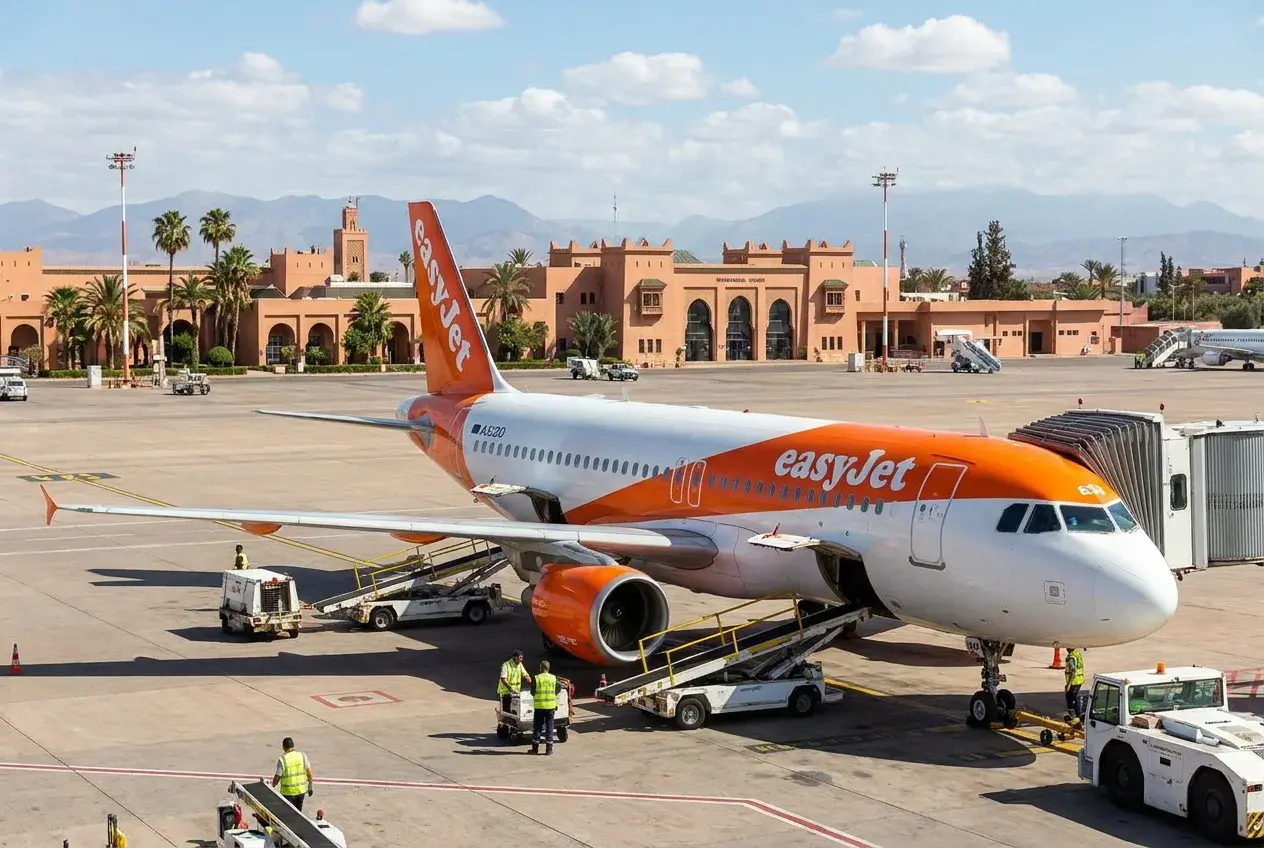
EasyJet has reached a new milestone in Morocco with the opening of its first African base at Marrakech-Menara Airport. The UK-based carrier now stations three aircraft year-round at the airport, a decision that significantly scales up its development in the country and underscores the strategic importance of the Moroccan market in its leisure-focused strategy. With this base, easyJet aims to offer 4 million annual seats to Morocco and introduces several new routes while stabilizing previously seasonal services.
The choice of Marrakech is far from coincidental. For a low-cost airline, establishing a base means having aircraft and crews on-site, enabling more early-morning departures, higher rotation rates, and better management of peak demand. It also sends a clear signal to the market: the airline is no longer just testing the destination but investing in a long-term presence. The announcement comes at a time when Morocco’s tourism sector continues to attract strong inflows from Europe, particularly from France, the UK, and Switzerland.
This expansion is supported by cooperation with Morocco’s National Tourism Office (ONMT) and the National Airports Authority (ONDA). For both institutions, the easyJet base enhances the country’s air connectivity and broadens access to Moroccan cities beyond the traditional major hubs. For the airline, it also opens the door to better commercial control in a market where demand spans short stays, family travel, and affinity traffic.
A Base Designed for the Long Term
EasyJet has chosen to base three Airbus A320 aircraft in Marrakech. In practice, this allows for increased flight frequencies, improved operational punctuality, and reduced reliance on tightly scheduled seasonal rotations. According to the airline, this move is expected to generate around 100 direct local jobs, in addition to indirect effects in the airport, hospitality, and tourism-related services. While this model is standard for a low-cost carrier, it remains relatively rare in North Africa at this scale.
With Marrakech as its hub, easyJet becomes the second airline to operate a base in the city, further solidifying its position in the Moroccan market. It also positions itself as the leading carrier from the UK and Switzerland to the Kingdom. This is a critical point in an industry where competition hinges not only on seat volume but also on the ability to offer schedules tailored to short stays.
The Moroccan base is part of a partnership signed in autumn 2025 between easyJet and ONMT. The stated goal is clear: to make air transport a driver of tourism growth by connecting Morocco more closely with key European outbound markets. For easyJet, this also means securing a broader traffic catchment area, especially as several airlines weigh the balance between fuel costs, route profitability, and demand stability.
Six New Routes and Several Stabilized Services
The base opening comes with six new routes. For the 2026-2027 winter season, easyJet will launch Marrakech-Prague, Marrakech-Newcastle, and Marrakech-Zurich, each with two weekly frequencies. These routes complement an already dense Morocco offering and target markets combining leisure tourism and affinity travel.
In spring 2026, the airline plans to add Nantes-Essaouira, Bordeaux-Agadir, and Birmingham-Agadir. These routes follow a clear logic: capturing passengers seeking short to medium-haul destinations with direct access to less saturated Moroccan cities. For Agadir and Essaouira, easyJet is focusing on beach getaways and off-season travel, with improved connectivity from western France and central England.
Additionally, several previously seasonal routes are transitioning to year-round services. This includes Lille-Marrakech, Strasbourg-Marrakech, and Hamburg-Marrakech. This shift provides tangible benefits for travelers and tourism stakeholders alike, offering greater booking clarity and allowing local operators to better plan their year-round offerings. EasyJet has also strengthened its presence in Tangier with a Geneva-Tangier route operating twice weekly.
Morocco Becomes a Key Axis for easyJet
With Marrakech, Agadir, Rabat, Essaouira, and Tangier now in its network, easyJet serves five Moroccan airports. The airline claims to have transported nearly 20 million passengers to and from Morocco since launching operations in 2006—a volume that highlights the country’s growing role in its non-European growth strategy.
The rise of Morocco as a strategic market for easyJet can be attributed to several factors. First, tourism demand remains robust, driven by leisure travelers, family trips, and diaspora traffic. Second, Morocco’s airport infrastructure has seen significant capacity and operational reliability improvements. Finally, the country’s authorities have pursued an active aviation development policy for years, aiming to attract European point-to-point carriers rather than relying solely on connections through major hubs.
In this context, the Marrakech base is more than just a commercial announcement. It reflects a broader market shift: Morocco is positioning itself as a network destination for European low-cost carriers, much like other Mediterranean hubs already dense in traffic. For easyJet, the question is no longer whether demand exists but how to capture it sustainably with an all-year-round offering capable of filling aircraft.
A Market Driven by Short Stays and Affinity Traffic
EasyJet’s positioning remains true to its model. The airline targets markets where price sensitivity is high but where travel frequency ensures route profitability. Marrakech fits this logic with stays of two to five days, departures from multiple European cities, and a customer base that often books in advance. The new routes to Prague, Zurich, or Newcastle demonstrate the airline’s effort to diversify its catchment areas rather than relying solely on historical markets.
Morocco also offers a practical advantage: it remains an easy sell for European travelers seeking sun, culture, and hassle-free short-haul trips without connections. In terms of air transport, this translates into predictable demand, efficient rotations, and quick aircraft turnarounds between Europe and North Africa. This is precisely the kind of setup a carrier like easyJet aims to lock in when opening a base.
Over the coming months, the real test will be performance outside peak demand periods. If the new routes withstand seasonality and the year-round services maintain their volumes, Marrakech could become a regional hub for easyJet, playing a role similar to that it already holds in several European cities. The Moroccan network would then gain density, with direct impacts on competition, fares, and capacity from France, the UK, and Switzerland.
Be the first to comment on this article