Turkish Airlines Orders 300 LEAP-1B Engines for 737 MAX: A $10 Billion Industrial Bet Reshaping Europe's Skies
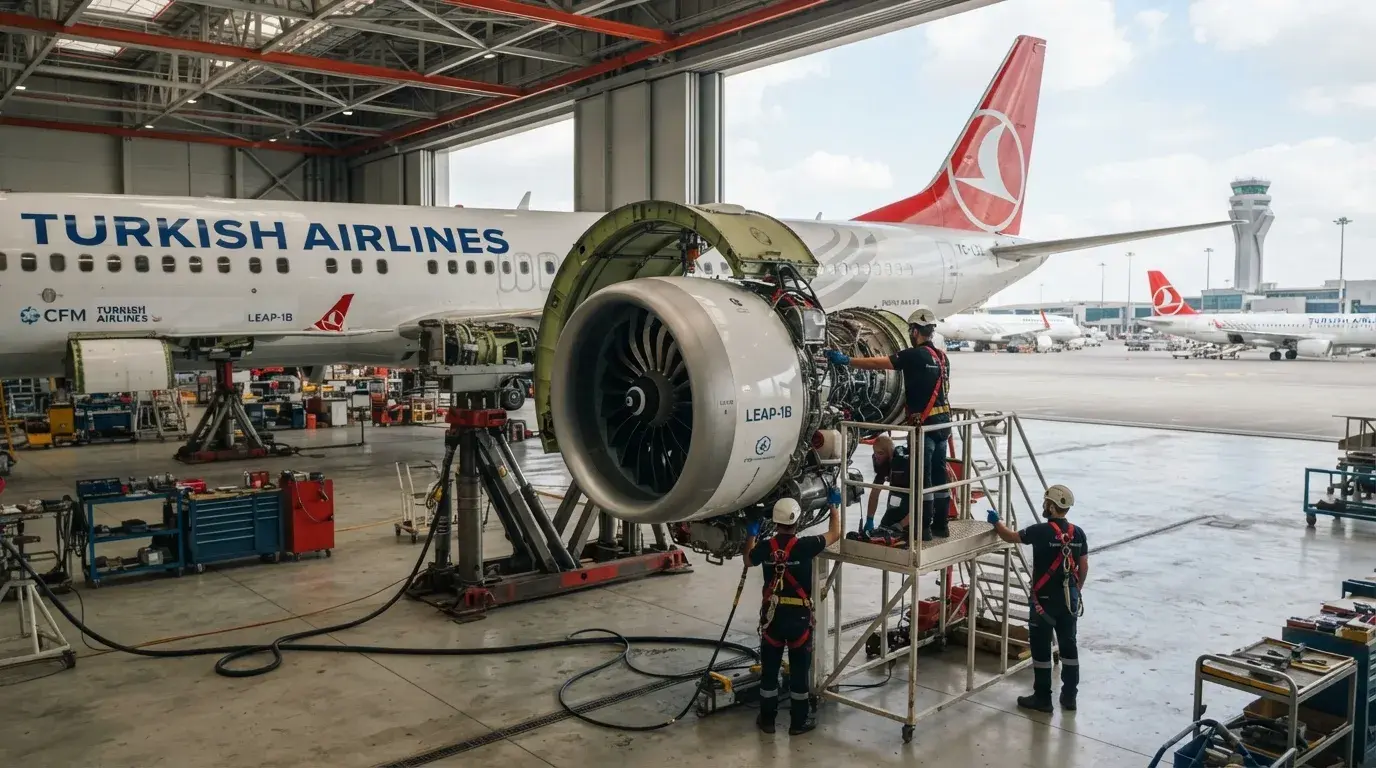
With a protocol agreement signed on October 16, 2026, in Istanbul, Turkish Airlines and CFM International have set a milestone that could disrupt Europe’s competitive balance. The Turkish giant has ordered more than 300 LEAP-1B engines, including spares, to power its future fleet of 100 firm Boeing 737 MAX orders and 50 options, a deal valued at over $10 billion. Beyond the financial commitment, this is a long-term industrial strategy, featuring the establishment of a maintenance center in Turkey and support services for over 600 engines in the coming years.
Signed in the presence of executives from both groups, this partnership marks a key step in Turkish Airlines’ expansion. Already well-established in Europe with a diverse fleet, the airline strengthens its position against competitors like Ryanair and Wizz Air, which rely on aggressive cost strategies. The delivery of these engines, scheduled between 2033 and 2037, aligns with an ambitious growth plan where each aircraft ordered reinforces Istanbul’s role as a major hub connecting Europe, Asia, and Africa.
For CFM International, the joint venture between GE Aerospace and Safran Aircraft Engines, this agreement confirms global enthusiasm for the LEAP family, already in service on thousands of aircraft. The LEAP-1B, specifically designed for the 737 MAX, boasts a 15% reduction in fuel consumption compared to previous generations—a critical advantage in a context of persistently high jet fuel prices. Turkish Airlines, which already operates 79 Boeing 737 MAX aircraft, aims to enhance operational efficiency while securing its supply chain.
A Growing MRO Ecosystem in Turkey
The other pillar of this agreement is even more strategic. Turkish Technic, the airline’s maintenance subsidiary, will develop a dedicated maintenance, repair, and overhaul (MRO) center for LEAP engines in Turkey. While financial and scheduling details remain undisclosed, the project aims to reduce reliance on European or American workshops for airlines operating in the region. Safran, a long-standing partner of the Turkish group, sees an opportunity to expand its global MRO ecosystem.
This center could become a key player for airlines in the Middle East and Africa, where demand for maintenance of new-generation single-aisle aircraft is surging. For Turkish Airlines, the stakes are twofold: ensuring engine availability while generating additional revenue through maintenance services for other operators. The airline plans to operate a total fleet of 130 Boeing 737 MAX aircraft by 2037, a fleet requiring robust logistical support.
A Evolving Spare Parts Market
The announcement arrives as the market for used parts for new-generation aircraft takes shape. Players like GA Telesis are dismantling aircraft such as the Airbus A320neo or Boeing 737 MAX 8 to supply spare parts inventories. This trend responds to persistent supply chain pressures, where delivery times for new critical components can exceed 12 months.
For Turkish Airlines, the agreement with CFM goes beyond engine procurement. The group will benefit from long-term support for over 600 engines, including those already in service and those on order. This coverage extends to its subsidiary AJet, reinforcing fleet consistency. The stated goal is clear: “to support the growth of our network and operational efficiency.” Behind this statement, however, lies a full-blown industrial battle where each ordered engine represents a competitive edge.
Europe and the Middle East in the Crosshairs
With this massive order, Turkish Airlines reaffirms its ambition to become Europe’s premier hub for flights to the Middle East and Central Asia. Istanbul, already competing directly with Dubai and Doha, could capture a growing share of long-haul traffic, particularly on routes to India, China, or East Africa. The modernization of its fleet, featuring more fuel-efficient and high-performance aircraft, is a major asset for attracting passengers and partner airlines.
The 737 MAX, with its extended range and ability to operate from short runways, is particularly well-suited to this role. Turkish Airlines, which expects annual traffic growth of 8 to 10%, views this order as a lever to strengthen its market share against rivals like Emirates and Qatar Airways. The group has already announced new route openings to destinations in Central Asia and Sub-Saharan Africa, regions where air transport demand is exploding.
A Future Bet with Managed Risks
Despite the scale of the investment, Turkish Airlines and CFM have taken precautions. The protocol agreement leaves several questions unanswered: the exact value of long-term services, the duration of the agreements, and the precise delivery schedule for the engines. However, the commitment of both parties appears solid, especially since the LEAP-1B is already a proven engine, with over 100 million flight hours accumulated across the entire LEAP family.
For CFM, this partnership aligns with a strategy to expand its MRO market presence, where competition with players like MTU Aero Engines or StandardAero is fierce. Through its joint venture, Safran is leveraging geographic proximity to attract regional airlines. Conversely, Turkish Airlines sees an opportunity to reduce maintenance costs and gain autonomy.
If the project succeeds, it could serve as a model for other agreements in Europe or the Middle East, where maintenance needs for new-generation aircraft are evolving rapidly. One thing is certain: after this order, the competitive balance between European hubs is set to shift.
A Fleet in Full Transformation Amidst Competition
Turkish Airlines is not alone in betting on the 737 MAX to modernize its fleet. Ryanair, for example, has already ordered more than 200 aircraft from this family, while Wizz Air and easyJet are closely following suit. However, Turkish Airlines distinguishes itself through an integrated approach: not only does it purchase aircraft, but it also secures their maintenance and spare parts supply for decades to come.
This strategy mirrors that of Lufthansa, which is diversifying its long-haul fleet with Airbus A350 and Boeing 787 aircraft. However, Turkish Airlines benefits from a competitive labor cost advantage in Turkey, a significant asset for its maintenance workshops. The creation of a dedicated LEAP MRO center could attract other operators, further solidifying Istanbul’s role as an industrial platform.
The group has also begun diversifying its revenue streams. In addition to its passenger business, Turkish Airlines is a major player in air cargo, with a dedicated fleet and strategic partnerships. Integrating the new Boeing 737 MAX into this network could further boost its results, especially if the airline captures a share of traffic between Europe and Asia via Istanbul, rather than through traditional hubs like Frankfurt or Amsterdam.
The Impact on Europe’s Air Transport Market
The massive arrival of new-generation single-aisle aircraft in Europe will inevitably reshape the competitive landscape. Ryanair and Wizz Air, which rely on reduced operating costs, may see their leadership challenged if Turkish Airlines succeeds in offering competitive fares while providing better geographic coverage. The 737 MAX, with its ability to fly longer distances than current low-cost aircraft, enables direct routes to emerging destinations.
Additionally, the establishment of an MRO center in Turkey could attract airlines from the Middle East or Africa seeking to reduce maintenance costs. Players like Saudia or Emirates might outsource part of their operations to Istanbul, further enhancing the appeal of the Turkish hub.
For passengers, this evolution will translate into a broader and more flexible flight offering. New routes served by the 737 MAX, combined with improved onboard services, could position Istanbul as a credible alternative to Europe’s traditional hubs. If Turkish Airlines delivers on its industrial promises, the entire European air transport sector could benefit.
A Model to Follow for the Aerospace Industry?
The agreement between Turkish Airlines and CFM highlights a strong trend in the aerospace industry: vertical integration. By securing not only the purchase of aircraft but also their maintenance and spare parts supply, airlines reduce their exposure to market volatility. A strategy that could inspire other groups, particularly in Asia or Latin America, where competition is increasingly fierce.
For CFM, this partnership is also a technological victory. The LEAP-1B, with its composite materials and optimized design, is one of the most advanced engines on the market. Its widespread adoption by Turkish Airlines could accelerate its deployment in other regions, strengthening the position of Safran and GE Aerospace against competitors like Pratt & Whitney and its GTF engine.
Finally, for Europe, this announcement is a strong signal: the continent remains a key market for the global aerospace industry, despite competition from Chinese and Russian manufacturers. The massive orders for single-aisle aircraft, whether the 737 MAX or the A320neo, show that Europe retains a central place in the strategies of major industry players.
What’s Next?
The coming years will be critical for Turkish Airlines. By 2037, the group must integrate over 130 Boeing 737 MAX aircraft into its fleet while expanding its network and infrastructure. The success of this wager will depend on several factors: the stability of the air transport market, the evolution of jet fuel costs, and the airline’s ability to maintain its reputation for service excellence.
Another challenge will be managing the coexistence of old and new aircraft generations. Turkish Airlines, which still operates Boeing 737 Next-Generation and Airbus A321neo aircraft, must optimize costs while ensuring an impeccable passenger experience. Crew training, hybrid fleet maintenance, and airport infrastructure adaptation will be major challenges.
For travelers, this transformation will result in a broader and more flexible offering. New routes served by the 737 MAX, combined with improved onboard services, could position Istanbul as a credible alternative to Europe’s traditional hubs. If Turkish Airlines delivers on its industrial promises, the entire European air transport sector could benefit.
Be the first to comment on this article