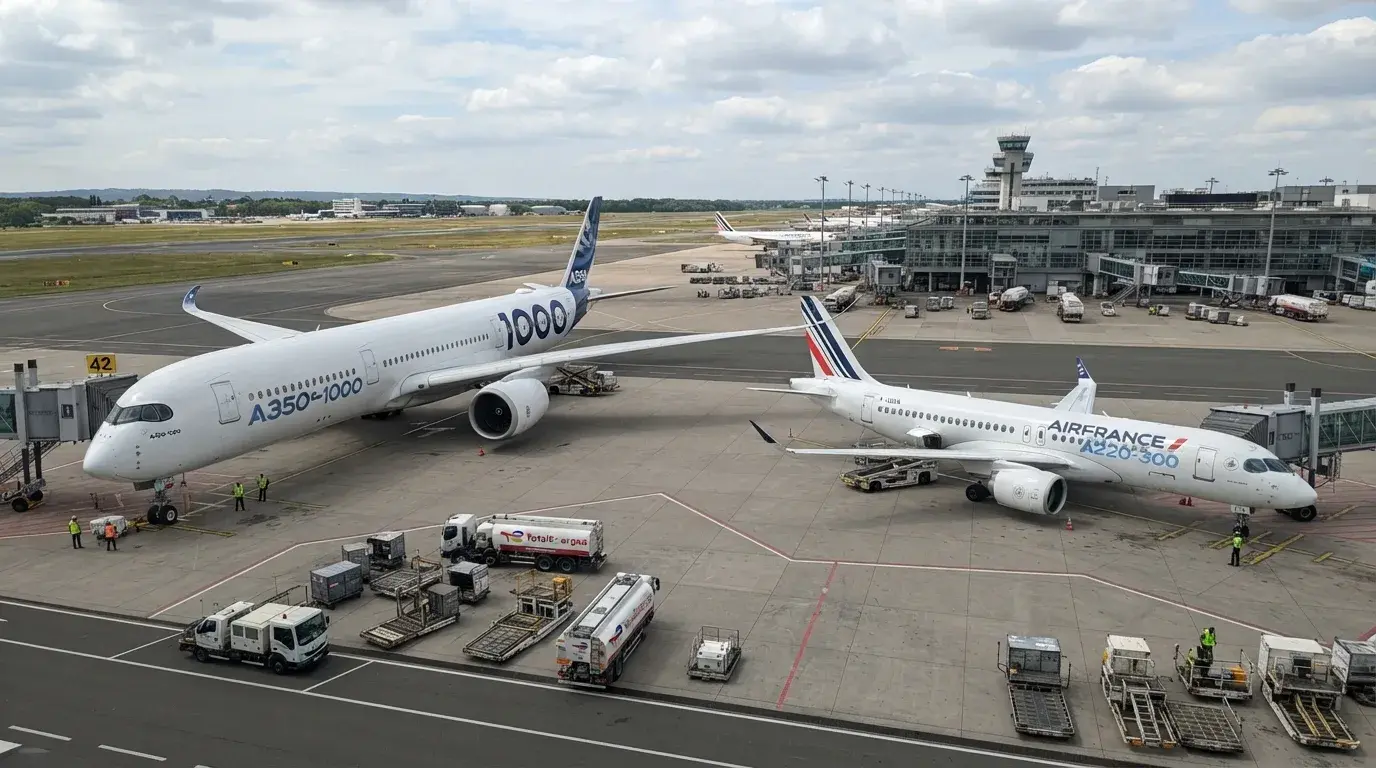
Airbus is quietly advancing plans for two stretched variants—the A350-2000 and A220-500—which could redefine the balance of power in the aviation industry. The European planemaker is exploring a higher-capacity version of its A350 and a larger A220-500 to expand its single-aisle lineup. Two major industrial and commercial challenges that could, over time, disrupt airline strategies.
With existing orders already keeping production lines busy, Airbus must now decide whether to maintain current output or invest in these new variants. As the aerospace industry undergoes rapid transformation, the planemaker’s next moves could give it a fresh competitive edge against Boeing.
Though neither the A350-2000 nor the A220-500 has been officially launched, signals from Airbus suggest strong future relevance. The manufacturer is betting on growing demand for larger or higher-capacity aircraft capable of meeting carriers’ efficiency and flexibility needs.
The A350-2000: A Giant to Challenge the Boeing 777-9
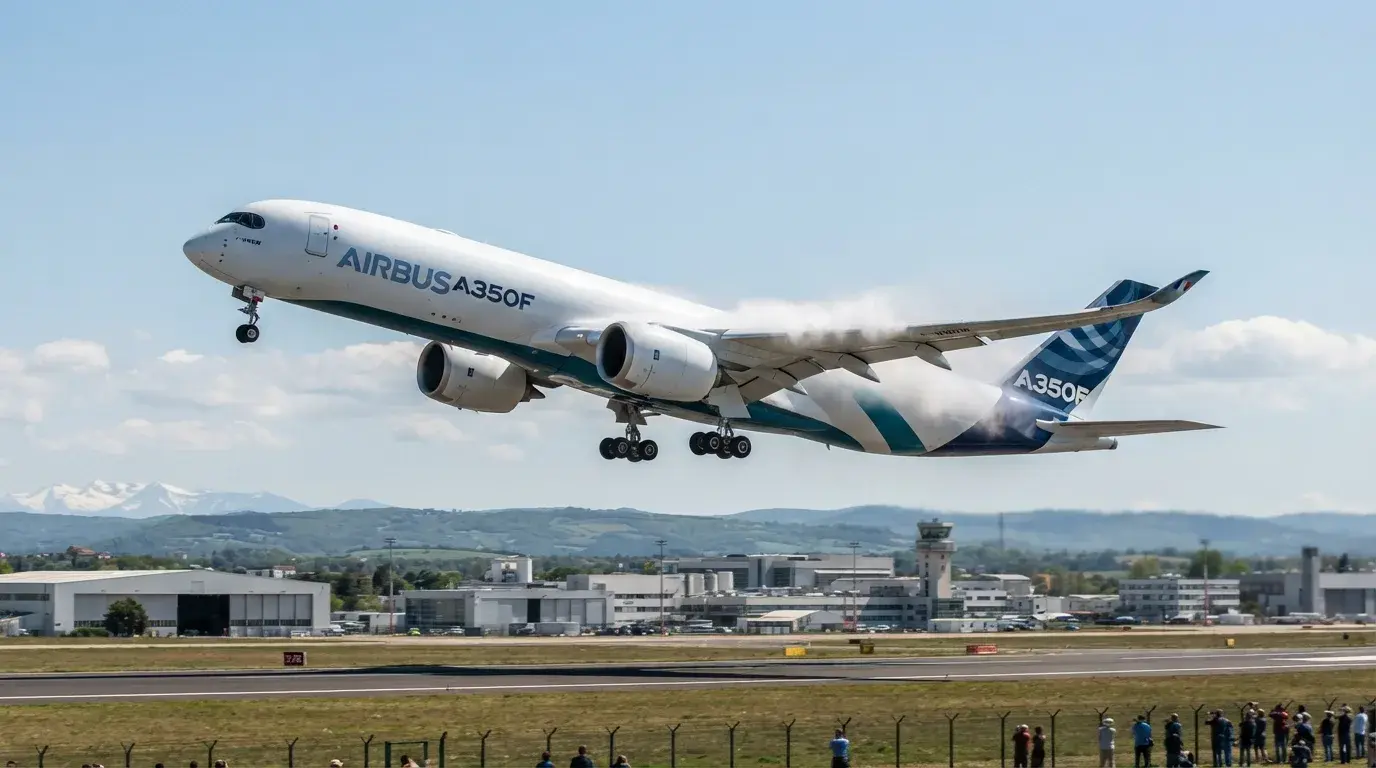
The proposed A350-2000 aims to strengthen Airbus’ long-haul offerings. With an estimated capacity of around 400 seats in a standard two-class configuration, the aircraft could bridge the gap between the A350-1000—currently the largest in the family—and next-generation models. The stakes are high: Airbus seeks to rival the Boeing 777-9, whose performance and capacity make it a formidable competitor on high-traffic routes.
Discussions about the A350-2000 are not new. As early as February 2026, Emirates President Tim Clark highlighted the airline’s interest in a larger aircraft capable of accommodating more passengers on routes to Europe and North America. Such demand could accelerate the project’s launch—provided Airbus can convince other carriers of its value.
Yet several challenges remain. The A350-2000’s engine choice is particularly complex. The current A350 family relies exclusively on Rolls-Royce Trent XWB engines, an exclusivity that may be reconsidered. Airbus has explored the possibility of integrating engines from GE Aerospace, though the U.S. manufacturer has shown limited interest so far. Such a decision would complicate the timeline and increase development costs without guaranteed returns.
Production capacity is another hurdle. Airbus aims to ramp up to twelve A350s per month by 2028, an already ambitious target. Adding a stretched variant would require additional investments in production lines, potentially necessitating new assembly facilities. Julien Puyou, Airbus’ Head of Large Aircraft Programs, confirmed that a decision on stretching the A350 won’t be made before 2026, underscoring the planemaker’s cautious approach.
The A220-500: Expanding the Family Without Disrupting the Lineup
At the other end of the spectrum, the A220-500 aims to meet a different demand: offering more seats without forcing airlines to switch aircraft types. The A220-300, currently the largest in the family, accommodates between 120 and 150 passengers in a standard two-class configuration, with a maximum of 160 seats. If launched, the A220-500 would increase this capacity while retaining the operational and economic advantages of the A220 family.
While commercial interest exists, the A220-500’s development hinges on Airbus’ ability to demonstrate its profitability. The A220 program remains unprofitable, and the planemaker must first meet its ramp-up targets before considering another stretch. Airbus aims for a production rate of thirteen A220s per month by 2028, leaving little room for a new variant in the near term.
The A220-500’s commercial positioning will be critical. Airbus must avoid cannibalizing sales of the well-established A320neo. A thorough analysis of airline needs and market segments will be essential to justify the investment.
Production and Industrial Strategy: Airbus at a Crossroads
Before deciding on these new variants, Airbus must address its production capacity constraints for the A350. Demand is strong, but the planemaker is struggling to keep up with orders. Lars Wagner, CEO of Airbus Commercial Aircraft, confirmed that increasing production rates is « inevitable ». The current target is twelve A350s per month by 2028, but the existing assembly system was designed for a capacity of twelve to thirteen aircraft. To exceed this threshold, Airbus would need to invest in new production lines and industrial systems—a decision that must be approved by the board.
This industrial challenge reflects a broader transformation in the sector. Airbus must now allocate investments across ramping up current programs, developing new variants, and preparing next-generation aircraft. The A220-500 and A350-2000 add to an already long list of projects, each with its own technical and financial challenges.
For the A350-2000, the engine choice will be decisive. If Airbus maintains its exclusive reliance on Rolls-Royce, it could limit options for airlines. Alternatively, if the planemaker opts for an alternative engine, it would need to secure GE Aerospace’s commitment—a scenario that remains uncertain at this stage.
A Market Craving Flexibility
The proposed stretches of the A350 and A220 reflect a broader industry trend: the search for flexibility. Airlines are seeking ways to adapt their fleets to fluctuating demand without investing in entirely new aircraft. An A350-2000 could allow carriers like Emirates or Qatar Airways to adjust capacity on high-demand routes while retaining the economic benefits of the A350 family.
Similarly, the A220-500 could offer regional and low-cost carriers a solution to increase capacity without switching platforms. This approach might appeal to operators like EasyJet or Volotea, which are focused on optimizing costs while meeting traffic growth.
However, the success of these projects depends on multiple factors: Airbus’ ability to control development costs, engine availability, and, above all, airlines’ willingness to commit to these new variants. A decision on the A350-2000 is expected by the start of Airbus’ five-year planning cycle, leaving little time to finalize technical and commercial studies.
Toward a New Era in Air Travel?
If Airbus successfully launches these projects, the industry could witness a reshuffling of the competitive landscape. The A350-2000 could emerge as a serious rival to the Boeing 777-9, while the A220-500 could invigorate the single-aisle market by offering increased capacity without a proportional rise in operating costs.
For Airbus, the challenge is twofold: proving the A350 family can still evolve and that the A220 can establish itself as a credible alternative to larger-capacity aircraft. In a market defined by fierce competition and tight margins, the planemaker must proceed with caution to avoid spreading its resources too thin.
One thing is clear: the aerospace industry is at a turning point. Airbus’ decisions in the coming months could redefine the rules of the game for years to come, offering airlines new opportunities to tackle the challenges of traffic growth.
Be the first to comment on this article