Airbus A350F: Historic First Flight of the Cargo Jet Set to Revolutionize Air Freight in 2027
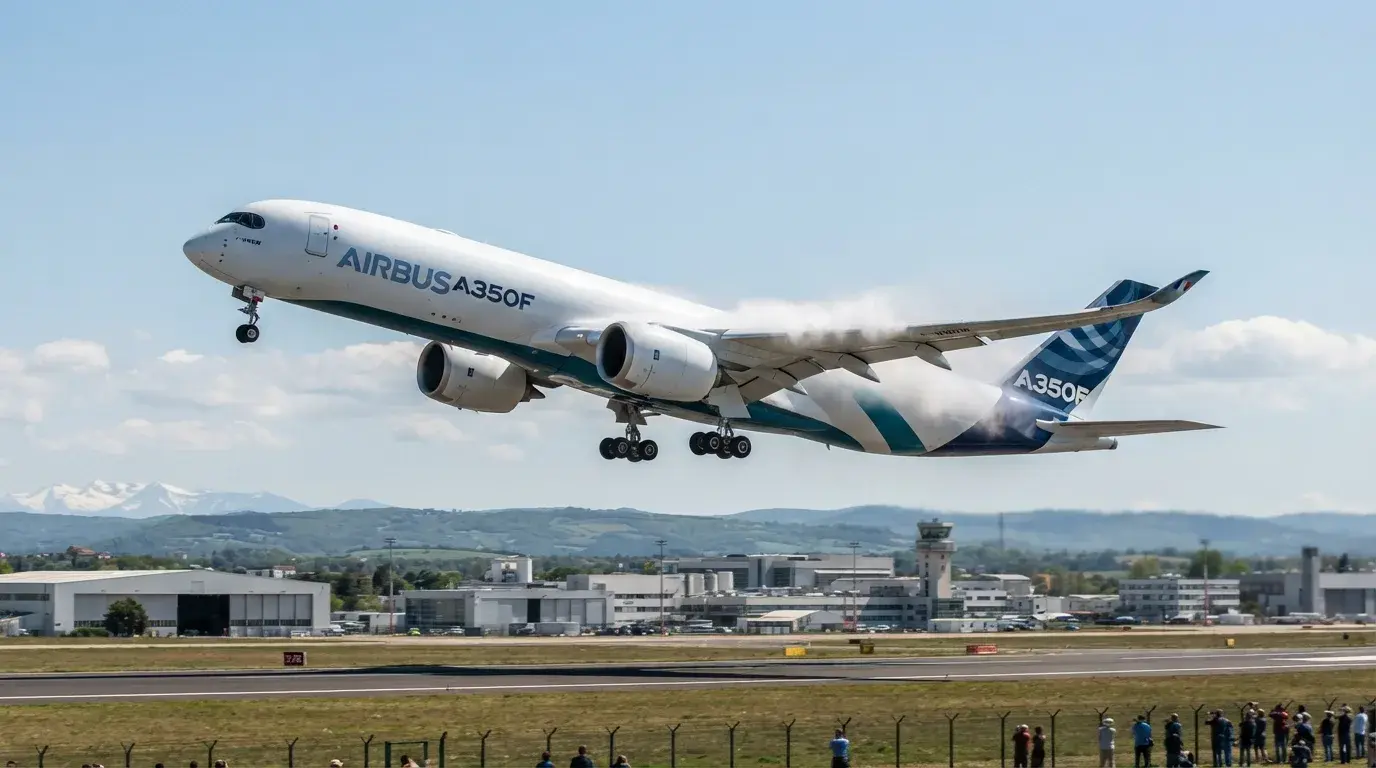
The aviation sector has just experienced a pivotal moment with the maiden flight, on Tuesday, September 29, from Toulouse-Blagnac, of the Airbus A350F. This prototype, registered F-WXLD, took off at 10:30 a.m. for a four-hour test flight, marking the start of a 400-hour certification campaign ahead of its entry into service scheduled for the second half of 2027. A turning point for Airbus, which is banking on this cargo jet to disrupt the balance of the air freight sector, long dominated by Boeing as the sole major player in the dedicated large-capacity freighter segment.
Under a livery evoking a giant package, the A350F is far more than just a passenger aircraft stripped of its windows. Its fuselage, redesigned for cargo and measuring 70.80 meters in length, combines the forward features of the A350-900 and the rear of the A350-1000, a unique geometry requiring extensive aerodynamic validation. Powered by two Rolls-Royce Trent XWB-97 engines, it can carry up to 111 tonnes of payload over 8,700 kilometers, featuring a 4.3-meter-high side cargo door to facilitate the loading of pallets or oversized items such as aircraft engines. Thermal regulation of the compartments also makes it suitable for sensitive goods like pharmaceuticals or perishables.
With 115 firm orders to date, including 20 for Atlas Air, the A350F directly competes with Boeing’s upcoming 777-8F, also in development. Airbus anticipates a promising market: its forecasts project 630 new large-capacity freighters by 2044, some from passenger-to-freighter conversions and others as new-build orders. The first flight from Toulouse paves the way for a critical technical demonstration before the commercial challenge of operational deployment.
Why could this freighter redefine the rules of air freight? First, its modern architecture enables it to consume at least 20% less fuel than comparable aircraft currently in service, a significant saving amid rising energy costs. Second, its operational versatility—capable of transporting both standard containers and outsize cargo—addresses shippers’ growing demand for flexible logistics solutions. Finally, Airbus is targeting rapid certification by 2027, a tight deadline that could allow it to outpace Boeing in certain market segments.
The coming months will be decisive. Five months of flight testing are planned across two aircraft, with the second prototype, MSN701, focusing on systems and extreme-temperature trials. Certification must be secured before the first deliveries, an ambitious timeline embedded in Airbus’ broader strategy to establish itself as a key player in long-haul air freight. For industry professionals, the stakes go beyond technical innovation: the question is whether the A350F can become the new standard for cargo aircraft, much like the 747 was for Boeing for decades.
A Fuselage Redesigned for Bulk and Precision Transport
The A350F is not a modified passenger aircraft but a purpose-built freighter from the ground up. Its fuselage, longer than that of the A350-900 and A350-1000, incorporates structural reinforcements and dedicated cargo-handling systems. The 4.3-meter-high side cargo door, a first in this segment, allows loading up to 30 standard pallets in a single operation, compared to 20 for a classic Boeing 777F. This capacity is a major asset for express freight carriers or those transporting aircraft engines.
Another key innovation is the thermal regulation of compartments, adjustable between 4°C and 25°C as needed. This feature is particularly useful for pharmaceuticals, foodstuffs, or temperature-sensitive electronics. Airbus highlights energy savings of 15% compared to traditional systems, a compelling commercial argument for shippers increasingly focused on traceability and cold chain compliance.
However, airlines will need to adapt. The A350F requires specific crew and maintenance team training, particularly to manage its advanced loading and climate control systems. Yet, the promise of a quieter, more fuel-efficient aircraft could appeal to airports keen to reduce their carbon footprint and noise pollution. Toulouse-Blagnac, where the aircraft was assembled, is already banking on this segment to attract new freight traffic.
Market Entry Amid Fierce Competition
The A350F enters a rapidly evolving market. Boeing’s 777-8F, with similar payload and range capabilities, takes a different approach: the U.S. manufacturer is focusing on converting existing 777s to accelerate entry into service, while Airbus opts for a brand-new design. This difference could favor Airbus for carriers seeking modern, optimized aircraft, but it also tightens the certification timeline.
Atlas Air, the A350F’s launch customer with 20 orders, has already announced plans for gradual integration into its fleet. The all-cargo specialist sees this new aircraft as an opportunity to modernize its fleet and meet surging demand from e-commerce and express deliveries. Other operators like Lufthansa Cargo and Singapore Airlines, which have also ordered A350Fs, are awaiting test results before finalizing their acquisition schedules.
Airbus’ challenge extends beyond technical performance. It must also convince shippers that the A350F offers tangible advantages over existing solutions, whether through passenger-to-freighter conversions or the use of less specialized aircraft like the Boeing 747-8F or 767-300F. The commercial battle promises to be intense, especially as fuel prices remain volatile and cargo airlines seek to optimize operational costs.
For passengers, the impact of the A350F will be indirect but real. Improved cargo connectivity means reduced delivery times for parcels, a boon for businesses reliant on global supply chains. Longer term, if the A350F becomes a standard, airports could see increased cargo traffic, with economic benefits for well-connected regions.
Next Steps: Balancing Technical Trials and Industrial Challenges
The 400 hours of testing planned for two aircraft will validate aerodynamic performance, onboard systems, and flight conditions across varied environments. The first prototype, MSN700, which completed the maiden flight, will focus on flight qualities and autopilot systems, while the second, MSN701, will concentrate on systems testing, climate control, and smoke detection. These trials will also include flights in extreme temperatures, a critical step to certify the aircraft under all climatic conditions.
Airbus aims for certification by mid-2027, enabling first deliveries in the second half of that year. A tight schedule that adds to the pressure of A321neo and A350 deliveries, already under scrutiny due to quality issues identified on some aircraft. For Airbus, the stakes are twofold: proving the A350F can be produced on schedule without major delays, and demonstrating operational reliability from the outset of commercial flights.
Industry observers are closely monitoring potential test delays, which could have a domino effect on orders and customer confidence. Yet, the A350F represents a unique opportunity for Airbus to diversify its portfolio and reduce its dependence on the already highly competitive passenger aircraft market. If successful, it could become a cornerstone of the Toulouse-based manufacturer’s industrial strategy for the next two decades.
For freight professionals, the A350F is more than just an aircraft: it’s a bet on the future of air cargo transport, a sector in constant growth and increasingly demanding in terms of speed and flexibility. After decades of near-exclusive Boeing dominance, Airbus could finally establish itself as a key player in this market, with significant economic and technological implications for the European aerospace industry.
The coming months will reveal whether the A350F lives up to its promises. One thing is certain: its first flight is only the beginning of an adventure that could reshape the global air freight landscape.
Be the first to comment on this article
On the same topic
- Emirates SkyCargo revolutionizes air freight with its first 777-300ERSF: 25% more volume and record 100-ton capacity
- Vueling and Shark Skin Film to Boost Fuel Savings in 2026
- China Southern Airlines bets on Boeing 777 cargo: a masterstroke to dominate global air freight
- Uganda Airlines Makes Bold Move: Orders 10 Boeing Jets to Become Africa’s Future Hub
- LATAM Launches Direct São Paulo-Brussels Flight: Belgium Now Accessible Nonstop from Brazil