Singapore Airlines under pressure: Why the Asian giant struggles to turn traffic records into profits
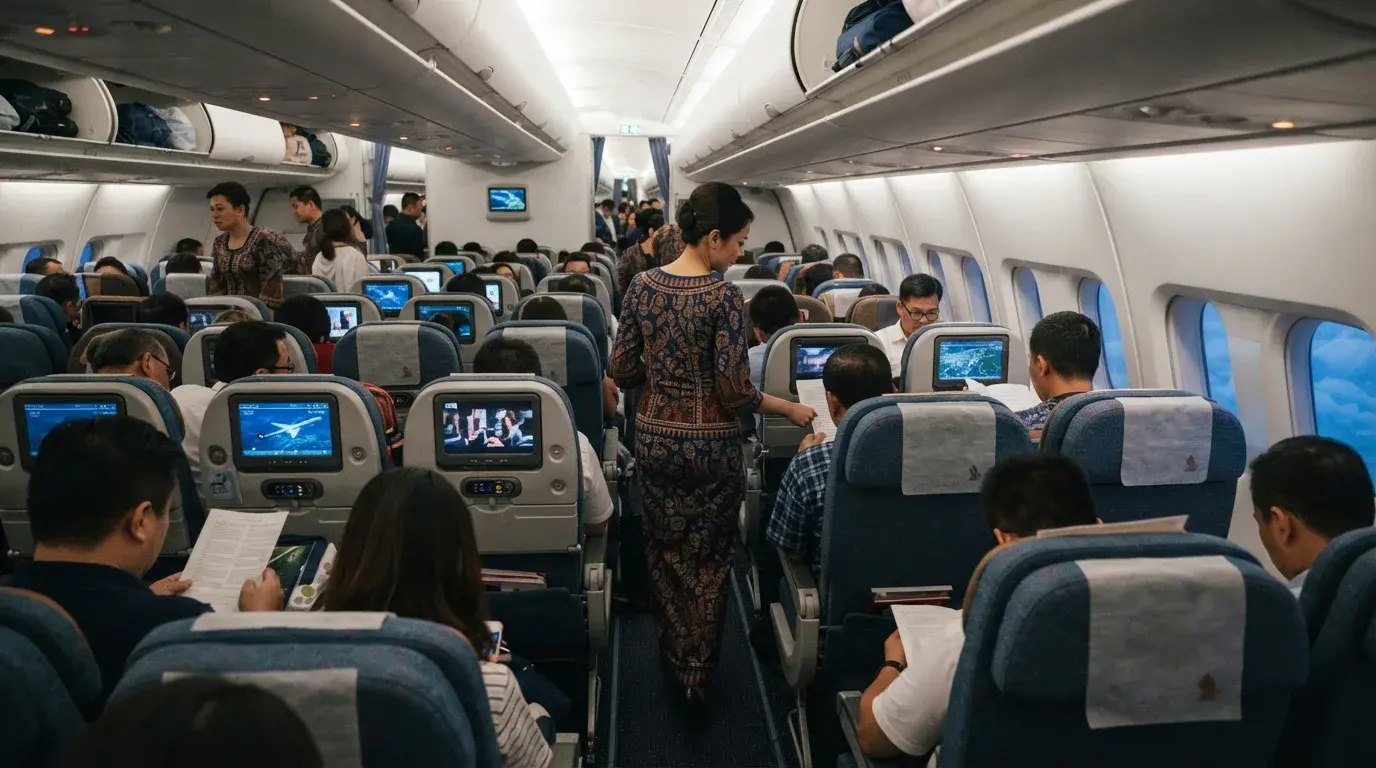
With 21.8 million passengers carried in the first half of 2026/2027, Singapore Airlines has set a historic record for the group. Yet this traffic milestone has failed to translate into the expected financial performance. Behind the upward curves of passenger numbers lies an increasingly difficult economic equation, undermined by soaring kerosene prices and operational costs. The situation raises questions about the resilience of a business model long renowned for its robustness.
The group, which includes the flagship carrier and its low-cost subsidiary Scoot, reported a 16.8% increase in total revenue to SGD 11.3 billion (about €8 billion). Despite this growth, operating profit fell by 29.1%, and net profit plummeted by 43.9%, dropping from €168 million to €94 million. This performance stands in stark contrast to the optimism typically displayed by executives, who have long emphasized the strength of Singapore’s model.
The surge in fuel prices is the primary driver of this imbalance. The average price of kerosene reached $171 per barrel during the period, an 86.7% year-on-year increase. Before hedging, the energy bill jumped by 90.3%, a shock even financial hedging strategies could not fully absorb. The gains from hedging contracts, estimated at SGD 731 million, only partially offset this cost explosion. As a result, net fuel costs now account for 37% of the group’s expenses, up from 29% a year earlier—a proportion that underscores the magnitude of the financial challenge facing Singapore Airlines.
A rise in traffic, but a slight dip in load factors
The 21.8 million passengers carried by the group between April and September 2026 represent a 5% year-on-year increase. Singapore Airlines alone welcomed 14.1 million travelers (+3%), while its low-cost subsidiary Scoot saw faster growth of 8.9%, transporting 7.7 million passengers. Yet this rise in traffic has not translated into improved load factors. Capacity, measured in available seat-kilometers, grew by 4.9%, outpacing the increase in revenue passenger-kilometers (+3.8%). The group’s load factor thus fell by 0.9 percentage points to 86.8%. While this decline may seem marginal, it carries significant weight in a high-cost environment.
Revenue per revenue passenger-kilometer rose by 12.1%, lifting passenger revenues to SGD 9.1 billion (€6.4 billion). This gain partially offsets the impact of rising costs but remains insufficient to compensate for margin erosion. The group is banking on higher unit revenues to support future investments, particularly in fleet renewal and onboard experience upgrades.
Cargo: an unexpected lifeline
While passenger transport remains Singapore Airlines’ core business, air freight played a pivotal role in the half-year performance. Cargo revenues surged by 30.2% to SGD 1.39 billion. This performance stems from a 25.4% increase in unit revenue, while traffic, measured in tonne-kilometers, rose by 4%. Several factors explain this momentum: sustained demand in semiconductors and cloud computing, as well as a shift from maritime to air shipments due to geopolitical tensions in the Red Sea and Black Sea.
This resilience in cargo helped mitigate the drop in operating profit, which fell to €399 million from €560 million a year earlier. The July-September period marked a significant rebound, with operating profit reaching SGD 463 million (+16.3%) and net profit at SGD 210 million, compared to just SGD 52 million in Q3 2025. This recovery is partly attributed to reduced losses at associated companies, including Air India, in which Singapore Airlines holds a 25.1% stake.
An expanding network, despite geopolitical constraints
As of September 30, 2026, the group operated 224 passenger and cargo aircraft across a network of 136 destinations in 35 countries and territories, including Singapore. Its order book included 58 aircraft, including 31 Boeing 777-9s and seven Airbus A350Fs. The 2026/2027 winter season will see the launch of new routes, such as Madrid via Barcelona and a daily service to the new Western Sydney International Airport. Yet this ambitious expansion faces major geopolitical hurdles.
Singapore Airlines’ flights to Dubai and Scoot’s services to Jeddah remain suspended, while the launch of Riyadh has been postponed to March 2027. These suspensions, linked to Middle East tensions, deprive the group of strategic market share on highly profitable routes. With SGD 8.98 billion in cash and liquidity, Singapore Airlines retains financial flexibility to pursue investments. But the question of medium-term profitability remains: how can traffic records be converted into sustainable profits when structural costs continue to climb?
The impossible equation of Asia’s airline sector
Singapore Airlines exemplifies a paradox sweeping across Asia’s airline sector: how to reconcile traffic growth, rising costs, and margin pressure? Regional carriers, accustomed to resilient demand and rapidly expanding markets, now face a harsher economic reality. Soaring fuel prices, intensified long-haul competition, and inflated operational costs are making every flight less profitable.
For Singapore Airlines, the solution may lie in optimizing its fleet, better managing operational costs, and diversifying revenue streams. The group is betting on the introduction of its new Business Class in 2027 and enhanced onboard experiences to justify higher fares. But in a market where price sensitivity is rising, this strategy carries risks. The question is simple: how far can Singapore Airlines push prices without losing market share to rivals like Qatar Airways or Emirates?
One thing is certain: the airline industry’s economic model, once built on traffic growth and cost control, must now factor in an additional variable—resilience against increasingly frequent external shocks. For Singapore Airlines, as for the sector at large, the focus is no longer solely on capturing new markets but on survival in an increasingly hostile environment.
With €8 billion in revenue and €94 million in net profit, the Singaporean giant remains an impressive economic engine. Yet the challenges ahead are commensurate with its ambition: turning traffic records into sustainable profits in an industry where profitability has never been more uncertain.
Be the first to comment on this article
On the same topic
- Emirates restores 91% of pre-conflict capacity despite Middle East tensions: the secret recipe for resilience
- Why European Airfares Will Skyrocket Until 2029: Expensive Fuel to Reshape the Industry
- Azores Airlines soon to change hands: five bidders vie for privatization
- Air Austral returns to profitability: How the Reunion-based airline rebuilt its strategy to attract travelers
- Air France-KLM Bets on Fee-Free Changeable Tickets: A Winning Strategy Against Fuel Price Fears This Summer
- AirBaltic clarifies rumors about fuel purchases from Russia