Cebu Pacific Transforms A321neo into a Living Canvas: Celebrating 30 Years with Filipino Art
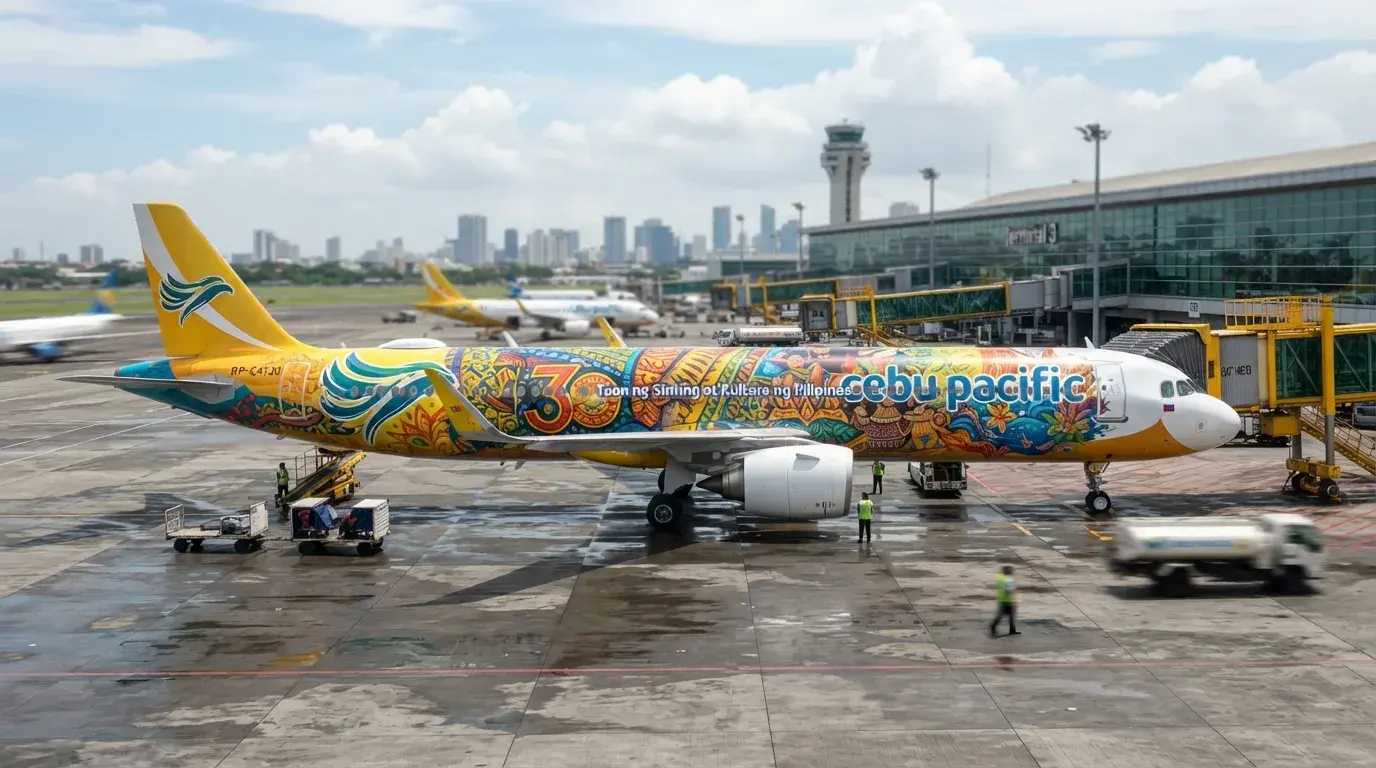
An Airbus A321neo adorned with vibrant murals that tell the soul of the Philippines: this is the surprise Cebu Pacific has in store for passengers to celebrate its 30th anniversary. Arriving from Hamburg on November 8, the aircraft, dubbed the « Dreamer Plane, » immediately trended on social media, propelling the airline to the top of the most-tracked planes on Flightradar24. A world first where local art merges with aviation, far beyond a simple anniversary celebration.
Behind this artistic endeavor lies a bold strategy: celebrating Cebu’s cultural roots while reaffirming its position as an accessible carrier. The « Dreamer Plane » is more than just a decorated aircraft—it’s a showcase of Filipino creativity, signed by the artist duo Johanna Deutsch and Mark Joseph Deutsch, known as Happy Garaje. Their central mural, « Dreamer Girl, » embodies the aspirations of millions of travelers to explore the world, while mangoes, guitars, and puso—rice cooked in coconut leaves—highlight the richness of local traditions. The aircraft made its first commercial rotation between Manila and Cebu on November 11, the same route that saw the airline’s birth in 1996.
For Cebu Pacific, this initiative goes beyond celebration. The choice of local art serves a precise purpose: to remind everyone that the airline exists to provide air transport access to millions of Filipinos, whether they travel abroad for work or discover their own archipelago. Candice Iyog, Director of Marketing, emphasizes this point: « Every candidate for a cabin crew position or every passenger we speak to dreams of travel as a childhood aspiration. This is the promise we carry. » The aircraft thus becomes a symbol of the low-cost model’s ambition: democratizing access to the skies without sacrificing ties to one’s homeland.
A Mural That Tells a Nation and Its Relationship with Aviation
The « Dreamer Girl » is more than just a decorative motif. She represents the young Filipino generation, ready to seize opportunities beyond borders. Surrounding her, blue and green stars symbolize the 53 cities and municipalities of Cebu, while the boy on a bicycle pays tribute to John Gokongwei Jr., the airline’s founder, who sold goods in his youth. The mangoes, for their part, evoke Cebu Province, renowned for its agricultural exports. Even the puso, this traditional rice dish, finds its place on the fuselage, reminding travelers that journeys often begin with familiar flavors.
Happy Garaje also worked on the landing gear, transforming every part of the aircraft into a canvas for cultural expression. For the airline, this artistic collaboration is a way to stand out in a market dominated by generic manufacturer liveries. « We wanted a visual identity that resonates with our passengers, not just decoration to grab attention, » explains Candice Iyog. The result is an Airbus A321neo that catches the eye of travelers at airports and on social media, while embodying Cebu Pacific’s identity.
This initiative is part of a broader fleet renewal strategy. The « Dreamer Plane » is the first in a series of aircraft whose special liveries are expected to multiply in the coming months. With seven deliveries planned for 2027, including a new A330 expected by late 2026, Cebu Pacific is betting on visual innovation to strengthen its brand awareness while modernizing its fleet.
A Business Model That Combines Accessibility and Local Culture
Behind the festive aspect, Cebu Pacific boasts impressive figures: over 26.9 million passengers transported in 2025, with growth expected for 2026. Despite rising fuel costs, the airline maintains its fares and continues to invest in its network, particularly to island destinations like El Nido or Coron. Its ATR turboprops remain essential for serving airports with short runways, while jet aircraft like the A321neo gradually expand the network.
The « Dreamer Plane » illustrates another facet of this strategy: attracting a clientele sensitive to authenticity and art. « We don’t want to be seen as just a low-cost airline, but as a cultural player connecting the Philippines to the world, » emphasizes Candice Iyog. This approach could inspire other Asian carriers, where art and aviation are beginning to intersect, particularly in Indonesia or Thailand.
For passengers, the experience onboard goes beyond travel. At Manila Airport, the aircraft already draws curious onlookers, and social media is flooded with photos of the « Dreamer Plane. » An organic communication strategy that costs less than a traditional ad campaign while forging a strong emotional connection with the brand. Cebu Pacific proves that an airline can balance economic performance, affordability, and cultural engagement.
Cebu Pacific: A Carrier Reinventing Itself Without Denying Its Origins
Founded in 1996 with a single route between Manila and Cebu, the airline has since transported nearly 300 million passengers. Its model is based on low fares and a diverse fleet, blending single-aisle jets and turboprops. The « Dreamer Plane » marks a new step in this evolution: the use of art as a differentiation tool. An initiative that could inspire other industry players, especially in Southeast Asia, where competition among low-cost carriers is intensifying.
With an order book including A321neo and A330 aircraft, Cebu Pacific is preparing for the future. Its goal? To continue making air travel accessible to Filipinos while strengthening its international appeal. The « Dreamer Plane » is just the beginning: more special livery projects are in the works, promising to turn every aircraft into a mobile work of art. A strategy that could redefine the face of low-cost airlines in the years to come.
For travelers, it’s an invitation to see aviation differently: less as a mere means of transport, and more as a cultural experience. Cebu Pacific proves that innovation isn’t limited to engines or cabins—it can also be found in the most visible details of its aircraft.
Be the first to comment on this article
On the same topic
- Paris-Orly to Salerno: easyJet Launches New Low-Cost Route to the Amalfi Coast for €50
- Airbus A330-900: Record 480-Passenger Capacity Set to Disrupt Long-Haul Flights
- Frontier Airlines Hikes Fares by 71%: Fuel Bill or Strategic Shift?
- Transavia expands its Breton network with Seville: how to fly nonstop to Andalusia from Brest
- New York-Tel Aviv for under €200: How this long-haul low-cost flight will revolutionize your getaways
- Pegasus Airlines Acquires Smartwings: Turkish Low-Cost Giant Expands into Central Europe