Emirates Reinvents Aircraft Financing: How Islamic Finance and French Leasing Revolutionize A350 Acquisitions
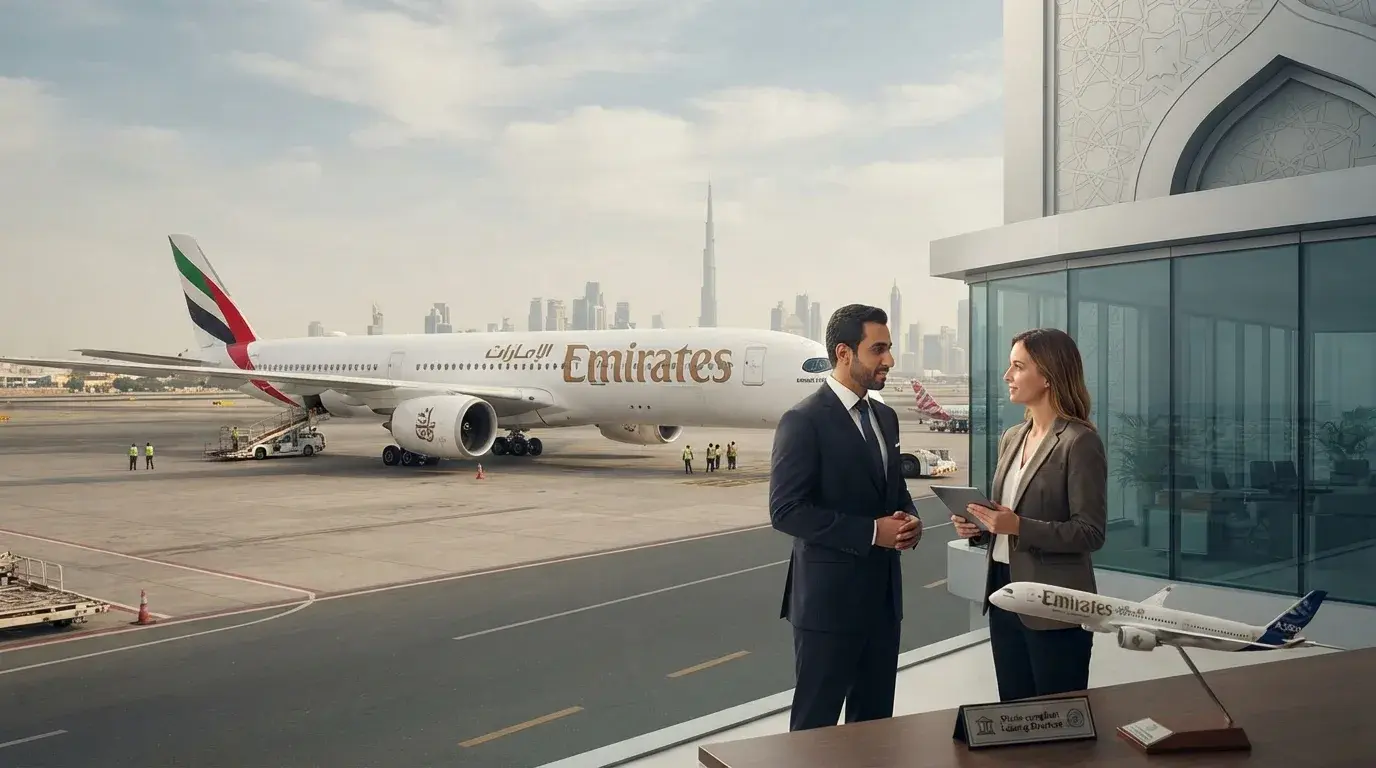
The aviation industry has just witnessed a quiet but major upheaval. Emirates, the Gulf’s aviation giant, has finalized an unprecedented financial deal to acquire two brand-new Airbus A350-900s: a 12-year financing package combining Islamic finance and French leasing. A world first that could redefine the rules for airlines worldwide.
As manufacturers and carriers struggle to secure stable financing amid high interest rates, this alliance between two seemingly opposing financial systems marks a turning point. Emirates, Dubai Islamic Bank, and Natixis Corporate & Investment Banking have joined forces to create a structure that reconciles Sharia compliance and French tax optimization. A bold bet that paves the way for diversifying capital sources for the aeronautical industry.
The agreement goes beyond a simple financial transaction. It’s a growth strategy for Emirates, whose A350 fleet is rapidly expanding. The two aircraft financed through this deal will join the nine A350-900s already delivered between April and September 2026. A progression that underscores the group’s ambition to modernize its fleet—long dominated by Airbus A380s and Boeing 777s—by integrating more recent, fuel-efficient twinjets.
To grasp the significance of this innovation, we must examine the specific constraints of each stakeholder. For Emirates, the goal is clear: access long-term financing by diversifying capital sources beyond traditional bank loans. The Dubai-based carrier is banking on continuous fleet expansion to maintain its long-haul market leadership, despite an uncertain economic environment.
Islamic Finance: An Overlooked Lever for Aviation
Contrary to popular belief, Islamic finance isn’t confined to Gulf countries or local transactions. It represents a global market estimated at over $3 trillion in assets, according to the latest figures from the Islamic Financial Services Board. For airlines, it offers an alternative to conventional financing, with structures compliant with Sharia principles: no interest payments (riba), but profit-and-risk-sharing mechanisms instead.
Dubai Islamic Bank, a key partner in the deal, played a central role in structuring the package. The bank adapted its traditional tools to the specific needs of the aviation sector, particularly regarding guarantees and financing duration. « This transaction reflects the growing sophistication and international relevance of Islamic finance », notes Naveed Ali, Head of Corporate Banking at DIB. A statement that encapsulates the evolution of a sector long seen as marginal, now gaining credibility among global investors.
The deal also incorporates elements of participatory finance, where investors become temporary shareholders in the project. An approach that spreads risk and mobilizes capital without violating religious prohibitions. For Emirates, the dual advantage is securing long-term funds while projecting an image of a responsible company aligned with local values.
The French Lease: A Little-Known Tax Asset
On the French side, Natixis Corporate & Investment Banking brings rare expertise: the French Lease, a specific lease financing structure under French law. Unlike traditional leases, this arrangement allows companies to benefit from significant tax advantages, particularly in deducting lease payments and optimizing cash flow.
Jean Chédeville, Head of Transport Financing at Natixis CIB, explains: « This deal demonstrates our ability to develop tailor-made financing solutions ». The French Lease is particularly well-suited to heavy investments like aircraft, where financing spans multiple years. For Emirates, pairing it with Islamic finance allows bypassing the limits of traditional financing while leveraging a tax-efficient structure.
The operation highlights a broader trend: the globalization of financial tools. Airlines, facing ever-growing capital needs, must now think in terms of sovereign wealth funds, Islamic banks, or emerging markets. This diversification reduces their dependence on Western markets and enables more favorable terms.
A Replicable Model for the Industry?
The success of this deal could inspire other carriers. Emirates and its partners are touting a replicable model for other international aviation financings. The idea? Create hybrid structures capable of mobilizing capital from different financial systems while respecting their respective constraints.
For now, the legal and tax details of the package remain confidential. But several factors suggest this approach could become mainstream. First, demand for A350s and other long-haul aircraft remains strong, particularly in Asia and the Middle East. Second, high interest rates in Western countries make traditional financing less attractive. Finally, Islamic finance is seeking to diversify investments beyond traditional sectors like real estate or energy.
The potential impact could be substantial. Industry estimates suggest that up to 20% of global aviation financing could come from alternative sources by 2030, up from less than 5% today. A shift that would profoundly alter the market’s structure and the balance of power between manufacturers and airlines.
Emirates Bets Big on the A350 to Modernize Its Fleet
Emirates’ choice of the A350 is no coincidence. Since 2024, the carrier has taken delivery of nine of these aircraft, with commercial service beginning in January 2025 on the Dubai-Edinburgh route. The A350-900s are configured with 312 seats, including 32 in business class, 21 in Premium Economy, and 259 in economy. A layout that reflects Emirates’ strategy: offering a premium product while optimizing profitability.
The financing deal for two new aircraft aligns with this dynamic. It enables Emirates to continue fleet renewal without increasing debt, while benefiting from the latest fuel-efficiency innovations. The A350-900 boasts a 25% lower fuel burn than previous-generation aircraft—a major asset amid soaring kerosene prices.
For Airbus, this deal validates the A350’s position as a must-have aircraft for carriers modernizing their fleets. It also strengthens the European manufacturer’s credibility against Boeing, whose programs like the 777X continue to face persistent delays.
Challenges Ahead
Despite the enthusiasm surrounding this innovation, several challenges remain. First, the legal and tax complexity of the deal could deter other carriers, especially those less familiar with Islamic or French financial systems. Second, the 12-year financing term exposes Emirates to risks tied to fuel price fluctuations or economic conditions. Finally, harmonizing practices between different financial systems will take time, particularly for cross-border transactions.
Yet the advantages appear to outweigh the risks. Emirates, already a long-haul market leader, is setting the pace in financial innovation. Its approach could inspire other carriers, particularly in Asia or Africa, where Islamic finance is gaining influence and demand for new aircraft is immense.
In an industry where profitability is often undermined by volatile fuel prices and fierce competition, this deal marks a turning point. It proves that aviation can adapt and innovate, even in the toughest periods. And if this model gains traction, it could reshape aircraft financing for decades to come.
Emirates and its partners have achieved what many thought impossible: creating synergy between two financial worlds that seemed incompatible. An achievement worth celebrating as the aviation industry braces for new challenges—climatic and economic alike.
Be the first to comment on this article
On the same topic
- Heathrow’s Third Runway: UK Regional Airports Demand Guaranteed Slots Before 2027
- Air India Bets Big on Wide-Bodies to Revive International Network and Challenge Boeing & Airbus
- US Mandates Mandatory Health Declaration for Air Travelers from DRC: What You Need to Know Before Departing
- Qatar Airways revolutionizes mid-haul travel with A321LR: 16 convertible business suites by 2027
- Etihad revolutionizes Europe-Asia travel with First Class suites on narrowbody from Luxembourg
- Air China bypasses Cuba's jet fuel shortage with Bahamas detour