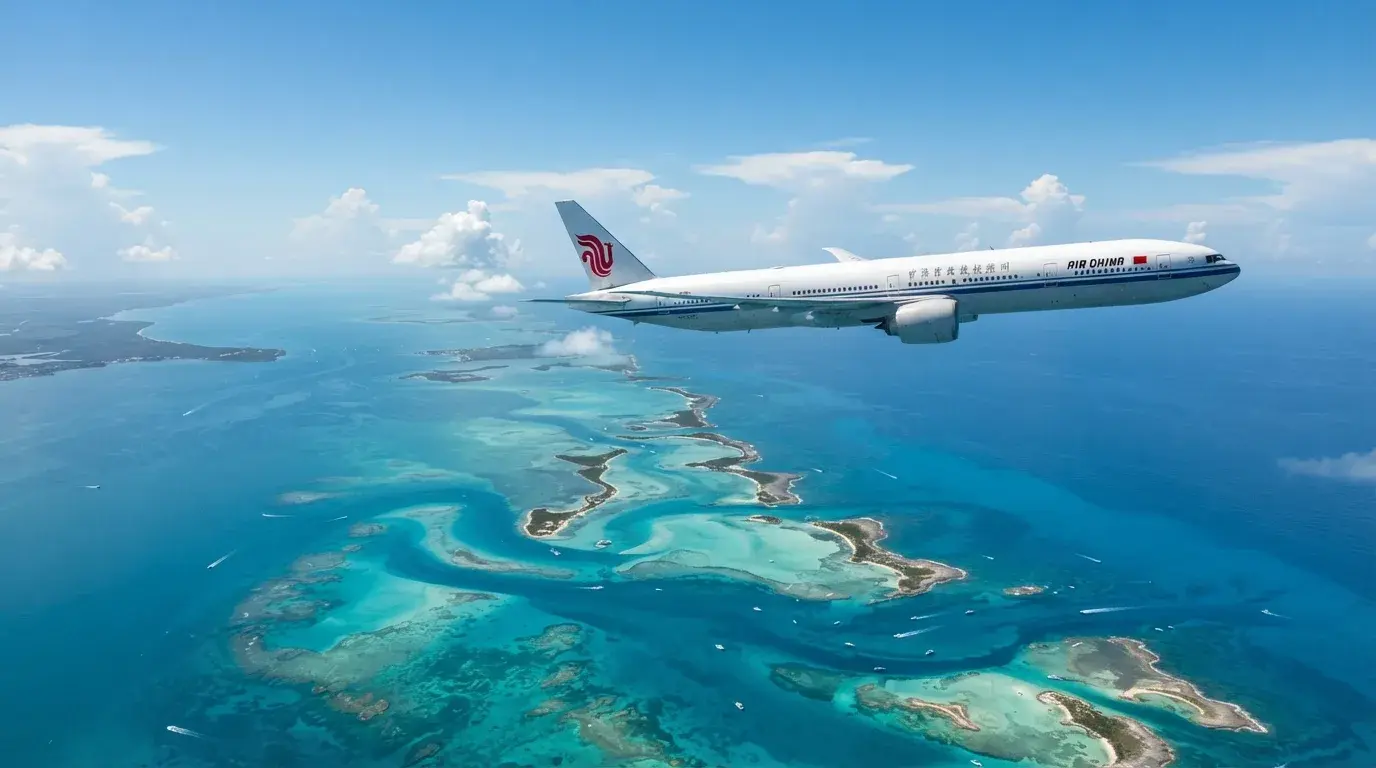
The fuel crisis gripping Cuba for months has forced airlines to rethink their strategies. Air China had to organize an exceptional flight departing from Havana to evacuate stranded passengers following repeated cancellations of its Madrid and Beijing routes. A technical stopover in Nassau, Bahamas, became the solution to bypass the unavailability of jet fuel on the island. This detour illustrates the logistical challenges faced by carriers operating in the Caribbean, where infrastructure and supply chains remain fragile.
Flight CA590, operated by a Boeing 787-9 Dreamliner, departed from Havana on Monday, October 19, at 10:33 PM, with a stopover in Nassau before heading to Madrid and then Beijing. According to data from Flightradar24, the aircraft landed in Nassau at 11:25 PM, before departing for Madrid at 1:43 AM the following day. A last-resort operation for dozens of passengers whose tickets had been canceled before October 10, without clear explanations from Air China or Chinese authorities.
This detour via the Bahamas is not unprecedented. As early as March 2026, Air China had already introduced a technical stopover in Nassau on the Havana-Madrid route to allow refueling, due to the unavailability of jet fuel in Cuba. The shortage of Jet A-1, exacerbated by infrastructure issues and geopolitical tensions, has transformed a normally direct transatlantic route into a two-stop journey. A scenario that echoes the difficulties faced by other airlines such as Air France, which suspended its Paris-Havana line after attempting to maintain a stopover in the Bahamas.
Fifth-freedom rights strain the Havana-Madrid-Beijing route
The Beijing-Madrid-Havana route, relaunched in May 2024, was designed to transport passengers between Spain and Cuba using "fifth-freedom" rights. This regulation allows an airline to market a segment between two foreign countries as an extension of a route to its home country. An economic advantage for Air China, which has attracted Cuban customers living in Europe, drawn by fares often more affordable than those offered by Air Europa.
However, testimonies collected by the South China Morning Post reveal major malfunctions: waits exceeding fifteen hours in Madrid, a severe lack of information for travelers, and recurring difficulties in obtaining refunds or compensation. These issues weigh heavily on the image of the Chinese airline, despite its efforts to maintain a presence in a crisis-stricken market.
Among the affected passengers, some told the South China Morning Post that Air China staff in Madrid had cited "works on a runway in Nassau" to justify the cancellations. The manager of Lynden Pindling International Airport confirmed the renovation of Runway 14/32, a project launched in August and due to be completed on October 31. While the partial closure of this infrastructure may have temporarily disrupted operations, it does not fully explain Air China’s issues. A capacity study had concluded that sufficient activity could be maintained, leaving room for doubt about other, possibly structural causes.
Cuba: a declining aviation hub
The jet fuel shortage in Cuba is not a recent issue. For years, the island has become increasingly dependent on fuel imports, a situation exacerbated by the U.S. embargo and international sanctions. Several foreign airlines have already reduced or suspended their routes: Air Canada, Air France, Iberia, and Turkish Airlines have all left the Cuban market, leaving Air China as one of the last foreign carriers maintaining a regular route to Havana.
To overcome these challenges, airlines must either carry extra fuel at takeoff or plan refueling in a neighboring country. A costly solution that extends travel times and complicates logistics. Air France had attempted to maintain its Paris-Havana line with a technical stopover in the Bahamas before giving up in March 2026. A decision that reflects the scale of the crisis and the difficulty in guaranteeing flight regularity under these conditions.
Despite these challenges, Air China continues to play a key role in connecting Cuba to the rest of the world. Its flights, though disrupted, remain a lifeline for travelers stranded on the island. A situation that underscores how critical stable jet fuel supply has become for global aviation, especially in regions with fragile infrastructure.
An uncertain future for Cuban routes
The detour via Nassau is a temporary solution, but it does not address the root cause: Cuba’s jet fuel supply. Ongoing works at Nassau’s airport could, in the long term, facilitate technical stopovers, but they will not guarantee lasting stability. The island’s dependence on imports and persistent geopolitical tensions offer little hope for rapid improvement.
For Air China, this crisis is also an opportunity to strengthen its influence on the Havana-Madrid-Beijing route, a strategic axis for serving Cuban communities in Europe. However, the airline will face increased competition, particularly from Latin American carriers that could capitalize on Air China’s weaknesses to capture part of the market.
In the meantime, Cuban and Spanish passengers will have to contend with persistent uncertainties. The coming months will be decisive in determining whether Air China can maintain its route or if it, too, will have to suspend flights due to fuel shortages and unreliable infrastructure.
To follow the evolution of this situation and discover other analyses on the challenges facing global aviation, stay connected with Flywest.
Be the first to comment on this article
On the same topic
- Boeing 737 MAX 10 Certification Nears: A Milestone for Global Aviation
- Airbus A350-2000 and A220-500: End of Twin-Aisle Monopoly?
- Emirates reinvents its fleet: Why the 777X could replace 35 Dreamliners
- JetBlue Acquires Spirit Airlines' Slots at New York LaGuardia: What It Means for Your 2027 Flights
- Biman Bangladesh Airlines bets on Airbus to conquer Europe and North America with A350 and A321neo
- Air Freight: Why This 4.4% Surge in August 2026 Will Drive Up Delivery Prices