Why Chinese Airlines Keep Reporting Losses Despite Record Air Travel in 2026
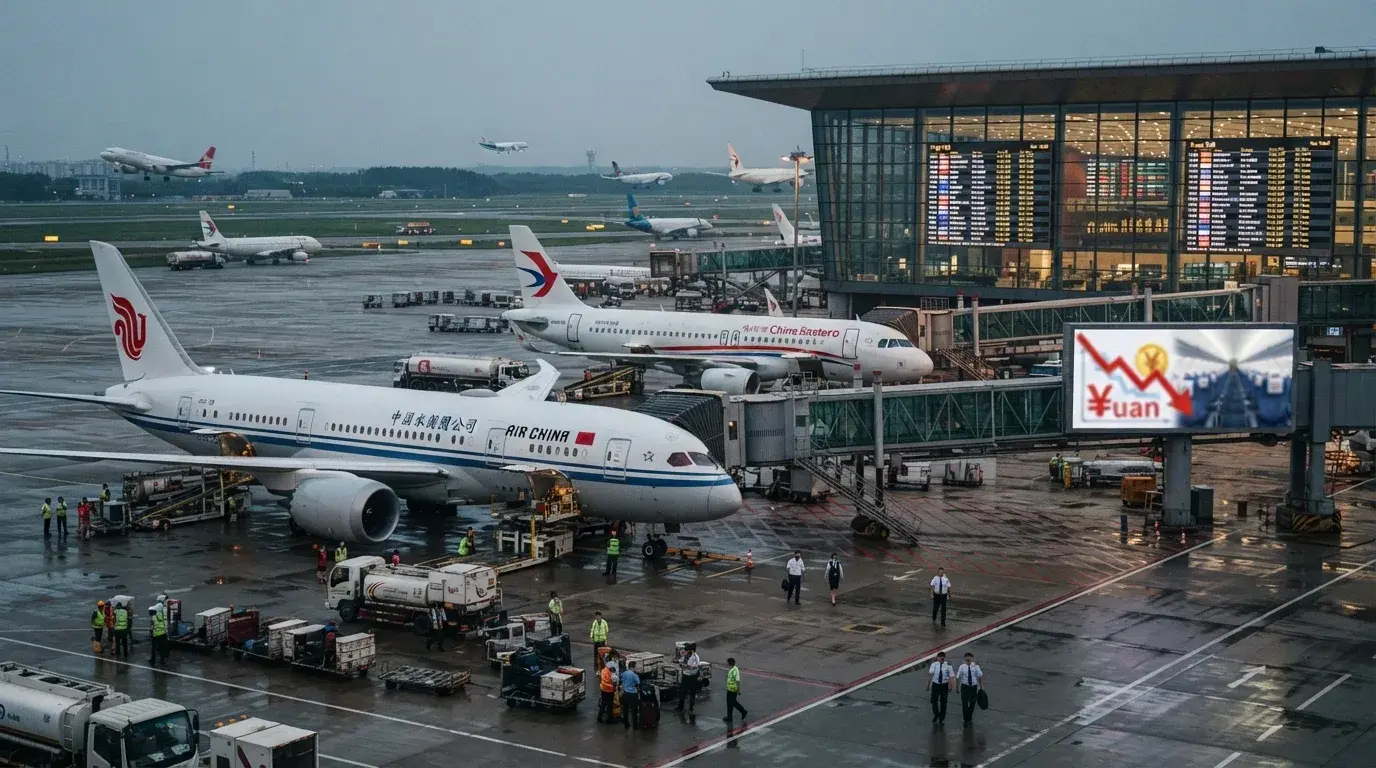
With over 770 million passengers carried in 2025 and a commercial airport network spanning 270 airports, China boasts the world’s largest aviation market—one that is unmatched in scale. Yet the country’s three major carriers—Air China, China Eastern Airlines, and China Southern Airlines—are struggling to translate this volume into profitability. Their third-quarter 2026 results confirm a troubling trend: Air China and China Eastern are on track to report their seventh consecutive annual net loss since the pandemic, while China Southern, which briefly returned to profitability in 2025, has slipped back into the red. Behind these figures lie structural challenges that raise serious questions about the future of China’s aviation sector.
The surge in kerosene costs since early 2026 is weighing heavily on the airlines’ balance sheets. Jet fuel prices have more than doubled compared to pre-COVID levels, and unlike their Asian or European counterparts, Chinese carriers make minimal use of financial hedging to mitigate exposure. The result? A 5% fluctuation in fuel prices can translate into a nearly ¥2.6 billion (€347 million) swing in costs for China Southern. China Eastern, for its part, saw its net profit plummet by 98.2% year-over-year, dropping from ¥4.6 billion to just ¥64 million (€8.6 million) in Q3 2026. These figures underscore the severity of the shock: carrying more passengers is no longer enough to offset soaring expenses.
The problem isn’t limited to costs—revenues are also under pressure. On domestic routes, Chinese airlines are struggling to raise fares amid fierce competition and sluggish demand. Passenger unit revenue, which measures average revenue per passenger per kilometer, fell by about 5% for Air China in Q3 2026. This decline means each flight generates less revenue per passenger, even as costs spiral upward. The situation is exacerbated by competition from high-speed rail, which offers a practical and often cheaper alternative on many routes. For example, a Beijing-Shanghai flight costs around ¥1,000 (€134), compared to ¥553 (€74) by high-speed train. Airlines have little choice but to keep prices low to stay competitive, further eroding their margins.
Climate disruptions, such as the typhoons that struck southern China in Q3 2026, have also disrupted operations and added to the financial burden. But the core challenge remains structural: how can China reconcile the sheer scale of its aviation market with sustainable profitability? Chinese airlines carry more passengers than all European carriers combined, yet their margins remain among the lowest in the industry. Analysts at BofA Global Research warn that Chinese carriers’ margins are "under extreme pressure due to soaring kerosene prices and weak consumption."
In response, airlines are attempting to adapt. China Southern, which returned to profitability in 2025, is focusing on better aircraft utilization to spread fixed costs over more flight hours. But these efficiency gains are insufficient to offset such a sharp rise in costs. Air China, meanwhile, is targeting business travelers—a more lucrative segment—to boost revenue through premium services. Yet even these efforts have struggled to reverse the trend.
A domestic market under strain
Despite its size, China’s aviation market remains fragile. Airlines face multiple simultaneous challenges. First, demographics: an aging population and declining birth rates are naturally reducing travel demand. Second, shifting consumer behavior: business travel, traditionally a key revenue driver, is in decline, while leisure travel—more price-sensitive—has yet to take off. Third, competition from other transport modes, particularly high-speed rail, limits airlines’ ability to raise fares.
The numbers speak for themselves: in 2025, Chinese airlines carried 770 million passengers, but only 10% of these were international. The rest were domestic routes, where price pressure is most intense. Even on these routes, airlines struggle to achieve profitability. According to Huatai Securities, cited by Reuters, Air China’s passenger unit revenue fell by 5% in Q3 2026, confirming that volume growth alone cannot offset declining unit revenues.
Chinese airlines are also investing heavily in fleet modernization and infrastructure upgrades to modernize their networks. The environmental transition, digitalization, and improved onboard comfort come with additional costs that weigh on their bottom lines. For example, domestically produced aircraft like the ARJ21 or C919 are more expensive than foreign models and require significant investments in crew training and maintenance.
Regulatory constraints also work against the airlines. While restrictions on investments in regional carriers were relaxed in May 2026, national carriers remain subject to strict pricing and capacity rules. China’s Ministry of Transport has attempted to support the sector by allowing capacity adjustments, but these measures have proven insufficient to restore profitability.
Kerosene: the airlines’ biggest enemy
Fuel costs are the primary driver of Chinese airlines’ financial difficulties. Since early 2026, jet fuel prices have surged, partly due to geopolitical tensions in Asia and restrictions on overflight rights over Russian airspace. Unlike their European or American counterparts, Chinese carriers make little use of financial hedging to protect against price fluctuations. This leaves them directly exposed to market volatility. According to DBS, a 5% increase in jet fuel prices could add ¥2.5 billion (€334 million) to Air China’s fuel bill and ¥2.6 billion (€347 million) to China Southern’s. This exposure is particularly problematic because airlines cannot fully pass these costs on to passengers. Intense competition and price-sensitive consumers limit their pricing power, forcing them to absorb much of the increase—directly impacting their results. China Southern, for example, reported a net loss of ¥609 million (€81 million) in Q3 2026, down from a profit of ¥3.8 billion (€513 million) a year earlier.
To mitigate the impact of fuel costs, airlines are optimizing operations by increasing aircraft utilization to spread fixed costs over more flight hours. However, these efficiency gains are not enough to offset such a sharp rise in expenses. Without a significant drop in kerosene prices or an improvement in revenues, Chinese airlines are likely to remain in the red for the foreseeable future.
International expansion: a potential lifeline?
Facing stagnation in the domestic market, Chinese airlines are betting on international expansion to restore profitability. With a network connecting 147 cities in 65 countries, the potential is vast. Yet this gamble is far from a sure bet. China remains an emerging player in international aviation, and its carriers struggle to compete with U.S., European, or Middle Eastern giants in terms of service, connectivity, and brand recognition.
2026 results confirm this difficulty. Despite a post-pandemic recovery in international travel, Chinese airlines have failed to capture a significant share of the global market. International traffic still accounts for only a small fraction of their operations, and margins on these routes are often thin or even negative. For example, routes between China and Europe or North America are highly competitive, with fares often lower than those offered by European or American carriers.
Chinese airlines are attempting to differentiate themselves through strategic partnerships. Air China has signed code-sharing agreements with several international carriers, while China Southern is developing its Guangzhou hub to attract more transit passengers. But these efforts are insufficient to offset weak demand and high costs. According to Nathan Gee, head of Asia-Pacific transport research at BofA Global Research, "Chinese airlines are expected to remain in net loss in Q4 2026 due to the impact of soaring kerosene prices."
International expansion also requires massive investments in new aircraft. Chinese airlines are ordering domestically produced planes like the ARJ21 or C919, but their deployment is slow. In the meantime, they must contend with aging fleets that are more expensive to maintain and operate. High costs limit their ability to attract international passengers, who are typically more lucrative than domestic travelers.
Geopolitical barriers also pose challenges. Restrictions on overflight rights over Russian airspace, due to the war in Ukraine, complicate routes between Asia and Europe or North America. These detours increase costs and reduce the competitiveness of Chinese carriers on these routes.
What does the future hold for Chinese airlines?
Forecasts for 2026 and 2027 are pessimistic. Analysts expect Air China, China Eastern, and China Southern to report net losses for several more quarters. The only glimmer of hope comes from a slight recovery in domestic fares after the October Golden Week holidays, but this is insufficient to offset rising costs. According to Nathan Gee, "Chinese airlines’ margins remain under extreme pressure due to soaring kerosene prices and weak consumption."
To break out of this impasse, Chinese airlines will need to adopt a multi-pronged strategy. First, they must improve operational efficiency to reduce costs—through better fleet management, optimized schedules, and reduced aircraft downtime. Second, they must boost revenues by developing higher-value services, such as premium economy and business class, and targeting business travelers and cargo. Finally, they must strengthen their position in the international market by developing more attractive hubs—like Guangzhou for China Southern—and forging strategic partnerships with foreign carriers. But these efforts will take time and require massive investments at a time when airlines are already under financial strain.
In the meantime, passengers and investors must brace for turbulence. Chinese airlines remain major players in global aviation, but their profitability is more threatened than ever by a combination of rising costs, weak demand, and fierce competition. Their ability to overcome these challenges will determine not only their own future but also the evolution of Asia’s aviation sector.
For travelers, these difficulties could translate into limited flight options or higher fares, particularly on domestic routes. For the airlines, the risk is an increased reliance on government subsidies—a solution that is neither sustainable nor healthy for the sector. One thing is certain: despite its size, China’s aviation giant has yet to find the key to balancing growth and profitability.
How to travel in China without bearing the brunt of rising costs
With air travel costs soaring in China, travelers have several options to mitigate the impact on their budgets. First, book in advance: fares tend to drop during periods of low demand, such as outside school holidays or national festivals. Second, consider alternatives to air travel. High-speed rail, despite longer travel times, remains an economical and comfortable option for routes between major cities like Beijing, Shanghai, or Guangzhou. Finally, monitor airline promotions, which frequently offer discounts on domestic flights, especially on less popular routes.
For international travelers, the challenge is different. Chinese airlines offer attractive fares on some routes, but it’s wise to compare these with offers from European or Middle Eastern carriers, which are often more competitive. Airports like Shanghai-Pudong, Beijing-Daxing, and Guangzhou-Baiyun remain the best-connected hubs for international connections to Europe, North America, and Southeast Asia.
In summary, traveling in China in 2026–2027 requires careful planning and flexibility. Travelers will need to anticipate their trips and explore all available options to avoid the surcharges linked to the current state of China’s aviation market.
Be the first to comment on this article
On the same topic
- Frontier Airlines Hikes Fares by 71%: Fuel Bill or Strategic Shift?
- Ryanair Slashes Winter Frequencies to Counter Soaring Fuel Costs—Here’s How It Affects Your Travels
- Ryanair snubs France in 29 new 2027 routes: UK regional airports and Morocco take center stage
- LATAM Airlines Brazil Bets on Embraer E195-E2 to Revolutionize Domestic Air Travel
- How Delta Air Lines’ refinery strategy is reshaping airline fuel costs and ticket prices
- Fuel surcharges on already-purchased tickets: What Brussels really prohibits airlines from doing