KLM cuts 1,000 jobs and switches to Embraer E195-E2: What this means for your travel
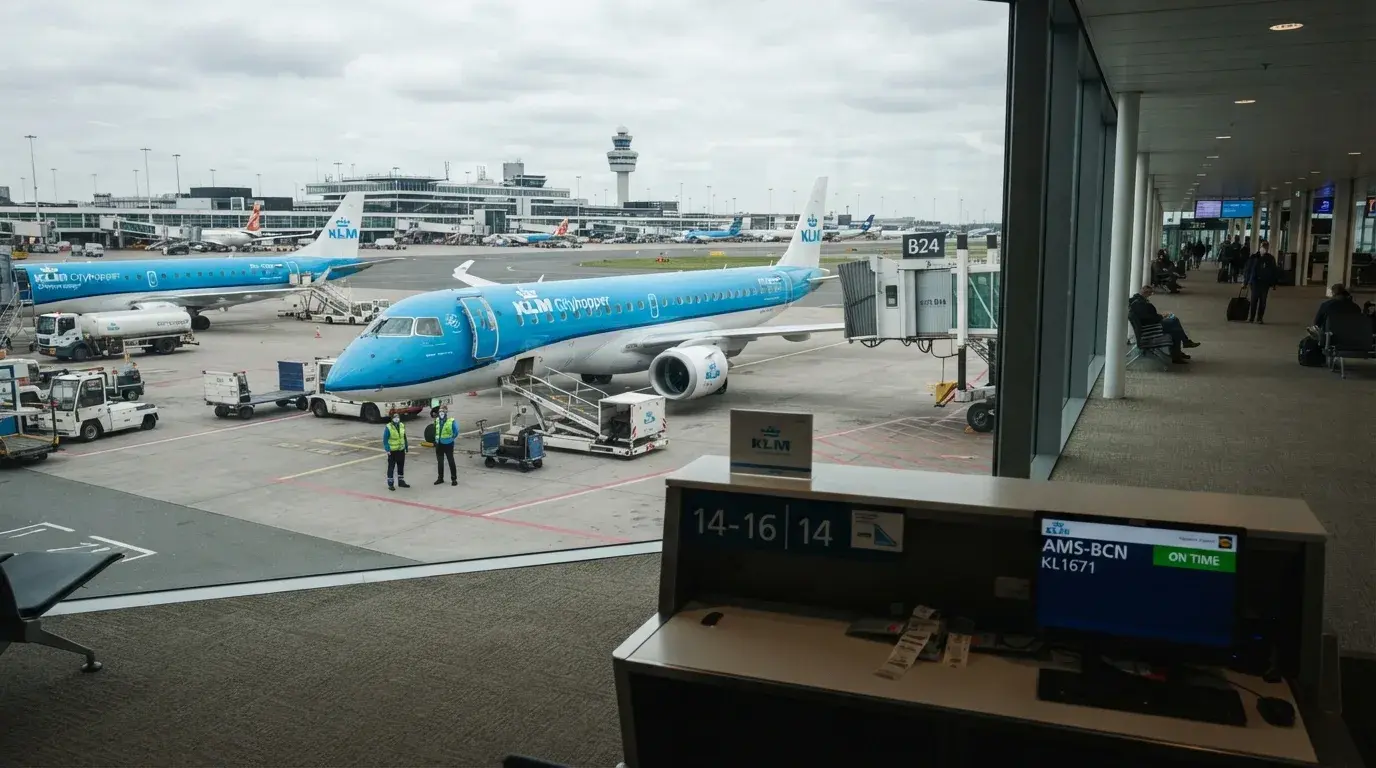
The Dutch group Air France-KLM has just launched one of the most ambitious restructuring plans in its recent history. With an announcement made in early November 2026, KLM will eliminate nearly 1,000 positions over the next two years while deeply reorganizing its European network around a new aircraft: the Embraer E195-E2. A decision with major consequences for travelers, affecting prices, frequency, and comfort on short-haul flights departing from Amsterdam.
This reorganization comes in a context where KLM reported an adjusted operating profit increase of €106 million in Q3 2026, yet its margin remains below its ambitions. The airline, which carried nearly 9.7 million passengers in the first nine months of the year (+4% year-on-year), is seeking to improve its competitiveness against rivals like Ryanair and EasyJet. To achieve this, it is banking on a lighter, more flexible fleet better suited to high-demand markets.
French travelers will be directly affected, as KLM operates numerous routes between its European hubs and French cities like Paris, Lyon, and Nice. The question arises: should we expect fare hikes, reduced frequencies, or improved services? The answer will depend on how KLM balances cost-cutting goals with the need to maintain an attractive offering for passengers. One thing is certain: this restructuring could reshape the short-haul air transport landscape in Europe.
Restructuring extends far beyond job cuts
Contrary to what some headlines might suggest, the 1,000 positions affected by KLM's restructuring do not mean 1,000 jobs will simply be eliminated. In reality, KLM will use multiple levers to achieve its goal of reducing its total workforce by nearly 15% within its scope.
First, outsourcing certain activities will play a key role. Around 1,250 jobs within KLM Catering Services have already been handled by external partners since spring 2026. At the same time, nearly 800 ground services positions will be entrusted to specialized providers. These two measures alone account for over 2,000 jobs no longer directly managed by KLM.
Next, around 2,000 positions will be transferred within the Air France-KLM group. Of these, 1,500 jobs will be integrated into the Cygnific customer service center, which handles passenger interactions. Finally, productivity gains are expected to allow KLM to eliminate an additional 1,000 positions. Not all of these cuts will be forced: the airline is relying on natural departures and internal mobility schemes to minimize social impact.
However, KLM does not rule out forced departures. Marjan Rintel, CEO of the airline, acknowledged that this reorganization would be “painful” for some employees, particularly those whose roles are outsourced or transferred. Dialogue with unions is already underway to mitigate social consequences.
The Embraer E195-E2 becomes the new flagship of KLM’s European network
The most visible aspect of this restructuring concerns the fleet. Until now, KLM relied on a mix of Airbus A320neo aircraft and others to serve its European routes. Under this new plan, the airline will gradually replace its A320s with Embraer E195-E2s, smaller aircraft offering better profitability on low-density routes.
The E195-E2 can accommodate up to 146 passengers in a two-class configuration, compared to 180 for an A320. But its advantage lies elsewhere: it is designed to operate on less frequented routes with reduced operating costs. KLM aims to fine-tune seat supply to match demand while maintaining high frequency on the most profitable routes.
The airline will also gradually phase out its Boeing 737s and Embraer E190s, which will be replaced by the new Brazilian aircraft. KLM Cityhopper, its regional subsidiary, will play an increased role in this new setup. The dual goal is to reduce operating costs and improve the profitability of European routes.
For travelers, this could mean improved punctuality on certain secondary routes or more competitive fares on less in-demand routes. Conversely, on the busiest routes, such as Paris-Amsterdam, frequencies may be maintained or slightly increased, but with capacity adjusted to actual demand.
What does this mean for French travelers?
If you frequently fly between France and the Netherlands, this restructuring could change your travel experience. Here’s what you can expect in the coming months.
First, fares could become more attractive on certain routes. The use of an aircraft like the E195-E2, which is less fuel-intensive and has lower maintenance costs, allows KLM to offer more competitive prices. This could be particularly true on less frequented routes like Lyon-Amsterdam or Bordeaux-Amsterdam, where demand is lower.
Second, frequencies may be adjusted. KLM has indicated it will maintain an attractive offering on its most profitable routes, such as Paris-Amsterdam or Nice-Amsterdam. However, on less in-demand routes, some frequencies may be reduced or replaced by flights operated by KLM Cityhopper using the E195-E2. These smaller aircraft allow for better matching of supply to demand.
Finally, onboard comfort may evolve. The E195-E2 features a two-class configuration, with Business and Economy classes. KLM's Business Class is renowned for its comfort, with wide seats and attentive service. In Economy, legroom will be slightly greater than on a Boeing 737 or A320, but passengers will need to adapt to a higher seat density.
For frequent flyers, KLM will also revamp its loyalty program, Flying Blue. Members may benefit from new perks, particularly on flights operated by KLM Cityhopper with the E195-E2. Partnerships with other Air France-KLM group airlines like Transavia may be strengthened to offer more flexible travel options.
A restructuring in a broader context
KLM's restructuring should not be viewed in isolation. It is part of a larger trend of cost rationalization within the Air France-KLM group. The group has already implemented a cost-reduction program, Back on Track, which has generated over €750 million in structural savings since 2024.
Yet despite these measures, the group is struggling to meet its profitability targets. KLM's adjusted operating margin remains below the group’s ambition of over 8%. Rising fuel costs, expected to reach $9.2 billion in 2026, are weighing heavily on results. Additionally, increased competition in the European market, including the arrival of new airlines like Norwegian or Play, is forcing the group to rethink its strategy.
In this context, KLM's restructuring is a high-risk gamble. While it may help the airline reduce costs and improve competitiveness, it could also weaken its network and lose market share to more agile competitors. For travelers, this means the offering could become more volatile in the coming months, with frequent adjustments to frequencies and fares.
It is advisable to book tickets in advance, especially if traveling during peak periods like school holidays or year-end festivities. KLM has already indicated that adjustments may be necessary based on market developments.
What travelers need to know before booking
If you plan to fly with KLM in the coming months, here are the key points to keep in mind to avoid surprises.
First, check the aircraft operating your flight. Since the start of the 2026-2027 winter season, KLM has begun deploying the Embraer E195-E2 on certain routes. If you book a flight between Paris and Amsterdam, you may find yourself boarding an E195-E2 instead of a classic A321neo. This could impact your travel experience, particularly in terms of space and comfort.
Second, pay attention to schedules. KLM may adjust frequencies on certain routes, especially those with seasonal demand. If you are used to taking a flight at a specific time, that schedule may be changed or removed. Regularly check the airline’s website for updates on potential changes.
Third, if you are a Flying Blue member, take advantage of the benefits before they change. KLM plans to revamp its loyalty program as part of this restructuring. Members may benefit from new perks, but some privileges could be reduced or replaced.
Finally, if you are traveling in Business Class, rest assured that KLM maintains a high-quality offering on its new aircraft. The Business Class cabin on the E195-E2 features lie-flat seats and on-demand dining. In Economy, legroom will be slightly greater than on a Boeing 737, but passengers will need to adapt to a higher seat density.
In conclusion, KLM's restructuring marks a turning point for the Dutch airline. While it may help KLM reduce costs and adapt to a rapidly changing market, it could also profoundly alter the traveler experience. One thing is certain: it’s time to closely monitor the airline’s announcements to anticipate changes and book your tickets accordingly.
Be the first to comment on this article
On the same topic
- LATAM Airlines Brazil Bets on Embraer E195-E2 to Revolutionize Domestic Air Travel
- LATAM Doubles Fleet with 11 New Aircraft Financed 80% Under Green Criteria
- Azul restores all Embraer E195-E2s to service: end of Brazil’s recurring engine issues
- Embraer Smashes Financial Records: How the E2 Family Will Reshape Your Future Flights in 2026
- British Airways and Porter Airlines: The Winning Duo for Exploring Canada Nonstop
- Embraer E195-E2 Surpasses 500 Orders: Why This Regional Jet Captivates Airlines Worldwide