How Delta Air Lines’ refinery strategy is reshaping airline fuel costs and ticket prices
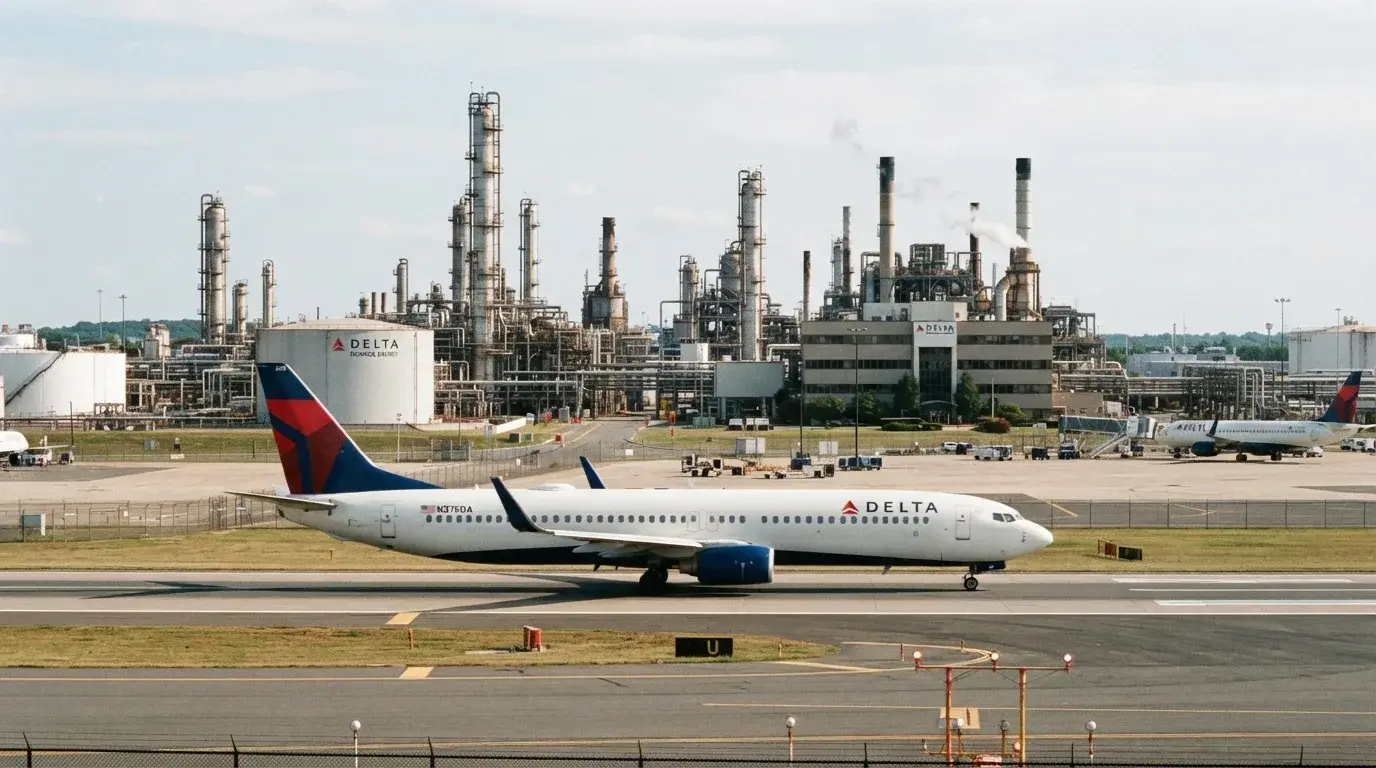
When discussing airlines, terms like fuel, costs, and margins dominate analyses. Yet behind these figures lies a lesser-known reality: a select few carriers have chosen energy independence over market volatility. Delta Air Lines made this bold move in 2012 by acquiring a refinery in Pennsylvania. Over a decade later, this high-risk strategy is finally bearing fruit. With record-breaking Q2 2026 results, the Trainer refinery is no longer just an industrial asset—it’s a strategic lever in an industry where even minor cost savings directly impact ticket prices.
For passengers, this mastery of energy costs could mark a turning point in flight pricing. By containing the surge in jet fuel prices—the largest expense for airlines—Delta gains a rare competitive edge in an industry plagued by geopolitical crises and oil market volatility.
But how did an airline come to own a refinery? And what does this mean for travelers in 2026? Here’s what you need to know about this one-of-a-kind industrial strategy.
A counter-trend industrial gamble in aviation
In 2012, when Delta Air Lines announced the acquisition of the Trainer refinery near Philadelphia, the aviation sector was baffled. At the time, no major airline owned such an industrial asset. The deal, executed via subsidiary Monroe Energy, was driven by a clear goal: cut fuel costs, which accounted for over 30% of Delta’s operational expenses. As the company’s official statement noted, the acquisition included strategic agreements with BP and Phillips 66, along with privileged access to logistics infrastructure supplying New York hubs (JFK and LaGuardia).
For nearly a decade, however, results were modest. Analysts calculated that the refinery generated just $108 million in cumulative operational profit over its first ten years—a disappointing return that led some observers to question the strategy’s validity.
But everything changed in 2022 with Russia’s invasion of Ukraine and the subsequent energy price surge. That year, the refinery posted $777 million in profits, marking a dramatic reversal. More recently, tensions in the Middle East and disruptions to maritime traffic around the Strait of Hormuz have further strained oil markets. The result? Refining margins—the gap between crude prices and refined products like jet fuel—have widened significantly. And it’s this very lever that Delta’s strategy relies on.
Record-breaking 2026 results: how the refinery became a master asset
In Q2 2026, the Trainer refinery achieved unprecedented performance. With $2.09 billion in revenue (+83% year-over-year), $351 million in operational profit, and a 13.4% margin—a historic high—the Delta subsidiary outperformed most airlines. For context, the facility reported a $10 million loss in Q2 2025.
These results are even more remarkable given a temporary production halt in June 2026 due to a major fire. This underscores the refinery’s resilience and its critical role in Delta’s operations.
The refinery produces roughly 200,000 barrels per day, covering nearly 75% of Delta’s fuel needs, either directly or through refined product exchanges. Surplus production of non-aviation fuels is sold to third parties or traded with other refineries to secure additional jet fuel. This vertical integration model remains unique among major airlines, which typically opt for hedging strategies over industrial investments.
For passengers, this energy cost control could translate into greater fare stability or even moderated price hikes. In an industry where airlines systematically pass fuel cost increases to ticket prices, Delta’s ability to produce some of its own jet fuel gives it a decisive competitive advantage.
A powerful model… but not without risks
Delta’s experience also highlights the strategy’s limitations. When refining margins contract, the asset can become a liability. The most striking example is 2020, when pandemic-driven air traffic collapse and fuel price drops led to a $216 million operational loss—the refinery’s worst performance since acquisition. Analysts emphasize that Delta’s advantage is heavily dependent on global energy market conditions.
Another concern is geopolitical exposure. Middle Eastern tensions, international sanctions, or health crises can disrupt crude supplies or refining capacity at any time. While Delta has secured some supply chains, it remains vulnerable to market volatility.
Additionally, this model demands heavy investment and complex industrial management. Unlike a traditional airline, Delta must navigate technical, logistical, and regulatory challenges specific to the oil industry—a significant burden in an already hyper-competitive sector.
Despite these risks, Delta’s strategy is starting to inspire imitators. Other carriers, like Emirates, have recently announced investments in energy infrastructure to secure fuel supplies—a trend that may accelerate as airlines seek protection against energy shocks.
Concrete impacts for travelers
If Delta sustains its industrial performance, passengers could see several benefits:
• Greater fare stability. Less reliant on oil market fluctuations, Delta could limit ticket price hikes or even offer more aggressive promotions on certain routes.
• Increased investment in customer experience. With more stable margins, the airline could allocate more resources to in-flight services, loyalty programs, or technological innovations.
• Enhanced resilience to crises. In the event of another energy or geopolitical crisis, Delta would be better equipped than competitors to absorb shocks and maintain stable operations.
For travelers, this energy strategy could prove transformative in the medium term. Whether other airlines follow Delta’s lead—and whether vertical integration becomes the new norm in aviation—remains to be seen.
The future: aviation in the energy revolution
Beyond Delta’s case, the question of airline energy autonomy is taking on new urgency amid accelerating ecological transition. Airlines face dual pressure: reducing carbon footprints while securing fuel supplies amid geopolitical tensions and resource scarcity.
Several solutions are being explored:
• Sustainable aviation fuels (SAF). Many airlines are investing in biofuels or synthetic fuels to reduce dependence on traditional jet fuel. However, these solutions remain costly, and large-scale availability is still limited.
• Partial electrification. For short-haul flights, projects for electric or hybrid aircraft are emerging, such as Airbus’ CityAirbus concept or Heart Aerospace’s initiatives. But these technologies are not yet mature enough for widespread commercial use.
• Diversifying energy sources. Some airlines are exploring hydrogen or ammonia for long-haul flights, though this requires major adaptations to airport infrastructure and fleets.
In this context, Delta’s model—combining energy autonomy with vertical integration—could inspire others. But it also raises ethical and environmental questions: Should an airline own a refinery, risking involvement in debates over ecological transition and corporate responsibility?
For now, Delta appears to have cracked the code. But the future will determine whether this strategy can be replicated at scale or remains confined to a handful of carriers willing to take major industrial risks.
One thing is certain: For passengers, this mastery of energy costs could change the game. With potentially more stable fares and greater resilience to crises, Delta may set a new standard in a rapidly evolving industry.
Keep a close eye on this story in the coming months and years.
Be the first to comment on this article
On the same topic
- Athens emerges as the new US gateway to Greece: Why this hub is winning over travelers
- Tel Aviv: Direct North American Flights Return in 2026 – What It Means for Travel
- Delta-Aeromexico Alliance Saved at the Last Minute: How This Legal Victory Changes Your US Flights
- The Grand Return of First Class in the Skies
- Rising Fuel Costs: Delta Air Lines Posts Loss, Cuts Capacity, and Raises Fares