Athens emerges as the new US gateway to Greece: Why this hub is winning over travelers
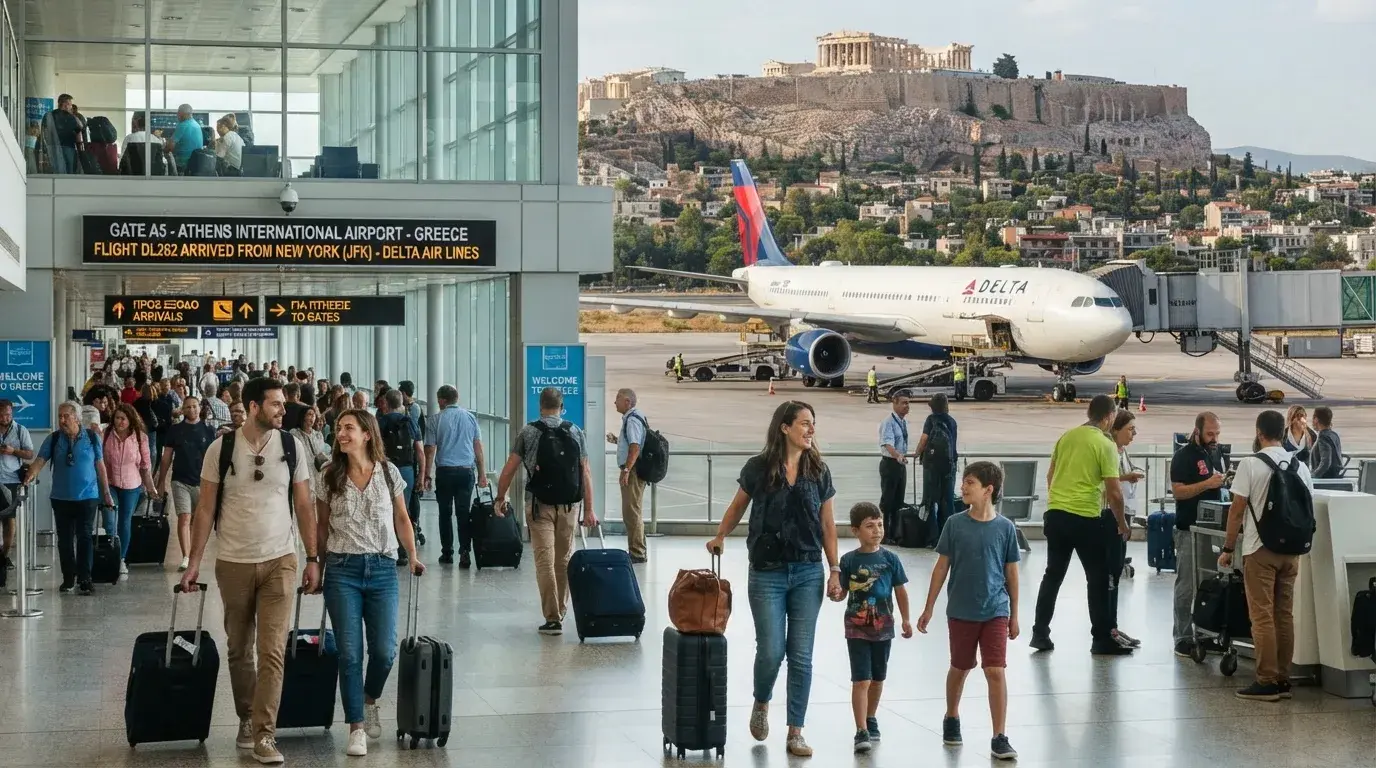
Nearly 700,000 American travelers passed through Athens International Airport Elefthérios Venizélos between January and July 2026, up 6% year-on-year. This figure underscores a broader trend: Greece’s capital has firmly established itself as the primary US gateway to Greece, capturing the bulk of nonstop flights between the two countries before onward travel to the Cyclades or Crete. This evolution extends beyond tourism, reshaping transatlantic air travel flows.
For American travelers, Athens is no longer just a technical stopover—it has become a must-visit stage in their journey, even a destination in its own right. From exploring the Acropolis to dining in Plaka’s tavernas and connecting to Santorini or Mykonos, the city offers an immersive introduction to Greek culture before visitors even reach the white-sand beaches. A winning strategy for Greece, which is banking on this high-spending clientele to boost tourism revenue.
The numbers speak for themselves. According to official airport data, 61% of origin-destination traffic between the US and Athens still involved a connection in 2025. This leaves significant room for growth in nonstop flights as demand for Greek destinations surges across the Atlantic. Airlines have taken notice, heavily investing in this corridor and transforming Athens into a new Mediterranean hub for American travelers.
A record 103 weekly flights to the United States
For the 2026 summer season, Athens is offering an unprecedented schedule with 103 weekly departures to the US—nearly 15 daily flights. Five carriers dominate this strategic market: American Airlines, Delta Air Lines, United Airlines, Emirates, and Norse Atlantic Airways. This network connects the Greek capital to nine US airports, including New York-JFK, Newark, Chicago-O’Hare, Philadelphia, Atlanta, Boston, Washington-Dulles, Charlotte, and Dallas-Fort Worth.
This exceptional density places the US market among Athens’ top long-haul routes, alongside European and Asian connections. What’s striking is the speed of this corridor’s development. In just a few years, Athens has gone from a secondary destination to an essential hub for North American travelers. This transformation stems from multiple factors: Greece’s growing appeal, improved air connectivity, and airlines’ aggressive strategies.
Among the highlights of this network, the Dallas-Fort Worth–Athens route, launched by American Airlines in May 2026, deserves special attention. The first direct connection between the Greek capital and Texas, this flight links Athens to the airline’s global hub, offering connections to the US Midwest and West, Mexico, and Latin America. A chance for Texan travelers to explore Greece nonstop—and for Greece to attract American adventurers seeking Mediterranean escapes.
A booming American market
The surge in flight frequencies coincides with a major economic opportunity for Greece. Provisional data from the Bank of Greece shows tourism revenue from US visitors reached €796.9 million between January and June 2026, up 10.8% year-on-year. Nationwide, travel receipts rose 14.8% in the first half of 2026 to €8.796 billion, while foreign visitor arrivals increased 15.4% to 13.49 million.
American travelers stand out for their spending power, particularly on accommodation, dining, and shopping. Greek media outlet Kathimerini estimates the average American visitor spends around €1,213 in 2026, up from €1,036 the previous year. These figures explain why airlines and Greek authorities see this market as a sustainable growth driver for the local economy.
Beyond the numbers, Greece’s image is evolving. Long seen as a mere stopover en route to the islands, Athens is now a destination in its own right. Increasingly, American travelers are integrating the capital into their itineraries, discovering a vibrant city where millennia-old history meets lively nightlife and renowned cuisine. This shift helps diversify Greece’s tourism offering and reduce seasonal fluctuations.
Why is Athens so appealing to Americans?
Several factors explain Athens’ growing allure for American travelers. First, the city offers exceptional connectivity: in addition to direct flights to the US, it boasts a dense domestic network, numerous connections to major European hubs, and the presence of both legacy and low-cost carriers. A major asset for travelers seeking flexibility and simplicity.
Second, Athens is an ideal platform for exploring Greece. From the capital, it’s easy to reach the Cyclades, Crete, or the Peloponnese by air or ferry. This setup allows travelers to combine urban discovery with beach getaways—a combination increasingly favored by Americans seeking varied experiences.
Finally, the city is pursuing an ambitious promotional strategy to attract visitors. Targeted ad campaigns, airline partnerships, and cultural events: Athens is positioning itself as a must-visit destination, rivaling Europe’s top cities like Rome, Paris, or Barcelona. A strategy that’s paying off, as evidenced by 2026’s record visitor numbers.
For American travelers, Athens is far more than a layover—it’s a destination where history, culture, and gastronomy converge for an unforgettable experience. With an ever-improving air network, Greece’s capital is on track to become the preferred US gateway to the Mediterranean.
What’s next for Athens and its US market?
Prospects for Athens and its US market are bright. Several factors could further boost this corridor in the coming years. First, the launch of new direct routes, particularly to US cities currently underserved. Second, the expansion of hotel capacity and tourism infrastructure to meet rising demand. Finally, Greece’s promotional strategy, which is leveraging Athens to attract an increasingly discerning international clientele.
For airlines, this market represents an opportunity to diversify revenue and build customer loyalty. For Greece, it’s a lever for economic growth and global influence. For travelers, it promises simpler, more enjoyable, and more enriching journeys.
One thing is certain: Athens is just getting started. With an expanding air network, a growing American clientele, and an ambitious tourism strategy, Greece’s capital is poised to become the new Mediterranean hub for North American travelers. A shift that could reshape transatlantic air travel for years to come.
Be the first to comment on this article
On the same topic
- Airbus A350-2000 and A220-500: End of Twin-Aisle Monopoly?
- Emirates reinvents its fleet: Why the 777X could replace 35 Dreamliners
- JetBlue Acquires Spirit Airlines' Slots at New York LaGuardia: What It Means for Your 2027 Flights
- Biman Bangladesh Airlines bets on Airbus to conquer Europe and North America with A350 and A321neo
- Air Freight: Why This 4.4% Surge in August 2026 Will Drive Up Delivery Prices
- AnimaWings in Crisis: Six A220s Grounded, Judicial Restructuring Underway