Dominica Bets Big on New International Airport to Attract Authentic Travelers
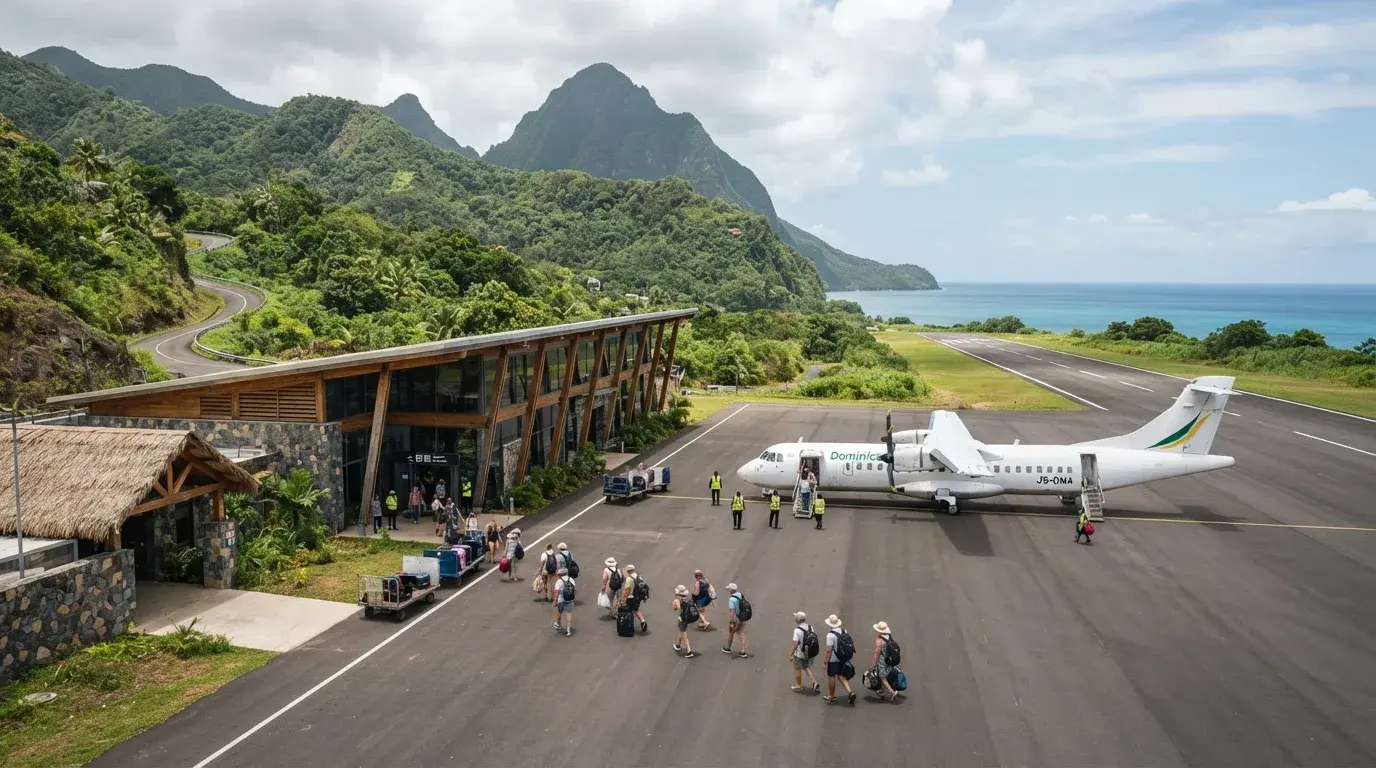
In Wesley, on the northeastern coast of the Caribbean island of Dominica, a major transformation is underway. For months now, construction machinery has been hard at work on the island’s future international airport, an ambitious project set to reshape Dominica’s tourism future. With an opening planned for the second quarter of 2028, this infrastructure could become the catalyst Dominica needs to attract an international clientele in search of authenticity, volcanic landscapes, and untouched nature.
According to Michel Salbot, representative of Dominica’s tourism office in France, the stakes are clear: « We have potential. We are consolidating it. Why not show it to the world? » Today, travelers looking to discover this Caribbean gem often face multiple connections, typically via neighboring airports in Guadeloupe or Martinique. The new international airport promises to simplify these routes by offering direct flights from Europe and North America, a development that could significantly boost the local economy.
Dominica, often dubbed the Nature Island for its UNESCO-listed Morne Trois Pitons National Park, is banking on its ecotourism image to stand out. Between hot springs, tropical forests, and hiking trails like the famous Waitukubuli, the island appeals to lovers of open spaces and responsible travel. The Dominican government has recently reinforced its commitment to protecting ecosystems by creating a dedicated sperm whale marine reserve—an additional asset for a destination focused on sustainability.
Tourism in Dominica already hit a record year in 2025, with nearly 488,000 passenger arrivals, a 13% increase compared to the previous year. Overnight visitors rose by 18%, while cruise passengers grew by 12%. Direct tourist spending on the island is estimated at over €134 million, a figure that underscores the island’s growing appeal. Yet, despite this positive momentum, challenges remain for a destination that rejects mass tourism. How can growth be balanced with environmental preservation? A critical question as local infrastructure prepares to evolve.
As early as 2026, Dominica saw a 10% increase in overnight visitors in the first quarter. Cruises, another economic pillar, experienced an exceptional season between October 2025 and April 2026, welcoming over 400,000 passengers—a 23% rise. Despite these encouraging figures, access to the island remains limited. Today, travelers from France typically transit through Pointe-à-Pitre or Fort-de-France before reaching Dominica via ferry from neighboring islands. A system that could soon change dramatically.
The future Wesley International Airport, whose construction was included in the 2026-2027 budget speech, is designed to accommodate long-haul flights. Air Caraïbes and Corsair have already been approached by local authorities to explore potential routes, though no official announcements have been made yet. Michel Salbot, optimistic, notes: « We are in discussions with several airlines to open direct flights from Europe. » The goal is to make Dominica more accessible without compromising its identity, avoiding overcrowded infrastructure and favoring human-scale accommodations.
Dominica’s challenge lies in its ability to grow without losing sight of its values. The government has already begun preparing a development plan for the island’s northeast, around Wesley and Woodford Hill, to organize the expansion of housing, businesses, and tourist activities. The objective? To prevent the emergence of mass tourism while creating economic opportunities for locals. How can the pitfalls of uncontrolled development be avoided? A question preoccupying local authorities and industry stakeholders.
Dominica is banking on a strategy of reasoned tourism, where small-scale accommodations like guesthouses and lodges play a central role. Michel Salbot emphasizes the importance of this diversity: « We need to find the right balance. We must not have only luxury. » For him, these local accommodations are integral to the travel experience, just as much as hiking or Creole culinary discoveries. The new airport could thus serve as a catalyst for a more resilient and inclusive local economy.
A Sustainable Airport Project at the Heart of Development Strategy
The future Wesley Airport is more than just an infrastructure—it aims to align with a sustainable development approach, in line with modern traveler expectations. Unlike the overcrowded hubs of the Caribbean, Dominica seeks to offer an alternative where quality trumps quantity. Discussions with Air Caraïbes and Corsair aim to integrate strict environmental criteria, such as the use of sustainable aviation fuels or minimizing noise pollution.
The Dominican government also adopted a 2025 law to protect marine ecosystems, particularly around sperm whales. This initiative complements efforts already underway to preserve tropical forests and hot springs—key assets for a destination focused on sustainability. The new airport could thus become a model for other Caribbean islands, proving that it is possible to combine tourism growth with environmental respect.
Local authorities stress the need to coordinate airport development with that of tourism infrastructure. A development plan is underway for the island’s northeast, including housing, businesses, and activities tailored to new visitor flows. The challenge is to create a cohesive offering where every element—from direct flights to accommodations—contributes to an authentic experience. How can the influx of tourists be managed without altering the island’s character? A question already guiding policymakers’ choices.
For travelers seeking an escape from crowds, Dominica represents a unique opportunity. The island offers an alternative to the saturated destinations of the Caribbean, with its preserved landscapes and rich culture. The new airport could well be the spark that allows this lesser-known destination to reveal its full potential. What will Dominica look like tomorrow? An island where tourism remains human-scale, nature is protected, and visitors leave with the desire to return.
Traveling in Dominica: Between Adventure and Relaxation
For travelers eager to explore Dominica before the new airport opens, several options are already available. Flights to Pointe-à-Pitre or Fort-de-France allow access to the island via ferry, a roughly two-and-a-half-hour crossing. Five weekly crossings are offered from Guadeloupe and Martinique, with schedules designed to facilitate air connections. It is also possible to organize an entirely aerial journey with a regional stopover at Douglas-Charles Airport, Dominica’s main airport.
Once on the island, the possibilities for discovery are vast. The UNESCO-listed Morne Trois Pitons National Park is home to natural wonders like the Boiling Lake hot springs, the Trafalgar Falls, and the Waitukubuli hiking trail, which traverses the island in 14 stages. Diving enthusiasts can explore the underwater world of the sperm whale reserve, while food lovers can indulge in Creole cuisine, rich in local flavors.
Several operators already offer travel packages tailored to all tastes. Among them, Nomade Aventure, which organizes guided hiking circuits, and Catlante Catamarans, which offers catamaran cruises from Pointe-à-Pitre. Travelers seeking relaxation can opt for a hotel stay, while those eager to explore the island in depth will find tailor-made circuits to suit their desires. How to choose between adventure and relaxation? Dominica offers both, with an authenticity that makes all the difference.
With the opening of the new international airport, Dominica could well become a flagship destination in the Caribbean. For now, the island remains largely untouched by mass tourism—a major asset for travelers seeking unique experiences. Between volcanic landscapes, Creole culture, and ecological commitment, Dominica has all the ingredients to captivate. Ready to discover this Caribbean gem?
The first direct flights from Europe could well take off by 2028. Until then, travelers still have time to plan their itinerary and take advantage of existing connections. One thing is certain: Dominica has all the makings of the Caribbean’s next great destination—provided it preserves what makes it so special.
A Model to Follow for the Caribbean?
The Wesley International Airport project is part of a broader reflection on the future of tourism in the Caribbean. While many islands in the region grapple with saturated infrastructure, Dominica is adopting a different approach: fewer tourists, but better-targeted visitors. A strategy that could inspire other destinations seeking sustainability and authenticity.
With tourism up 13% in 2025 and a local economy in full transformation, Dominica proves that growth and identity preservation can go hand in hand. The new airport, by enabling direct flights from Europe, could be the missing lever to attract a clientele in search of responsible escapism. An opportunity not to be missed for an island that has everything to become a model.
Be the first to comment on this article