Syrian Airlines relaunches its network: Damascus bets on Europe and the Middle East to rebuild air traffic
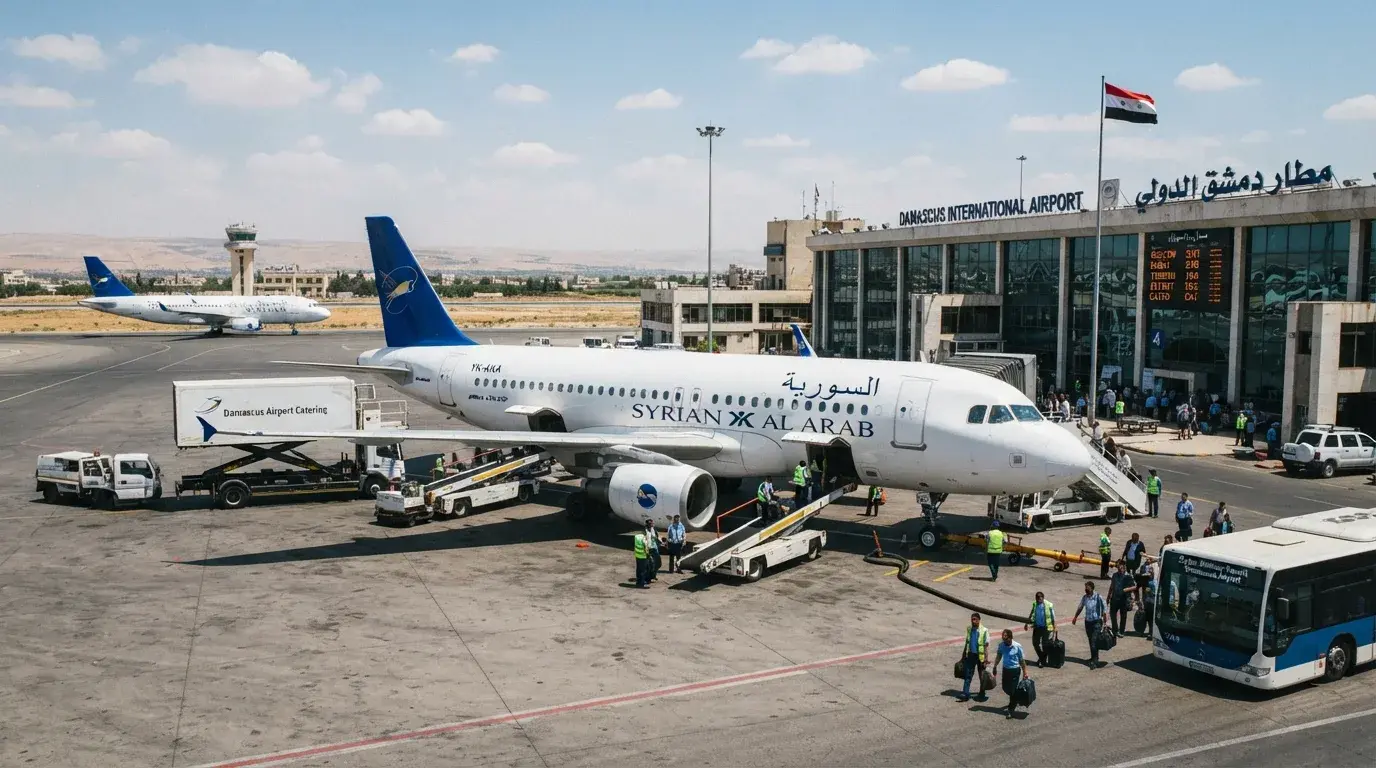
Syria is turning a page after years of war and isolation. Under the impetus of Syrian Airlines, the country is gradually relaunching its international air network and modernizing its infrastructure. Two new Airbus A320s have just been delivered, marking a symbolic step in this reconstruction.
After years of embargo and restrictions, Syrian Airlines is resuming flights to Europe and the Middle East. The national carrier took delivery in late August of two second-hand Airbus A320s, registered YK-AKI and YK-AKJ. Configured with 156 seats—12 in Business Class and 144 in Economy Class—these aircraft are set to strengthen the airline’s short- and medium-haul routes. Their entry into service comes as Syrian Airlines expands its route network from Damascus.
Damascus revives European connections
The carrier resumed direct flights between Damascus and Amsterdam on July 2, 2026, a first since the partial lifting of European sanctions. It also restored a weekly service to Berlin on August 15 and plans to open new routes to Vienna and Copenhagen as early as September. These routes are part of a broader strategy to reconnect Syria with countries hosting large Syrian diasporas.
The Middle East is no exception: Syrian Airlines relaunched a weekly service to Medina, Saudi Arabia, on August 11. This route meets strong demand for religious and family travel between the two countries. A service to Moscow also resumed on August 16 after an interruption of a year and a half due to geopolitical tensions.
Rebuilding the fleet
Syrian Airlines’ fleet remains modest and still relies heavily on second-hand aircraft. According to AeroTime, the airline theoretically operates eight A320s, two A340-300s, two Tupolev Tu-134Bs, and two Ilyushin Il-76 cargo planes. However, some of these aircraft, particularly the A340s, have remained grounded due to a lack of available spare parts. The two new A320s, acquired on the secondary market, should help gradually restore operations.
Challenges abound. Syrian Airlines must rebuild its maintenance capabilities, secure the necessary authorizations to operate in new markets, and stabilize its supply chains. The carrier must also demonstrate compliance with the operational requirements of the countries it serves—a process that is often lengthy and complex.
Damascus bets on the airport to attract airlines
The recovery of Syrian Airlines is supported by a major modernization program at Damascus International Airport. In November 2025, Syria’s General Civil Aviation Authority signed a $4 billion concession contract with an international consortium led by Qatar’s UCC Holding. This Build-Operate-Transfer project includes upgrades to Terminals 1 and 2, increasing the airport’s capacity to 6 million passengers per year by the end of 2026. A Terminal 3 is planned to add 10 million passengers, followed by two extensions of 7.5 million each, bringing the final capacity to 31 million passengers annually.
The works also include modernizing navigation equipment, air traffic control systems, baggage handling, and ground services. A five-star hotel integrated into the airport is also in the plans. These investments aim to support a sustainable return of international routes and reassure airlines and travelers about the reliability of Syrian infrastructure.
A gradual but fragile recovery
The partial lifting of European sanctions in February 2025 facilitated Syrian Airlines’ return to some European airports. However, technical and commercial obstacles persist. The airline must rebuild its operational capabilities, train its crews, and secure spare parts and maintenance services.
Despite these challenges, Syrian authorities are cautiously optimistic. Regional air traffic appears to be gradually recovering: official figures show 20,315 overflights of Syrian airspace in July 2026, a promising sign of normalization.
Why are these route openings strategic for Syria?
The relaunch of Syrian Airlines and its air network responds to several key challenges for the country. First, it reconnects Syria with countries hosting large Syrian diasporas, facilitating family travel and remittances. Second, it supports the country’s economic reconstruction by attracting foreign investment and boosting tourism. Finally, it strengthens Damascus’s position as a regional hub—a priority for Syrian authorities.
A target market in Europe
The openings to Europe, particularly Germany, the Netherlands, Austria, and Denmark, are particularly symbolic. They mark Syria’s return to the European aviation scene after years of isolation. These routes should also meet growing travel demand between Syria and Europe, driven by Syrian communities in Germany, Austria, and Scandinavia.
Traffic to Europe remains modest for now but could intensify if political and security conditions continue to stabilize. European airlines may also be encouraged to resume services to Damascus if demand and safety allow.
The Middle East as an immediate priority
Routes to Saudi Arabia and Russia address immediate needs. The service to Medina, in particular, is crucial for Syrian pilgrims. The link to Moscow aligns with a political and economic rapprochement between the two countries, which could translate into stronger trade and tourism exchanges.
A heavy but necessary investment
The modernization of Damascus Airport represents a $4 billion investment—a colossal sum for a country still in reconstruction. However, this effort is necessary to attract airlines and reassure travelers. Syria’s aging and war-damaged airport infrastructure must be upgraded to meet international standards.
What does this relaunch mean for travelers?
For travelers, the relaunch of Syrian Airlines and the improvement of Syrian airport infrastructure open up new travel opportunities to and from Syria. Routes to Europe and the Middle East make it easier to travel for tourism, business, or family visits. However, it is still too early to speak of a return to normalcy. Travelers should anticipate administrative formalities and check flight availability before planning their trips.
Simplified but still restrictive procedures
Syria has introduced an Electronic Travel Authorization (ETA) system to facilitate access to the country. However, travelers must still check the specific requirements for their nationality and any restrictions imposed by their country of residence. The political and security situation in Syria remains a concern, even as encouraging signs multiply.
A market to watch
Syria could become an unexpected tourist destination in the coming years if political and security stability holds. Travelers seeking authenticity and off-the-beaten-path experiences may be tempted by a visit to Damascus, Aleppo, or Palmyra. However, it is still too early to talk about a tourism boom. The country’s reconstruction will take years, and tourist infrastructure must still modernize.
Be the first to comment on this article
On the same topic
- Ryanair snubs France in 29 new 2027 routes: UK regional airports and Morocco take center stage
- Biman Bangladesh Airlines bets on Airbus to conquer Europe and North America with A350 and A321neo
- RwandAir bets on long-haul with four additional Airbus A330-200s: here are the targeted destinations
- China Finally Validates Its Order for 200 Boeing Aircraft: What This Means for Your Next International Flights
- Why French Airports Are Losing Passengers While Europe Takes Off in 2026
- Aegean Airlines to Take Control of Volotea: What It Means for Your European Travels