Why French Airports Are Losing Passengers While Europe Takes Off in 2026
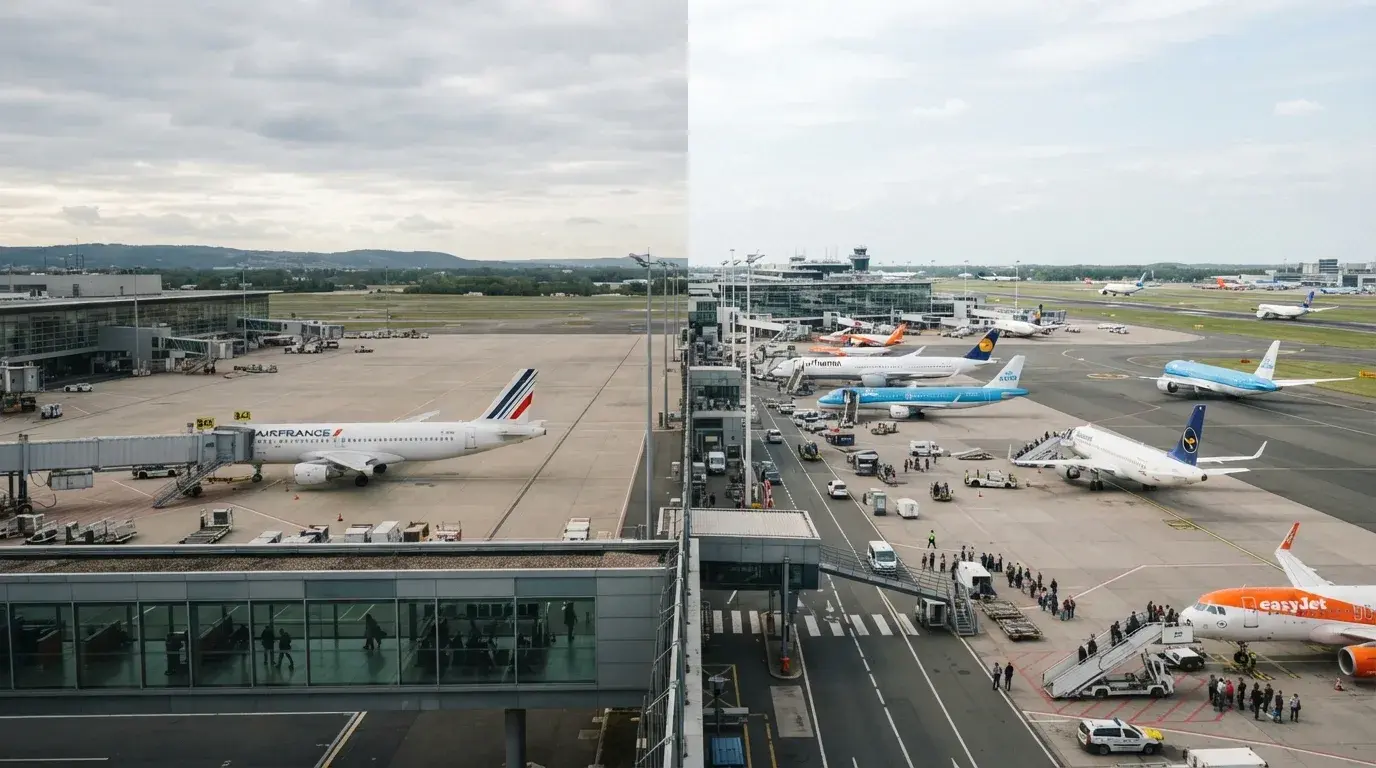
French airports are experiencing an unprecedented decline in passenger traffic in early 2026, with 98.3 million travelers recorded between January and June—a 0.8% drop from 2025. This slump starkly contrasts with Europe’s 2.6% annual growth, now exceeding pre-pandemic levels by 6.9%. The gap is widening, and France appears to be falling behind in the race to recover air transport.
The figures speak for themselves. While French airports struggle to regain momentum, their European neighbors report mixed but generally positive performances. Italy saw a 4.2% increase, Spain 3.7%, while Denmark and Greece recorded strong growth. In contrast, France ranks among the least performing major markets, alongside the UK (+0.4%) and Germany, which remains in decline (-1.2%). This raises a critical question: why is France, Europe’s second-largest air market, failing to keep pace with the broader trend?
A fiscal shock weighing on airlines
According to the Union of French and Francophone Airports (UAF & FA), the increase in the Air Transport Solidarity Tax (TSBA), introduced in 2025, is a key factor in this downturn. The organization estimates that reduced frequencies, route cancellations, and aircraft redeployments could result in up to one million potential passengers lost during summer 2026 compared to summer 2024. The rise in security and safety tariffs further pressures airlines already strained by soaring jet fuel prices.
The TSBA, applied to all flights departing from France, was designed to fund airport ecological transition projects. However, its impact on the competitiveness of French hubs is now under scrutiny. Airlines, particularly low-cost carriers, are increasingly choosing between French airports and their European counterparts, where air taxation remains lighter. This trend is leading to route cancellations and reduced capacity on certain destinations.
The closure of Basel-Mulhouse, an additional blow
The UAF & FA highlights that the temporary closure of Basel-Mulhouse Airport’s main runway between April 15 and May 16, 2026, resulted in the loss of approximately one million passengers. While the runway reopened, this incident exacerbated France’s decline, with June traffic still 1.9% below June 2025 levels, according to the airport organization.
Yet, the closure alone does not fully explain France’s downturn. Even after reopening, domestic and regional connections remain fragile, while international traffic—which drove recovery in 2025—has also weakened. French airlines, facing high operating costs, are cutting frequencies on less profitable routes, particularly to Northern Europe and some Mediterranean destinations.
Domestic routes hold steady, but international traffic suffers
Not all segments are declining. Radial domestic routes, especially from Paris, show resilience. Paris–Nice traffic rose by 5.5% in the first half, and Paris–Toulouse by 7.1%, driven partly by the growth of Transavia. These gains are linked to the rise of low-cost carriers, which are capturing demand.
In contrast, international routes—once the engine of recovery—are slowing sharply. French airlines are adjusting capacity based on costs, prioritizing the most profitable destinations while reducing frequencies on less lucrative routes. This strategy, driven by the need to protect margins, is leading to reduced capacity and a loss of competitiveness against less-taxed European rivals.
Europe on the rise: Why France is losing ground
Data from ACI EUROPE reveals a growing gap between France’s performance and its neighbors. In the first half of 2026, European traffic grew by 2.6% year-on-year and now exceeds 2019 levels by 6.9%. Several factors explain this dynamic:
Lower air taxation: In many European countries, ticket taxes remain far below France’s levels. For example, the Netherlands recently reduced its long-haul flight tax by €15.38, while Germany imposes far lower levies than France. These cost differences allow airlines to maintain more attractive offerings and capture a larger share of traffic.
Better adaptation to travel trends: European airports have capitalized on new traveler expectations, particularly in connectivity and services. Hubs like Amsterdam, Frankfurt, and Madrid have expanded their transfer offerings, attracting international transit passengers. In France, the concentration of traffic in Paris, combined with high taxation, limits this ability to attract additional passengers.
More favorable regulatory frameworks: In countries like Spain and Italy, local authorities have implemented incentive measures to support the aviation sector. These policies, often paired with tax reductions, have enabled airlines to maintain or expand their networks. In France, the absence of such measures is acutely felt as the sector faces intensified competition.
Geopolitics and fuel costs worsen the situation
ACI EUROPE notes that European growth slowed from 4.3% in Q1 to 1.3% in Q2 due to geopolitical disruptions in the Middle East and rising fuel prices. These factors have led some airlines to reduce capacity, particularly on long-haul routes. In France, the situation is exacerbated by high taxation, which further inflates flight costs.
French airlines like Air France and Transavia face some of Europe’s highest operating costs. The surge in jet fuel prices—reaching $181.46 per barrel in September 2026, per IATA—is severely impacting margins. Facing this pressure, airlines have little choice but to cut capacity on less profitable routes, leading to declining traffic and eroded competitiveness.
What can be done to reverse the trend?
The UAF & FA is not merely observing the decline—it is urging the government to act swiftly. As part of the 2027 Finance Bill, the organization is calling for a reduction in air taxation, including revising the TSBA and lowering levies on domestic flights. It argues that such measures could help recover up to one million lost passengers and reignite sector growth.
Thomas Juin, President of the UAF & FA, warns: « While Europe continues its momentum and gains passengers, France is losing them and falling further behind. » The organization stresses the urgency of action before the situation worsens, as the 2027 Finance Bill is currently under parliamentary review. Without corrective measures, the risk is that airlines continue to reduce capacity, triggering a negative spiral for French airports.
July data offers a glimmer of hope: French passenger traffic rebounded by 1.4% year-on-year. However, year-to-date figures remain 0.4% below 2025 levels. This suggests recovery is possible but requires swift, targeted action. French airports still have the means to reclaim their position in European competition—but only if they address the barriers weighing on their competitiveness.
For now, France continues to lose ground to neighbors pursuing more ambitious policies to support their aviation sectors. The challenge is clear: reform without delay to avoid lasting decline.
Potential solutions to revive traffic
Several strategies are being considered to reverse the trend. The first would involve revising air taxation, particularly by reducing the TSBA or targeting exemptions for long-haul and regional flights. Such measures could lower ticket prices and attract more passengers. The UAF & FA also proposes supporting airlines by easing levies on domestic flights, which are often economically fragile.
Another approach would be to enhance the competitiveness of regional airports by strengthening their appeal to low-cost carriers and developing partnerships with tour operators. Platforms like Lyon-Saint Exupéry, Marseille-Provence, or Nice Côte d’Azur could capture some of the traffic currently lost to neighboring European hubs. Finally, better integration into European hubs could improve connectivity and attract more transit passengers.
A major economic and social challenge
The decline in French air traffic extends beyond airports, with broader economic repercussions. The sector supports over 350,000 direct and indirect jobs in France and contributes less than 2% to national GDP. A loss of competitiveness in this area could have far-reaching consequences, particularly for tourism and trade.
Industry stakeholders are calling for urgent awareness. Without corrective action, France risks continuing to lose market share to better-equipped European competitors. The government and Parliament now have a window of opportunity to act before the situation becomes irreversible.
In conclusion, the downturn in French airports in 2026 reflects a broader issue: excessive air taxation, a lack of airline support, and intensified competition in Europe. The solution lies in structural reforms aimed at restoring balance and enabling French airports to compete with their neighbors. The stakes are high, and time is running out.
Be the first to comment on this article
On the same topic
- Aegean Airlines to Take Control of Volotea: What It Means for Your European Travels
- Syrian Airlines relaunches its network: Damascus bets on Europe and the Middle East to rebuild air traffic
- Qantas Revolutionizes Business Class: Flat-Bed Suites on A321XLR from 2028 – How Europeans Can Benefit
- Emirates Skywards Transforms Miles into Train Travel Across Europe: How to Benefit Now
- Singapore Airlines Expands European Network with Madrid, Manchester and Munich
- How Ryanair Prepares for Its Biggest 2026/27 Winter with 80 Million Seats and 1,700 Routes