Why Dubai Airport Sees 42% Traffic Drop and How Emirates is Fighting Back
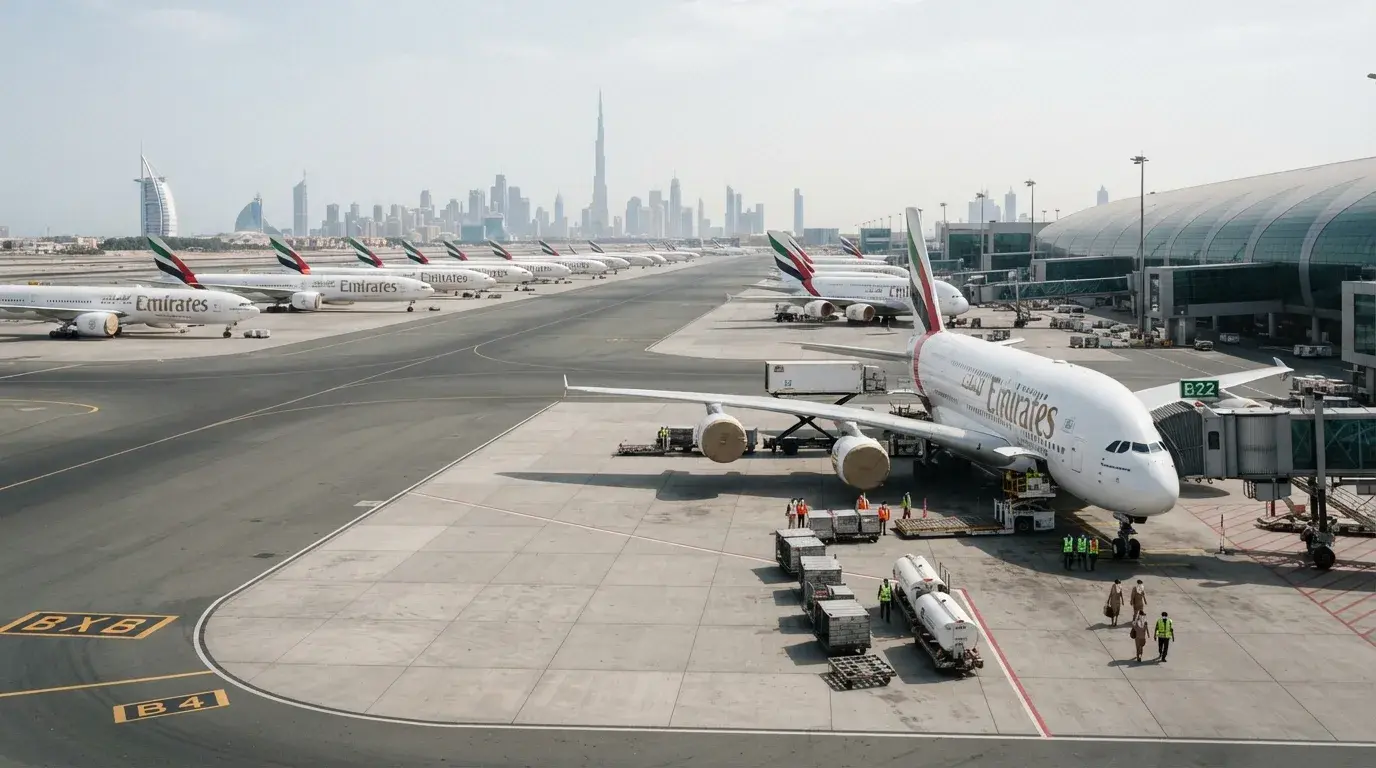
Dubai International Airport (DXB), the world’s leading hub for international traffic, has just recorded a historic drop in passenger numbers. Between April and June 2026, only 13 million travelers passed through the airport, a 42% decline compared to the same period the previous year. This unprecedented decline is directly linked to the consequences of the war in Iran, which has disrupted air operations across the Gulf.
Temporary airspace closures, overflight restrictions, and diversions have thrown a regional system—built on dense connections between Europe, Asia, and Africa—into disarray. For an airport where over 80% of activity relies on transit passengers, the impact was immediate: fewer available flights mean fewer connection opportunities and, consequently, a sharp drop in the number of travelers processed.
Quarterly statistics, however, offer a glimmer of hope. After hitting a low of 3.5 million passengers in April, traffic gradually increased to 4.5 million in May and 5 million in June. While this recovery remains insufficient to offset the crisis, it confirms a trend of gradual improvement. Aircraft movements followed a similar pattern, with 62,500 takeoffs and landings in the second quarter, down 32.1% year-on-year.
According to Paul Griffiths, CEO of Dubai Airports, this gradual improvement is proof of the airport’s resilience. « The first half of the year tested every component of the air transport system and demonstrated our resilience. As capacity gradually returns, demand responds immediately, » he stated. This cautious optimism comes as the Middle East conflict continues to weigh on operations.
Cargo has not been spared either, with a 28.7% drop in volumes handled in the first six months of the year. This decline is attributed to both airspace restrictions and rising fuel costs, another disruptive factor for airlines operating in the region.
For Emirates, Dubai’s flagship carrier, this crisis represents a major operational and commercial challenge. Despite the difficulties, the airline claims it was operating at 90% of its capacity last month, according to its president, Tim Clark. While this performance falls short of pre-war levels, it reflects a determination to maintain long-haul connections from its hub at all costs.
However, several major international carriers have extended suspensions of certain routes or maintained a cautious approach to the region. Lufthansa, British Airways, and Singapore Airlines have reduced their programs to Dubai, depriving the hub of a significant portion of its connection capacity. This absence is taking a heavy toll on the airport’s appeal.
DXB is now banking on the winter season to accelerate recovery. The operator expects the gradual return of European and American carriers as networks are restored and travel advisories are lifted. « We cannot take the first six months as an indicator of long-term strength, » Griffiths said. « Our network, our geographic position, and our importance in global air traffic mean we will undoubtedly finish the year in first place. »
A Rebuilding Traffic, But Still a Dominant Position
By the end of the first half of the year, the airport was served by nearly 50 international airlines, connecting Dubai to 217 destinations in 99 countries. Load factors were approaching 2025 levels, according to Dubai Airports, suggesting that demand remains intact as long as seats and frequencies return to the market.
Despite the crisis, operational performance remains strong. In the first half of the year, 98.98% of departing passengers cleared passport control in under ten minutes, while 99.34% passed security checks in under five minutes. The rate of mishandled baggage stood at 2.7 per 1,000 passengers, below the global average.
DXB now expects around 70 million passengers for the full year 2026, far from the 95.2 million recorded last year. The symbolic threshold of 100 million passengers, initially expected this year before the conflict, has been pushed back to 2027. This revision reflects the scale of the crisis but also the airport’s resilience.
The operator is continuing its investments to modernize infrastructure. Key projects include new remote departure paths, self-service kiosks, biometric development, and flow optimization. These adjustments are necessary to absorb future traffic and enhance the traveler experience.
Recovery will largely depend on the restoration of Emirates and flydubai networks—the two Dubai-based carriers—as well as the full return of foreign carriers. Their absence is reducing direct capacity to Dubai and, above all, the connection capacity available within the hub.
Emirates and flydubai: Pillars of a Gradual Recovery
Emirates, which alone accounts for nearly 50% of DXB’s traffic, has had to adapt its programs to limit losses. The airline has refocused operations on the most profitable destinations and reduced frequencies to the most affected areas. Despite this, it remains a key player in the hub’s recovery.
flydubai, the group’s low-cost subsidiary, has also adjusted its offering. The airline has concentrated flights on less affected regional destinations while maintaining routes to Africa and South Asia. This strategy has allowed it to preserve part of its traffic despite the challenging environment.
Foreign carriers, for their part, are adopting a more cautious approach. Several have suspended services to Dubai or reduced frequencies, awaiting a stabilization of the geopolitical situation. This decision is weighing on the hub’s overall capacity and limiting connection options for passengers.
According to internal sources, Emirates and flydubai plan to strengthen their offerings during the winter season, with increased frequencies to Europe and Asia. This strategy aims to capture some of the demand that typically routes through Dubai for connections.
Experts agree that recovery will be gradual and largely dependent on the evolution of the conflict in Iran. A stabilization of the geopolitical situation would allow a faster return of international carriers, while further escalation could prolong the crisis.
A Hub Still Indispensable, Despite the Storm
Despite the traffic drop recorded in the first half of the year, Dubai remains an indispensable hub for international air transport. Its geographic position, midway between Europe, Asia, and Africa, makes it an ideal platform for connections. This characteristic has allowed it to maintain its status as the world’s top airport for international passenger traffic for twelve consecutive years.
The investments made in recent years in infrastructure and cutting-edge technology have also played a key role in DXB’s resilience. Modern equipment, efficient flow management, and an optimized traveler experience enable the airport to maintain high operational performance even during crises.
For travelers, Dubai remains a must-stop for journeys between Europe and Asia or connections to Africa and Oceania. Despite the temporary drop in traffic, the hub retains its advantages: optimal security, smooth connections, and a diverse commercial offering.
Airlines, for their part, continue to rely on Dubai for its central role in their hub strategies. A position they cannot afford to lose, despite current challenges. One thing is certain: recovery is underway, even if it will be slower than expected.
For passengers, this means longer connection times or more frequent layovers in the coming months. A temporary constraint, but one that will not undermine Dubai’s strategic importance in the global aviation landscape.
In the meantime, travelers and airlines are keeping a close eye on the evolution of the geopolitical situation. A stabilization of the conflict in Iran would be the best signal to accelerate recovery and allow Dubai to reclaim its position as the world’s leading air traffic hub.
Be the first to comment on this article