Dubai in Crisis: World-Famous Airport Sees 42% Traffic Collapse Amid Iran War
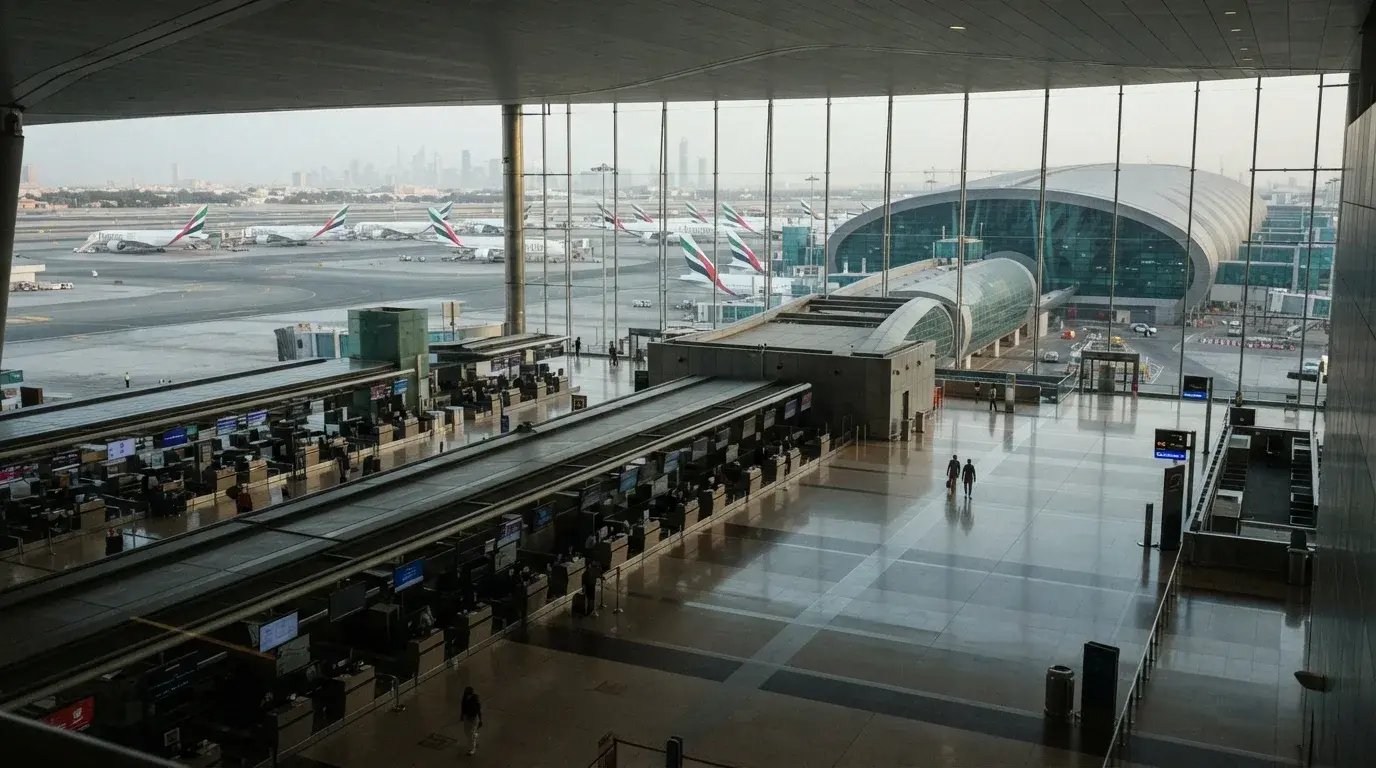
Dubai International Airport (DXB), long regarded as the world’s premier hub for international traffic, is experiencing its worst crisis in recent history. Between April and June 2026, the Emirati hub handled just 13 million passengers—a staggering 42% drop compared to the same period in 2025. This sharp decline, directly linked to the fallout from the war in Iran, marks a turning point for an airport that once dominated global rankings in international passenger traffic.
The causes of this disastrous performance are multifaceted. Temporary airspace closures, overflight restrictions, and flight cancellations have severely disrupted connections between Europe, Asia, Africa, and the Indian subcontinent. These once ultra-dense routes relied on a network of connections that now bypasses detours or alternative hubs. The conflict has also driven up fuel costs, adding further pressure on airlines already weakened by operational disruptions.
Traffic has been gradually recovering since April. After 3.5 million passengers in April, the hub recorded 4.5 million in May and 5 million in June. While this upward trend is encouraging, it remains far below pre-crisis levels. Aircraft movements followed the same pattern: 150,600 movements in the first half of 2026, a 32.1% decline year-over-year. Cargo was not spared either, with a 1% drop in volumes handled, totaling 217,317 tonnes over six months.
This crisis comes at a time when Dubai’s hub was in full expansion mode. In 2025, DXB welcomed 95.2 million passengers, an all-time record for a global airport. Despite the current shock, Dubai Airports remains optimistic about the future. In a statement, CEO Paul Griffiths said: « The first half of 2026 tested every component of the aviation system and demonstrated our resilience. As capacity gradually returns, demand follows immediately. » The hope now lies in the upcoming winter high season and the gradual return of European and American carriers, whose flight programs had been significantly reduced.
Emirates and flydubai, the two Dubai-based airlines, play a key role in this recovery. Emirates, in particular, was already operating at around 90% of its capacity by July 2026, according to its president, Tim Clark. Yet this improvement remains incomplete. Major international carriers like Lufthansa, British Airways, and Singapore Airlines have adopted a cautious approach toward the region, either limiting services or suspending certain routes. This absence not only reduces direct offerings to Dubai but, more critically, diminishes the hub’s connecting capacity—a cornerstone of its business model.
Recovery is expected to accelerate with the arrival of the winter season, traditionally strong for air traffic. However, the airport has had to revise its ambitions downward. DXB now projects around 70 million passengers for the full year 2026, a 26% drop compared to 2025. The symbolic threshold of 100 million passengers, initially anticipated for this year, has been pushed back to 2027. A perspective that underscores the scale of the shock suffered by the world’s leading hub.
A Business Model Vulnerable to Geopolitical Crises
Dubai Airport’s economic model is uniquely dependent on transit passengers. Before the crisis, approximately 70% of its passengers were in transit—a figure that has plummeted with the reduction in available flights. Fewer flights mean fewer connection opportunities, leading to a mechanical decline in passenger numbers. This transit dependency makes the hub particularly vulnerable to regional crises, as it relies on dense networks and intercontinental connectivity.
Before the war in Iran, DXB was served by nearly 50 international airlines connecting 217 destinations across 99 countries. Aircraft load factors were approaching 2025 levels, suggesting that demand still exists—provided seats and frequencies return to the market. However, reduced flight programs create a domino effect: fewer available flights lead to fewer connections, which in turn discourages airlines from increasing frequencies, creating a vicious cycle difficult to break.
The current crisis highlights the risks of an economic model centered on a single platform. Unlike more diversified hubs such as London-Heathrow or Paris-Charles de Gaulle, DXB relies nearly 80% on transit flows between Europe, Asia, and Africa. This specialization, once an asset, has become a weakness when geopolitical crises disrupt air routes in the Gulf region. Dubai Airports’ leadership is well aware of this and is ramping up investments to diversify revenue streams, particularly through the expansion of retail and parking facilities.
Impact on Travelers and Airlines
For passengers, the crisis translates into higher fares and reduced flight options. Airlines, forced to cut programs, prioritize the most profitable routes, often at the expense of less frequented connections. Travelers heading to Europe, Asia, or Africa must now plan for longer layovers or connections through alternative hubs like Istanbul, Doha, or Abu Dhabi, which benefit from a reputation for relative stability.
Dubai-based carriers like Emirates and flydubai are attempting to mitigate the impact by adjusting capacities. Emirates, for example, has refocused operations on high-demand destinations while maintaining a premium offering to attract passengers willing to pay for high-end service. However, the Emirati carrier, which accounts for a significant share of DXB’s traffic, cannot alone compensate for the overall decline.
For European and American airlines, the crisis presents an opportunity to capture some of the traffic that previously transited through Dubai. Carriers like Lufthansa or Air France could strengthen their Asia or Africa routes by offering direct connections from their respective hubs. This strategy would reduce travelers’ reliance on Dubai while providing more reliable alternatives in the event of another regional crisis.
The Future of Dubai: Between Resilience and Transit Dependency
Despite the current crisis, Dubai Airports is betting on massive investments to modernize its infrastructure and attract new traffic flows. Ongoing projects include transforming passenger areas near the city, replacing Dock A (one of the main boarding terminals), and constructing a new control tower. These upgrades aim to enhance the traveler experience and optimize passenger flows, even amid reduced traffic.
The airport is also focusing on developing new destinations, particularly in India, where it recently launched Noida International Airport near Delhi. While growth is gradual, this platform could eventually offer an alternative to traditional routes via Dubai. However, its impact will be limited in the medium term, as the Noida hub is not expected to reach significant capacity for several years.
In the meantime, Dubai Airports anticipates a gradual recovery in traffic starting October 2026, with the arrival of the high season. The group expects traffic to return to around 90% of capacity by year-end, though this forecast remains contingent on geopolitical stabilization in the region. For now, the airport maintains strong operational performance, with 98.98% of departing passengers clearing passport control in under 10 minutes and 99.34% passing security checks in under five minutes. The mishandled baggage rate also remains below the global average at 2.7 per 1,000 passengers.
For travelers and industry professionals, Dubai’s crisis underscores the importance of diversifying air hubs. In an era of geopolitical instability, airlines and passengers will increasingly need to rely on alternatives to avoid disruptions caused by regional conflicts. If Dubai overcomes this challenge, its status as the world’s leading hub could be reinforced. Conversely, if the crisis persists, other platforms like Istanbul, Doha, or Abu Dhabi may seize the opportunity to fill the void.
For now, travelers must contend with longer routes and less seamless connections, while airlines adjust their networks to minimize risks. The war in Iran has exposed the fragility of a business model built on transitivity, and Dubai—despite its resilience—remains vulnerable to further shocks in a world where geopolitical tensions are becoming the norm rather than the exception.
To stay updated on the situation and book your next flights, visit the official Dubai Airports website.
Be the first to comment on this article