Qantas Revolutionizes Business Class: Flat-Bed Suites on A321XLR from 2028 – How Europeans Can Benefit
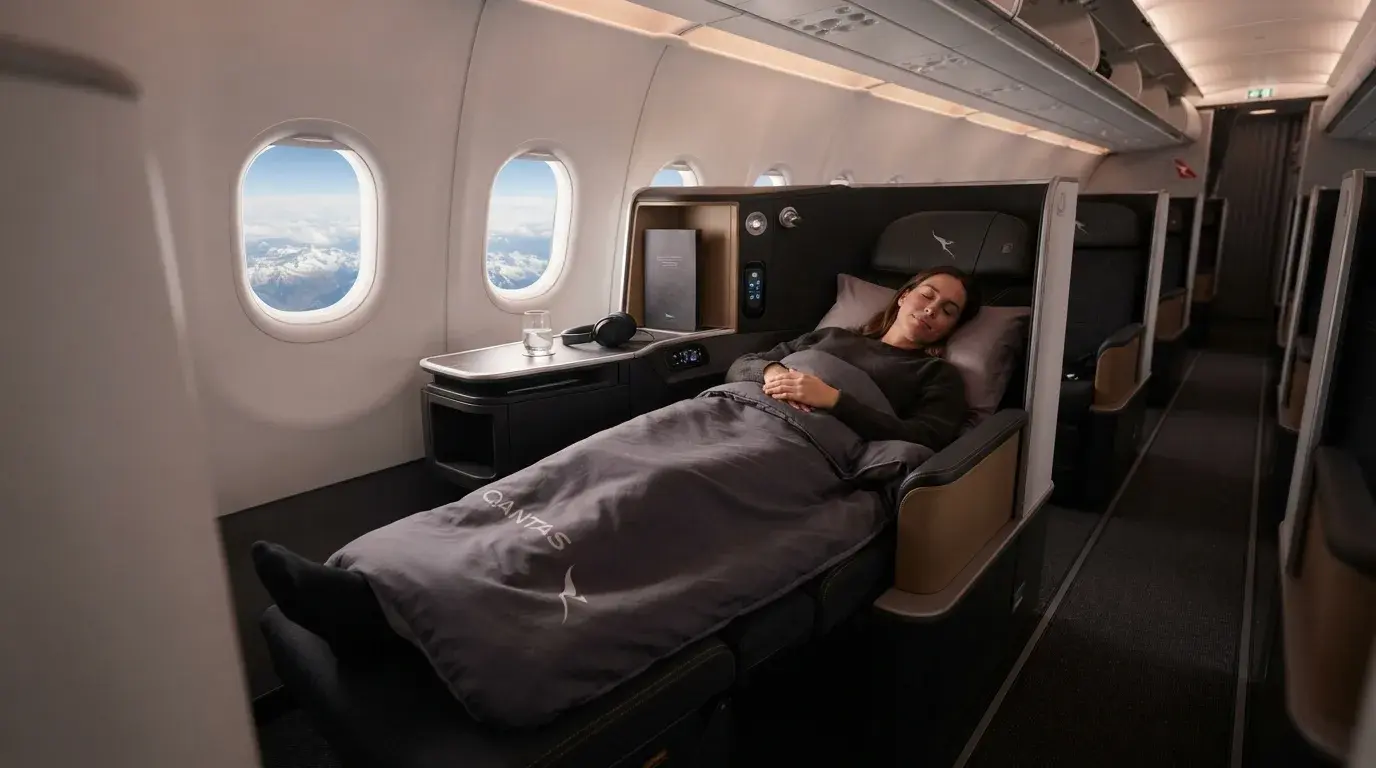
Qantas is making a bold move in aviation with a major innovation: the introduction of fully flat-bed Business Class suites on its upcoming Airbus A321XLR aircraft, a first for a single-aisle jet in the Australian carrier’s fleet. Starting in 2028, sixteen of these aircraft will feature a completely redesigned cabin, with 1-1 seating offering direct aisle access and a sliding door for total privacy. This breakthrough follows upgrades to the Business Class cabins on new Boeing 787-9s, which also feature individual doors.
This significant upgrade responds to growing demand from business travelers for travel conditions that rival hotel stays. On Qantas’ international network, premium cabin revenues surged by 15% in the 2025-2026 fiscal year—twice the growth rate of economy class. The A321XLR, with its 8,700 km range, becomes a key tool for balancing comfort and efficiency, particularly on long-haul transcontinental routes.
This evolution is part of a broader industrial strategy. Qantas is gradually replacing its oldest aircraft with A220s, A321XLRs, and 787-9s, while preparing for the arrival of future A350-1000s under the Project Sunrise program. The dual goal is to reduce unit costs and increase the share of high-contribution seats. But how can European travelers take advantage of these innovations?
Qantas plans to deploy the A321XLR intensively on domestic Australian routes, such as Perth-Sydney or Perth-Melbourne, where overnight flights of four to five hours make the Business Class product a major differentiator against competitors. With a range 3,000 km greater than the Boeing 737 it replaces, the A321XLR could also open new regional routes in Asia and the Middle East.
1-1 Business Suites with Direct Aisle Access: A First for Qantas
Starting in 2028, sixteen Qantas Airbus A321XLRs will feature a Business Class cabin with suites arranged in a 1-1 reverse herringbone layout. Each passenger will enjoy direct aisle access, a fully flat bed, and a sliding door. This marks a first for a single-aisle aircraft operated by Qantas, previously reserved for wide-body jets or twin-aisle planes on long-haul routes.
The airline highlights a suite designed for working, dining, and sleeping, complete with a 19-inch entertainment screen, wireless charging, USB-C ports, fast and free Wi-Fi, and ample storage for laptops and personal items. Vanessa Hudson, Qantas Group CEO, notes that this upgrade aligns with a broader strategy to enhance premium offerings.
The introduction of flat beds on the A321XLR is particularly well-suited to Australia’s geography. Qantas plans to deploy these aircraft on transcontinental routes, especially to and from Perth—more than 3,200 km from Sydney and nearly 2,700 km from Melbourne. On these domestic overnight flights, the Business Class product becomes a key differentiator against Virgin Australia.
Individual Doors Also Coming to Future Boeing 787-9s
Qantas has also unveiled an upgrade to its Business Class for additional Boeing 787-9s it will receive starting the 2027-2028 fiscal year. Each Dreamliner will feature 42 Business Class suites, maintaining capacity comparable to existing 787-9s, but with a highly anticipated addition: an individual sliding door.
The airline will thus introduce this privacy enhancement for the first time on its Dreamliners. The seat, an evolution of Qantas’ current suite, will convert into a flat bed measuring 80 inches (203 cm). Footrests have been widened following ergonomic testing and customer feedback. The suite will also include a 19-inch screen and redesigned storage.
The interior design will draw inspiration from Australian landscapes, with tones inspired by the red earth of Western Australia’s Pilbara region. This new cabin will likely equip new Boeing 787-9s, which are set to play an increasing role in Qantas’ long-haul network as Airbus A380s begin to phase out starting in 2028.
This announcement underscores a clear industrial and commercial choice: gradually replacing older aircraft with A220s, A321XLRs, 787-9s, and eventually A350-1000s. The airline aims to reduce unit costs and fuel consumption while increasing the share of high-contribution seats.
How Can European Travelers Benefit?
While Qantas does not yet operate direct flights from Europe to Australia with its A321XLRs, French and European travelers could soon access these innovations through connections. Several scenarios are emerging:
First, Singapore Airlines or Qatar Airways could integrate these aircraft via codeshare agreements, offering combined itineraries with a stopover in Singapore or Doha. These partners, already aligned with Qantas, could provide comparable Business Class suites on their own A350s or 787-9s, featuring the same comfort standards.
Second, Etihad Airways, which already serves Abu Dhabi with Boeing 787-9s, could offer a similar experience. The Emirati carrier, expanding its European network, may adopt these innovations for its own Business Class cabins, particularly on routes to Australia.
Finally, travelers looking to reach Australia from France could consider alternative routes. For example, a Paris-Singapore itinerary on Singapore Airlines’ Airbus A350, followed by a connection on a Qantas A321XLR or 787-9, would allow access to these innovative Business Class suites. Frequent flyer programs like Velocity Frequent Flyer or KrisFlyer could be leveraged for these bookings.
A Fleet in Full Transformation to Meet Market Demands
Qantas is progressively replacing its oldest aircraft with more modern, fuel-efficient models. The A321XLR, with its 8,700 km range, enables direct connections between Europe and the Asia-Pacific, reducing the need for multiple layovers.
The Boeing 787-9s, with their upgraded Business Class cabins, also present an attractive option for travelers seeking optimized comfort. Their Australian-inspired interiors and 2-3-2 economy layout make them a popular choice for long-haul flights.
For European business travelers, these innovations represent an opportunity to watch. Airlines are increasingly integrating premium comfort standards—once reserved for wide-body jets’ premium cabins—even on single-aisle aircraft. Bookings for these new aircraft are expected to open by 2028, with fares reflecting this premium upgrade.
In the meantime, it’s advisable to check Qantas’ website regularly or that of its partners to monitor evolving offers and available connections. Frequent flyer programs may also offer perks for the first passengers to experience these new cabins.
This revolution in Business Class marks a significant milestone for the aviation industry. It demonstrates that even on single-aisle aircraft, it’s possible to deliver comfort comparable to long-haul jets while optimizing operational costs. An evolution that could well spread to other airlines in the years ahead.
Be the first to comment on this article
On the same topic
- Icelandair bets on Madrid and St. Louis for summer 2027: a revolution for your travels to America and Europe
- RwandAir bets on long-haul with four additional Airbus A330-200s: here are the targeted destinations
- Finnair nearly triples flights to Tokyo: how to seize this opportunity for your next Japan trips
- Air Canada Launches A321XLR on Lyon Route: The Long-Haul Revolution Transforming Travel
- Etihad deploys Airbus A321LR between Abu Dhabi and Brussels: how this upgrade transforms your flights to the Emirates
- Etihad Strengthens African Network with Three Major Agreements: How to Travel Easier to Africa