Icelandair Slashes Fleet and Sets Load Factor Records Amid Fuel Crisis
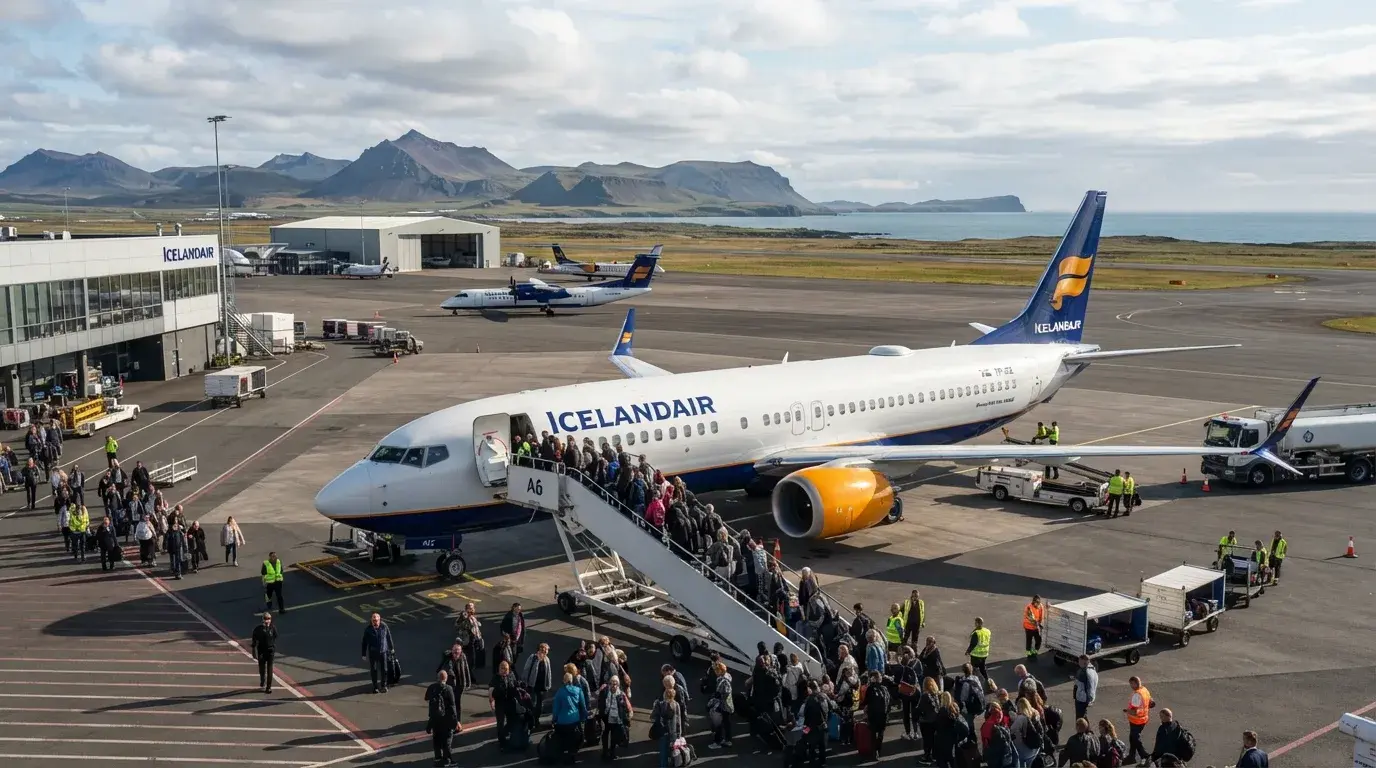
Icelandair has just set a record load factor of 86.1% for October 2026, according to the latest figures released by the airline. Yet behind this impressive figure lies a more nuanced reality: the Icelandic carrier transported 5% fewer passengers than in the same month a year earlier, dropping from 464,248 to 438,943 travelers. This paradox highlights Icelandair’s strategy in the face of soaring fuel costs, which has involved a drastic reduction in capacity and an accelerated phase-out of its oldest aircraft.
This approach, which may seem counterintuitive, is based on a simple principle: by aligning its supply with actual demand, the airline manages to fill more seats while mitigating losses from the surge in jet fuel prices. “We adjusted our capacity in response to the significant rise in fuel prices, reducing our flight program and accelerating the gradual retirement of older aircraft generations,” explains Bogi Nils Bogason, President and CEO of Icelandair. This decision has led to an improvement in unit revenue and a boost in punctuality—two key indicators of an airline’s financial health.
The results speak for themselves: despite a decline in traffic, the load factor has reached a record level, while revenue per passenger-kilometer (yield) has increased by 9%, rising from 9.11 to 9.92 US cents. This performance demonstrates how the Icelandic carrier has turned an external constraint into an operational opportunity while maintaining momentum on its network.
A winning strategy for passengers and shareholders
The capacity adjustment has not only enhanced financial performance but also had a positive impact on flight punctuality, an increasingly critical factor for travelers. In October 2026, Icelandair’s on-time performance stood at 84.5%, a 3.2-point improvement compared to the previous year. This progress is part of a broader trend: over the first ten months of the year, the average punctuality reached 82.2%, a figure that remains below target but shows a clear improvement compared to previous years.
For passengers, this strategy translates into fuller planes and a better travel experience. By aligning capacity with demand, Icelandair reduces wait times at check-in counters and minimizes the risk of overbooking—a phenomenon that can quickly turn a flight into a nightmare for travelers. With a focus on service quality to differentiate itself, Icelandair appears to have struck a balance between profitability and customer satisfaction.
A network refocused on direct flights to and from Iceland
The decline in traffic primarily affects the three international components of Icelandair’s network. Travelers to Iceland, who account for 36% of passengers in the month, fell by 8% year-on-year. The outbound market from the island, representing 21% of the total, contracted by 2%. Meanwhile, passengers connecting in Iceland during transatlantic journeys—constituting 38% of traffic—saw a 6% drop in volume. The only segment to grow was the domestic network, which carried 24,044 passengers, a 3% increase and roughly 5% of the total.
This shift reflects a strategy to refocus on routes with Iceland as the origin or destination, rather than transatlantic connections, which are more sensitive to fuel price fluctuations. Indeed, refueling stops, often necessitated by adverse winds and Iceland’s weather, have impacted the network’s environmental efficiency in October. According to the airline, these constraints led to a 1% increase in CO₂ emissions per ton-kilometer, an unusual but temporary rise.
Despite these challenges, Icelandair’s total emissions decreased by 10% in October, falling from 108,429 to 97,616 tons of CO₂. This reduction aligns with a broader trend: since January, total emissions have dropped by 4%, while the emissions per ton-kilometer indicator has improved by 3%. These figures show that capacity adjustments can also contribute to lowering the carbon footprint—a growing consideration for environmentally conscious travelers.
Freight and leasing activities see strong growth
Beyond passenger transport, Icelandair has recorded significant growth in its other aviation activities. Freight, for example, increased by 4%, with 11.65 million ton-kilometers transported. Block hours sold through leasing activities—measured from departure from the parking stand to immobilization at destination—reached 2,631 hours, up 12%. These results extend the trend observed since the start of the year, with a 6% increase in freight and a 7% rise in block hours sold for leasing.
This diversification of activities allows Icelandair to partially offset the decline in passenger traffic. It also illustrates the airline’s resilience, maintaining growth in segments less exposed to fuel price volatility. A strategy that could inspire other airlines facing similar challenges.
A new winter destination to boost the network
Despite the overall reduction in its offering, Icelandair continues to innovate to attract new passengers. In October, the airline launched flights to Tromsø, Norway, a winter destination expected to enrich its network. This expansion demonstrates that, even amid a contraction in activity, the carrier remains attuned to local opportunities and traveler expectations.
This targeted development aligns with a resource optimization strategy. By focusing on destinations less exposed to fuel price fluctuations, Icelandair maintains momentum on its network while limiting financial risks. A pragmatic approach that could serve as an example for other airlines facing similar challenges.
Could Icelandair’s model be the future of aviation?
The case of Icelandair illustrates a fundamental trend in the aviation industry: the need to adapt quickly to cost fluctuations while maintaining an attractive offering for passengers. By combining capacity reduction with improved service quality, the Icelandic carrier has turned a constraint into an opportunity, while limiting the impact on its finances.
This strategy could well inspire other industry players, particularly low-cost carriers and regional airlines, which are often the first to feel the effects of fuel price hikes. By adopting a flexible and responsive approach, they could not only survive the crisis but emerge stronger. For travelers, this transformation means fuller planes, better punctuality, and a more pleasant travel experience—a virtuous cycle showing that even in tough economic times, profitability and customer satisfaction can go hand in hand.
Be the first to comment on this article
On the same topic
- SWISS Launches Toulouse Route: Swiss Airline Expands into Southern Europe for Summer 2027
- Aegean Airlines to Take Control of Volotea: What It Means for Your European Travels
- Syrian Airlines relaunches its network: Damascus bets on Europe and the Middle East to rebuild air traffic
- Emirates Relaunches Strategic Offensive in Africa and the Middle East: Baghdad, Algiers and Basra in Sights
- easyJet soon in Apollo’s hands? What the fund battle means for your European flights
- AirAsia Group Transforms into a Global Low-Cost Giant: How the Malaysian Airline Challenges Aviation Titans