Emirates Relaunches Strategic Offensive in Africa and the Middle East: Baghdad, Algiers and Basra in Sights
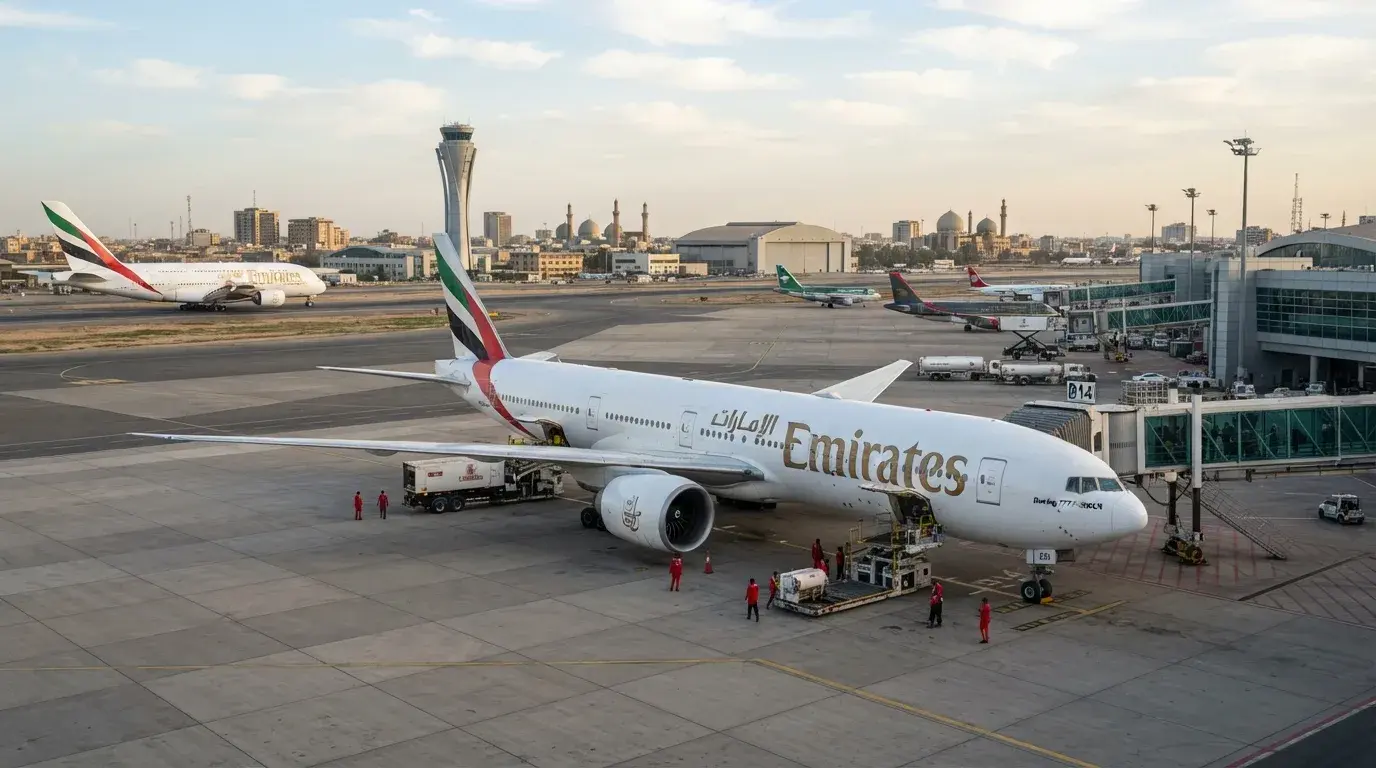
Emirates is reshaping its regional network for August 2026, signaling a strategic shift in its expansion policy across the Middle East and North Africa. Following months of restrictions due to geopolitical tensions, four key destinations are returning to the airline’s schedule: Baghdad in Iraq, Algiers in Algeria, Bahrain in the Gulf, and Basra in Iraq. Two other cities, Tehran and Damascus, remain suspended, underscoring Emirates’ cautious approach amid a still unstable environment.
This adjustment comes as Emirates maintains its leadership in the long-haul air transport market, backed by a modernized fleet and a targeted route strategy. Four routes suspended in March 2026 due to security or airspace access issues are set to return next month. The decision reflects a commitment to stabilizing capacity while assessing residual risks in these markets.
Baghdad, Algiers, Bahrain, and Basra will feature in the August 2026 schedule with frequencies and aircraft types tailored to operational constraints. Travelers heading to these destinations will now have direct alternatives from Dubai, eliminating the need for intermediate stops.
For passengers originating from Europe or other regions, these new connections offer the opportunity to extend itineraries to secondary regional hubs without costly or time-consuming technical stops.
Emirates notes that several suspended routes are set to return in September and October 2026, while Tehran and Damascus remain without a resumption date. Cited reasons include air safety concerns, airspace restrictions, and persistent regulatory uncertainties in the region.
This network update aligns with a broader strategy to strengthen connectivity between Europe, the Middle East, and Africa while ensuring operational reliability and safety. Travelers are advised to check updated flight schedules on the airline’s official platforms.
Baghdad and Basra: Two Iraqi Destinations on the Rise
The route between Dubai and Baghdad is the first to return to Emirates’ schedule. Starting October 1, 2026, the service will operate daily using the Airbus A350, with two seating configurations: 298 or 312 seats depending on demand. This route was suspended in March 2026 before a brief reopening in May, followed by another suspension.
For travelers heading to or from Iraq’s capital, this direct and modern link offers a seamless option from one of the Middle East’s major international hubs. Iraq, a country in reconstruction, attracts both business travelers and tourists, particularly to its historical sites and economic projects.
Meanwhile, the route between Dubai and Basra, a strategically vital Iraqi port city, resumes on September 2, 2026. Operated five times weekly using the Boeing 777-200LR and 777-300ER, this service responds to growing demand linked to commercial exchanges and professional travel in southern Iraq.
These two routes highlight Emirates’ commitment to restoring connections to emerging markets often overlooked by other major carriers due to operational constraints. Baghdad and Basra are now positioned as key gateways to a region undergoing reconstruction.
Algiers and Bahrain: Strategic Hubs in North Africa and the Gulf
Algeria’s capital, Algiers, returns to Emirates’ schedule on September 1, 2026. The route will be operated using the Boeing 777-300ER, a long-haul aircraft ensuring optimal passenger comfort. This service, suspended for several months, was highly anticipated by Algeria’s diaspora in Europe and business travelers.
For passengers traveling from France, Spain, or Italy, this direct link to Algiers eliminates the need for technical stops, reducing travel time and the risk of disruptions. Algeria, with its developing economy and growing tourism appeal, represents a key market for Emirates.
In the Gulf, Bahrain also returns to the schedule on September 1, 2026, operated exclusively with the Airbus A350. Often underestimated by travelers, this route serves as a critical transit point for connections between Europe and Asia, particularly for passengers transiting via Dubai.
Bahrain, with its modern airport and infrastructure suited for wide-body aircraft, is an ideal hub for technical stops and connections. Emirates is leveraging this destination to strengthen its presence in a region where competition among carriers is intense.
Tehran and Damascus: Two Suspended Destinations
Despite pressure from passengers and travel agencies, Emirates maintains the suspension of two major routes: Tehran in Iran and Damascus in Syria. These services, halted in March 2026 and November 2025 respectively, remain without a resumption date due to persistent geopolitical tensions and airspace restrictions.
For Tehran, a resumption will depend on the evolution of Iran’s security situation and the granting of overflight permissions by regional authorities. Despite its tourism and cultural potential, the Iranian capital remains a high-risk market for airlines due to international sanctions and regional tensions.
As for Damascus, its reopening is contingent on political stabilization in Syria and the gradual lifting of restrictions imposed by several states. Syria, still grappling with a prolonged conflict, remains a highly uncertain market for airlines, despite some travelers’ interest in its historical and cultural sites.
Emirates, aware of these challenges, is adopting a cautious and pragmatic approach. Rather than maintaining unprofitable or high-risk routes, the airline prefers to wait for more favorable conditions before reintroducing them to its network.
A Regional Network in Constant Recomposition
Emirates’ adjustments for August 2026 reflect a broader logic of constant recomposition in its regional network. Since the start of the year, the airline has faced multiple challenges: airspace restrictions, geopolitical tensions, and volatile operational costs. These constraints have led to frequent schedule and frequency adjustments.
For passengers, these changes require heightened vigilance when planning trips. It is now essential to regularly check updated schedules on Emirates’ official website or through authorized travel agencies.
Despite these challenges, Emirates is reaffirming its commitment to maintaining a stable and attractive offering on key markets in the Middle East and North Africa. The return of Baghdad, Algiers, Bahrain, and Basra is seen as an opportunity for travelers looking to explore destinations still underserved by other major carriers.
For both business and leisure travelers, these new routes offer enhanced flexibility and optimized travel options, particularly for itineraries combining multiple stops in a single booking.
Traveler Perspectives: How to Benefit from the New Routes
Passengers looking to take advantage of Emirates’ new routes to Baghdad, Algiers, Bahrain, or Basra are advised to book tickets as soon as possible. Reservations are now open on the airline’s official website and through partner travel agencies.
Travelers from Europe can easily combine these new routes with other long-haul flights operated by Emirates. For example, a stopover in Dubai allows for direct connections to Algiers or Baghdad without changing planes, significantly simplifying travel.
It is also advisable to monitor promotional offers launched by Emirates for these destinations. The airline frequently introduces competitive fares for new routes to attract a diverse clientele, from business travelers to tourists.
Finally, for passengers looking to extend their stay, Emirates facilitates connections to other destinations served by the airline, particularly in Asia or Africa. This flexibility enables travelers to optimize itineraries and explore multiple countries in a single trip.
Baghdad and Basra: Stops for Business and Leisure Travelers
The routes to Baghdad and Basra are particularly well-suited for business travelers, given the economic opportunities presented by Iraq’s reconstruction. Sectors such as oil, construction, and tourism are booming, attracting many foreign professionals.
For tourists, these destinations offer a unique experience, with historical sites like the ruins of Babylon, the ziggurats of Ur, or the museums of Baghdad. Emirates is capitalizing on this potential by offering packages that include accommodation and guided tours.
Algiers and Bahrain: Hubs for Travel to Africa and Asia
Algiers, with its modern airport and strategic location, is an ideal transit point for travelers heading to Sub-Saharan Africa or Europe. The Boeing 777-300ER route ensures optimal comfort and schedules tailored to connections.
Bahrain, meanwhile, is a critical hub for connections between Europe and Asia. Its airport, equipped with the latest technology, enables fast and efficient transfers. Emirates is leveraging this destination to reinforce its role as a transit platform between the two continents.
For travelers looking to explore multiple destinations, these new routes offer unprecedented flexibility. Whether for business or leisure, Emirates provides tailored solutions for all types of passengers.
Tehran and Damascus: An Uncertain Horizon, but an Opportunity to Watch
Despite the lack of a resumption date for Tehran and Damascus, Emirates has not ruled out a return for these destinations in the coming months or years. The airline is closely monitoring geopolitical developments and remains in contact with local authorities to assess conditions for reopening.
Travelers interested in these destinations are encouraged to sign up for Emirates’ email alerts to receive real-time updates on network changes. A resumption of these routes could open new opportunities for travelers looking to explore countries still largely inaccessible by air.
In the meantime, Emirates continues to strengthen its other routes in the Middle East and North Africa, reaffirming its role as a leader in this strategically vital region of global air transport.
Be the first to comment on this article
On the same topic
- discover the world's five longest flights
- WestJet unveils its new enriched winter program with a record number of sunny destinations
- Brussels Airlines prepares for a busy summer travel season
- Summer forest packages: Southern Europe tops the list for French tour operators
- EasyJet expands its network with 9 new routes from France this winter
- Southwest Airlines, pioneer of low-cost airlines worldwide