Lufthansa’s Airbus A321neo: A Cabin Telling Employee Stories in 12 European Tales
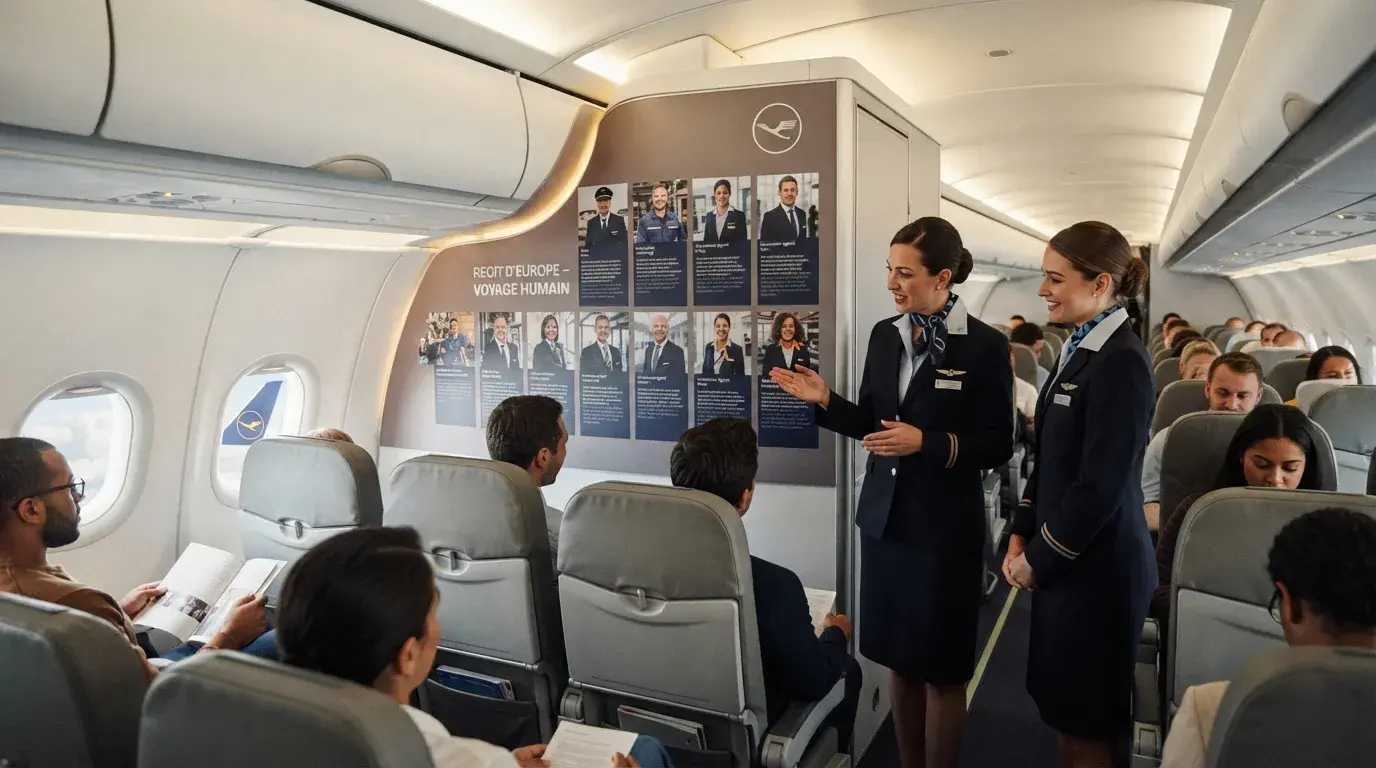
On board an Lufthansa Airbus A321neo, passengers don’t just travel between cities—they traverse a human chronicle. Since October 30, 2026, one of the German carrier’s European fleet aircraft sports a unique livery, turning its fuselage into a memory album composed of twelve stories selected from employee testimonies. Launched to mark Lufthansa’s centenary, this initiative transcends a mere celebration: it reveals, through illustrations and symbolic motifs, the soul of a company shaped by those who keep it flying.
The A321neo registered D-AIEM, nicknamed “Hamm”, has become in just a few months the vessel of a collective memory. Since spring 2026, Lufthansa teams invited colleagues to share their most memorable anecdotes—whether a repatriation flight during the Covid-19 pandemic, a layover memory in Vancouver, or a pivotal moment in German reunification. Twelve stories were shortlisted, put to a staff vote, and immortalized as vibrant murals on the fuselage. Each illustration includes a QR code, allowing travelers to dive deeper into these stories directly from their smartphones. “All our colleagues are part of Lufthansa’s history,” notes Jens Ritter, CEO of Lufthansa Airlines, “and this special livery pays tribute to them while telling our adventure from their perspective.”
Among the most evocative motifs, two recent stories were added in October to cap the series. The first draws from a repatriation mission organized from Frankfurt to Bogotá at the height of the health crisis. Two arms embracing an aircraft tail symbolize the operation where a crew brought stranded passengers home after a week in Colombia. The second evokes an employee’s role in opening Lufthansa’s first sales offices in Dresden in 1990, at the dawn of reunification. Its illustration depicts people walking hand-in-hand past the Brandenburg Gate, embodying the freedom found through ticket sales. These two motifs highlight an often-invisible dimension of air travel: its human impact, beyond schedules and statistics.
The project’s other illustrations span a broader spectrum, blending aeronautical history with personal journeys. They include the early days of the Frankfurt–Leipzig route in 1989, before the fall of the Berlin Wall, or a chance encounter between a flight attendant and a flight attendant during a layover in Vancouver. Intertwined hands, proposed by Lufthansa Technik teams, recall the team spirit uniting mechanics and technicians. Another mural honors Lufthansa’s first two female pilots, Nicola Lisy and Evi Hetzmannseder, breaking a glass ceiling in a still largely male-dominated sector in 1988. Once selected, these stories were transformed into graphic art by in-house artists and printed on the aircraft using weather-resistant techniques.
The project follows a precise timeline: the A321neo “Hamm” will retain its commemorative livery until the end of 2028, crisscrossing Europe with Lufthansa’s rotations. This duration extends the centenary celebration beyond 2026, a pivotal year for the German carrier whose origins trace back to the founding of the first “Luft Hansa” in January 1926. It also coincides with a symbolic overhaul of Lufthansa’s identity, balancing historical heritage with fleet modernization. Unlike the six other aircraft featuring a giant crane livery, “Hamm” stands out for its participatory, decentralized approach: every employee, regardless of role, contributed to shaping the project.
A Fleet in Transition: Between Heritage and Innovation
The A321neo “Hamm” is not alone in sporting centenary colors this year. Six other Lufthansa aircraft have received anniversary liveries featuring giant cranes, including an Airbus A350-900, a Boeing 747-8, and an Airbus A380. Yet “Hamm’s” design breaks away entirely from Lufthansa’s iconic blue, favoring motifs inspired by employee stories. A visual departure reflecting a desire to center the airline’s identity on its human resources rather than traditional symbols.
This initiative aligns with accelerated fleet modernization. In November 2026, Lufthansa will take delivery of its first Airbus A350-1000, registered D-AIFA and named “Deutschland”. Scheduled to enter service in December, the aircraft will bolster long-haul routes to destinations like Tokyo-Haneda. This strategic choice underscores a dual focus on diversification, modernization, and maintaining a strong link to the company’s history.
For passengers, boarding the A321neo “Hamm” becomes more than a flight—it’s a journey through time and space via stories and memories. QR codes near each illustration turn the plane into a flying exhibition, accessible to all. A tangible reminder that behind every flight are the women and men whose daily work shapes the experience of millions of travelers.
Collective Memory in the Digital Age
The special livery project is more than a PR stunt; it’s an attempt to preserve and transmit a fleeting memory in an industry where staff and strategy changes are frequent. By giving employees a voice through their stories, Lufthansa creates an intangible heritage accessible to travelers and new generations of staff alike. QR codes embedded in the murals let passengers access full stories in real time, complete with locations, dates, and people involved. A way to keep this memory alive and interactive, rather than confined to a book or museum.
The two final illustrations added in October 2026—Bogotá and Berlin—embody this ambition to tell both local and universal stories. They remind us that air travel is more than planes and schedules; it’s a story of solidarity, freedom, and resilience. By carrying these narratives across Europe for two years, the A321neo “Hamm” becomes more than transport—it embodies a piece of Lufthansa’s soul.
Could This Model Inspire the Industry?
While Lufthansa’s project remains unique for now, it could inspire airlines worldwide. In an industry where brands vie for differentiation, turning a fuselage into a canvas for collective memory offers an alternative to purely commercial liveries. It fosters an emotional connection with passengers while elevating the often-overlooked work of employees.
For now, Lufthansa has not announced a sequel. Yet the airline has already begun soliciting new stories from staff, hinting at the possibility of expanding the initiative to other aircraft or themes. One thing is certain: the A321neo “Hamm” has already etched itself into Lufthansa’s centenary history—not by its appearance, but by what it represents. A discreet yet powerful homage to those who keep the airline flying every day.
For travelers, boarding this aircraft is an opportunity to journey through time and space, story by story. A reminder that behind every flight lies a human tale.
A Selection of Stories That Captivate the Imagination
Among the twelve stories immortalized on the A321neo “Hamm,” some stand out for their power to stir passengers’ imaginations. The first motif, featuring two arms embracing an aircraft tail, stems from a poignant account: the crew of a repatriation flight from Frankfurt to Bogotá in March 2020. Hundreds of travelers were stranded in Colombia with no way home. The crew organized a special flight to bring them back, navigating a global health crisis. The illustration symbolizes solidarity, where the plane becomes a lifeline between continents, and the crew’s arms, a promise of safety.
Another story, rooted in history, honors an employee who helped open Lufthansa’s first sales offices in Dresden in June 1990. At the time, Germany was still divided, and every ticket sold represented a promise of freedom for travelers from the former GDR. The illustration shows people walking hand-in-hand past the Brandenburg Gate, a powerful symbol of reunification. This motif underscores how air travel has often been a vector for social and political change, far beyond its primary function.
Other stories, like the chance encounter between a flight attendant and a flight attendant during a layover in Vancouver, or the tale of Lufthansa’s first female pilots, Nicola Lisy and Evi Hetzmannseder, add a touch of humanity to aviation history. Once transformed into illustrations, these narratives become accessible to all passengers, fostering a dialogue between the company and its customers. A way to show that behind every flight are individuals whose work makes thousands of journeys possible each year.
When the Plane Becomes a Mobile Art Gallery
One of the project’s most original aspects is its ability to turn a commercial aircraft into a mobile art gallery. The murals, inspired by employee stories, are designed to withstand the extreme conditions of air travel: temperature swings, UV exposure, and friction. Each illustration is printed on a composite material, ensuring durability throughout the aircraft’s two-year service. Lufthansa’s in-house artists worked closely with technical teams to adapt their creations to the fuselage’s constraints while preserving their expressiveness.
For passengers, this flying gallery offers an immersive experience from boarding. The vibrant motifs immediately catch the eye, while QR codes provide deeper context for each story. A way to make the journey more interactive and forge an emotional connection with the airline. Social media has played a key role in amplifying the project, with travelers sharing photos of the aircraft and discovering the stories behind the illustrations. A visibility that extends far beyond those on board, turning the A321neo “Hamm” into a true ambassador of Lufthansa’s collective memory.
The A321neo “Hamm”: A Symbol of Modernity and Humanity
By choosing an Airbus A321neo for this commemorative livery, Lufthansa makes a bold wager: pairing technological modernity with human memory. Delivered in 2020, the aircraft is a flagship of the airline’s European fleet, boasting 15% lower fuel consumption than its predecessor, the A321ceo. Its extended range enables nonstop flights to more distant destinations while offering passengers enhanced comfort through a quieter cabin and optimized pressurization.
Yet it’s less for its performance than for its ability to embody a narrative that the A321neo “Hamm” distinguishes itself. The aircraft becomes a symbol of a Lufthansa that looks to the future while honoring its past. An approach that could inspire other airlines in an industry where technological innovation often overshadows the human dimension. By transforming a plane into a canvas for collective memory, Lufthansa reminds us that air travel is, at its core, a story of people, solidarity, and resilience.
For travelers, boarding this aircraft is an opportunity to journey through time and space, story by story. An experience that turns a simple flight into a human and cultural adventure.
To learn more about the employee stories and technical details of the A321neo “Hamm,” visit the official Lufthansa website.
Be the first to comment on this article