easyJet soon in Apollo’s hands? What the fund battle means for your European flights
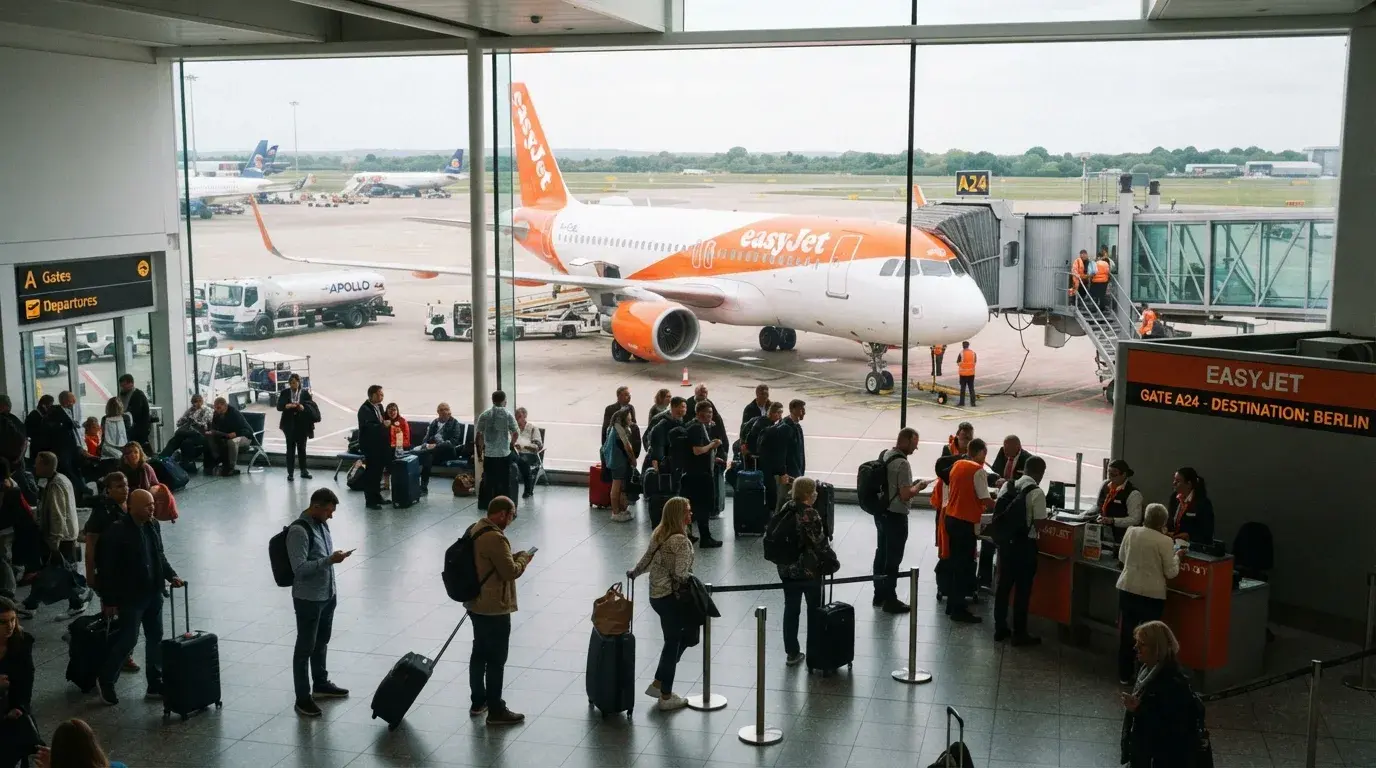
Apollo Global Management’s offer to acquire easyJet for £5.7 billion (€6.7 billion) is now the preferred solution for the UK low-cost carrier’s board. This strategic shift could reshape Europe’s air transport landscape, as the airline operates a fleet of 356 aircraft across 150 destinations.
This turnaround follows months of financial strain for easyJet, marked by a £552 million pre-tax loss in the first half of 2026, primarily driven by soaring fuel costs linked to the Middle East conflict. Jet fuel prices have surged by over 80% since February, forcing the airline to adjust its fares and capacity. Despite a 6% increase in passenger numbers and a 90% load factor, the situation remains fragile.
In this context, Apollo has proposed an all-cash offer, valuing easyJet at £7.15 per share—higher than the £6.90 initially proposed by Castlelake. The easyJet board has indicated it will no longer recommend Castlelake’s offer, now backing Apollo’s bid. A merger could be finalized as early as August 7, pending shareholder approval.
Why is a US fund interested in easyJet?
Apollo Global Management’s strategy hinges on several key factors. First, easyJet boasts a dense network of 150 destinations across Europe, North Africa, and the Middle East, with strong positions at capacity-constrained airports like London-Gatwick, Geneva, and Paris-Orly. Second, the airline has a near-280 aircraft order book, primarily consisting of Airbus A320neo models, enabling gradual fleet modernization while maintaining controlled growth.
Additionally, the easyJet Holidays subsidiary reported 22% growth in the first half of 2026, providing a complementary revenue stream and greater resilience against demand fluctuations. Apollo is betting on this diversification to enhance the airline’s profitability while optimizing operational efficiency. The fund believes this hybrid model—balancing pure low-cost operations with vertical integration into tourism—is well-suited to current market needs.
Analysts note that this acquisition could help easyJet better absorb economic shocks while capitalizing on the gradual recovery of long-haul travel. This strategy contrasts with Castlelake’s offer, which was criticized for its opacity on social and industrial plans.
French easyJet pilots oppose the takeover
Despite investor enthusiasm, French easyJet pilots have expressed strong resistance to the deal. Represented by the Syndicat national des pilotes de ligne (SNPL), they argue the project is purely financial, with no guarantees on jobs, bases, or social conditions. Jean-Marc Cioffi, president of the easyJet section at SNPL, stated, “There is no evidence that an investment fund is necessary for the sustainability of an already viable company.”
Concerns center on potential restructuring or breakup scenarios, fueled by persistent rumors. Pilots also question whether the capital structure complies with EU rules requiring over 50% of an airline’s capital to be held by EU member states or European nationals. While Castlelake created an Irish investment vehicle to meet this requirement, unions remain skeptical about its true independence.
Beyond financial aspects, pilots fear that productivity pressures under fund management could lead to increased crew fatigue and, consequently, flight safety risks. This is particularly sensitive given easyJet’s reliance on aircraft like the Airbus A320, whose reliability depends heavily on rigorous maintenance and crew experience.
Europe’s air transport market in flux
This battle over easyJet reflects a broader trend of consolidation in Europe’s air transport sector. Low-cost carriers, once seen as disruptive, are now central to acquisition and consolidation strategies driven by investment funds seeking profitability and external growth.
For easyJet, the stakes are twofold: maintaining independence against rivals like Ryanair or Wizz Air, which continue aggressive expansion, and successfully transitioning to a more resilient model capable of withstanding geopolitical and economic shocks. Apollo’s strategy emphasizes gradual upscaling, with a focus on boosting ancillary revenues (guaranteed cabin baggage, priority boarding, loyalty programs) and expanding the Holidays business, which could account for up to 20% of revenue by 2030.
Observers suggest this type of acquisition could inspire other industry players, particularly in France, where Air France and Transavia are frequently cited as potential targets. However, EU ownership rules complicate such maneuvers, forcing foreign funds to structure complex legal arrangements to avoid losing control of operating licenses.
What does this mean for easyJet passengers?
For travelers, the key question is whether the takeover will impact fares, flight frequencies, or service quality. In the short term, no major disruptions are expected: easyJet is maintaining its flight plans and fares for the 2026 summer season, with departures from its main European hubs proceeding as scheduled.
However, unions and consumer groups are urging caution. They warn that Apollo’s focus on profitability could lead to cost-cutting measures, particularly in maintenance, crew training, or onboard services. EasyJet has already faced social tensions in 2025, with sporadic strikes over working conditions. A deterioration in these conditions could, over time, affect flight reliability or passenger comfort.
Regular easyJet passengers are advised to monitor official announcements from the airline and the acquiring fund. For now, easyJet remains committed to its development strategy, with a modernizing fleet and an expanded network. The UK low-cost carrier is banking on its brand image—associated with competitive fares and strong punctuality—to reassure customers.
What’s next? Possible scenarios for easyJet
Several potential outcomes could unfold for easyJet under Apollo’s leadership or another acquirer. The most optimistic scenario for passengers would be a consolidation of the current model, with strengthened ancillary revenues and a modernized fleet. EasyJet could emerge as an even more dominant player in Europe, blending low-cost operations with premium services.
A more pessimistic scenario, highlighted by unions, would involve aggressive restructuring, including drastic cost reductions, the elimination of less profitable routes, or the outsourcing of certain activities. In this case, passengers might face reduced flight frequencies or higher fares on less-traveled routes.
A third, more speculative scenario could involve a partial or full sale of the airline to another airline group. Rumors have circulated about potential interest from IAG (parent company of British Airways) or Lufthansa. Such a move could strengthen these groups’ positions in the intra-European market but would likely lead to route redundancies and consolidations.
For now, passengers can continue booking easyJet flights with confidence, while staying alert to developments. The airline has confirmed that existing bookings will not be affected by the takeover, and summer 2026 flights will operate as planned. One thing is certain: the battle for easyJet is just beginning, and its repercussions will extend far beyond the aviation sector.
Be the first to comment on this article
On the same topiclow-cost
- Wizz Air to equip all Airbus aircraft with Starlink Wi-Fi from 2027: what it means for European flights
- Flybondi: March Salaries Unpaid as Argentine Low-Cost Airline Faces Pressure
- T'way Air transforms into Trinity Airways: South Korea's hybrid strategy
- Volotea strengthens its presence in Asturias with new European routes
- Wizz Air links Paris-Beauvais to Varna, new gateway to the Black Sea
- easyJet links London-Stansted to Paris-Charles-de-Gaulle, boosting cross-Channel service