Ryanair Files Complaint Against France: French Air Traffic Control Costs Airlines €800 Million Annually
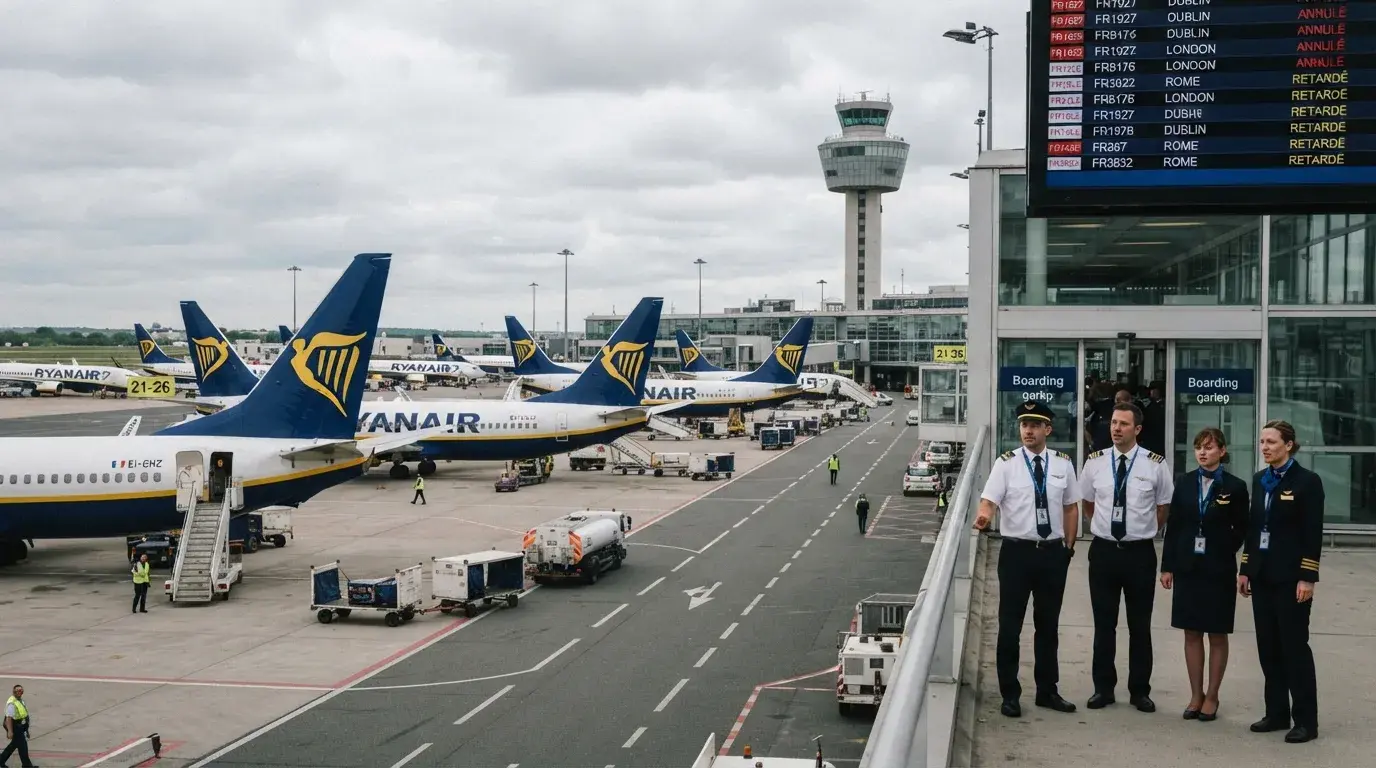
Delays and malfunctions in France’s air traffic control (ATC) system are taking a heavy toll on airlines, and Ryanair has struck back. The Irish low-cost carrier sent a scathing letter to Ursula von der Leyen, President of the European Commission, denouncing a situation it describes as “the worst in Europe”, with delays up 60% in 2025 compared to 2019. According to a French Senate report, these failures cost airlines €800 million in 2025—a staggering figure that has intensified tensions between the French state and air transport stakeholders.
French air traffic management has been a source of criticism for years. Delays attributed to France’s ATC are among the highest on the continent, directly impacting airlines’ bottom lines. Ryanair, which shared the Senate report with the European Commission, notes that delays surged by 60% in a single year, a rise reflecting France’s structural inefficiency. Michael O’Leary, Ryanair’s CEO, even went so far as to rebrand Ursula von der Leyen as “Useless von der Leyen” in a statement, accusing her of talking about competitiveness without ever delivering. The outburst underscores the growing frustration of airlines with the European institutions’ inaction.
Ryanair’s demands go beyond mere criticism. The airline is urging the Commission to require air navigation service providers (ANSPs) to be fully staffed from the first morning wave of flights, a measure aimed at preventing cascading delays from the start of the day. Another bold proposal: protecting overflights of French territory during national air traffic controller strikes, inspired by systems already in place in other European countries. These requests come amid a backdrop of repeated strikes by French controllers that regularly paralyze traffic, with knock-on effects across Europe’s air network.
France, often singled out for its persistent delays, continues to underperform. A 2025 Eurocontrol study revealed that nearly one-third of ATC delays in Europe are attributable to French airspace. These delays aren’t just an inconvenience for passengers—they generate massive additional costs. For airlines, every minute of delay is expensive, from wasted fuel to extended crew wait times and compensation payouts. Ryanair estimates that 21 million of its passengers faced delays or cancellations in 2025 due to French ATC failures and staffing shortages.
A system at breaking point: structural delays and repeated strikes
France’s air traffic control problems are nothing new. The French Court of Auditors recently delivered a scathing assessment, highlighting soaring delays, controller working hours below sector standards, and an expensive yet ineffective social protocol. The already weakened minimum service levels are no longer sufficient to ensure continuity, especially during peak periods like summer. Strikes—sometimes initiated by minority unions—regularly ground French airspace, with immediate repercussions for overflight traffic and foreign airlines operating in the region.
These unpredictable industrial actions have a direct impact on flight schedules. In 2025, strikes by French air traffic controllers led to thousands of cancellations and disrupted thousands more flights, particularly those operated by non-French carriers. IATA and Airlines for Europe have repeatedly called for stricter regulation of these strikes or the implementation of continuity plans to protect overflights. Yet despite repeated warnings, little has changed. France remains one of Europe’s most strike-prone countries for air traffic controllers, with consequences that extend far beyond its borders.
Airlines—both low-cost and legacy—are paying a heavy price for this situation. The costs of delays and cancellations are passed on to ticket prices and passenger service quality. For Ryanair, the issue is no longer just technical—it’s political. The Irish carrier accuses the European Commission of turning a blind eye to failures costing the sector hundreds of millions, even as reports from the French Senate and Eurocontrol data highlight the urgency of the crisis.
Ryanair’s proposals: radical measures to break the deadlock
Frustrated by institutional inaction, Ryanair is not just pointing out the problems—it’s proposing solutions. The airline’s first demand is for ANSPs, including France’s DSNA, to be fully operational from the first wave of morning flights. The logic is simple: preventing delays from accumulating early in the day, a phenomenon that then ripples across the entire network. For Ryanair, this requirement is especially justified given that morning delays are often caused by staffing shortages—a recurring issue in France.
The second measure is even more ambitious: protecting overflights of French territory during national air traffic controller strikes. Today, strikes paralyze French airspace, grounding thousands of overflight operations and disrupting schedules for foreign carriers. Ryanair proposes adopting systems already in place in other European countries, where mechanisms ensure continuity of overflights even during industrial action. If implemented, such a solution could significantly reduce the impact of strikes on Europe’s air traffic.
These proposals come as France racks up poor performance scores in air traffic management. Eurocontrol data shows that delays attributed to DSNA increased by 50% over a single summer compared to the previous year—a rise far outpacing the European average. For airlines, this situation is unsustainable. Margins are already thin, and every euro lost to delays or cancellations weighs heavily on the bottom line. Ryanair, one of the carriers most exposed to these issues, has decided to take a hardline stance, even if it means challenging European institutions.
A stalled European reform: the Draghi report ignored
Ryanair is leveraging the Draghi report, published in 2024, to highlight the European Commission’s inaction. The report, intended as a roadmap to boost European competitiveness, has gathered dust according to the airline. Michael O’Leary goes so far as to accuse Ursula von der Leyen of “delivering zero reforms”, despite promises of competitiveness. The Draghi report recommended modernizing aviation infrastructure and improving ANSP performance, but these suggestions have yet to translate into concrete action.
The European Commission, for its part, argues that ATC remains largely a national competence. While Brussels can influence economic regulation or SES performance plans, its direct power to intervene is limited. Yet Ryanair insists the Commission could do more, such as imposing sanctions on underperforming ANSPs or tying EU funding to tangible improvements. For the low-cost carrier, the era of declarations is over: it’s time for action.
The debate has now moved beyond France’s borders. ATC delays in Europe are a structural issue affecting multiple countries. Yet France stands out for its negative records: the highest delays, the most frequent strikes, and one of the least efficient air traffic management systems on the continent. If nothing changes, airlines will continue to foot the bill, and passengers will face repeated disruptions. For Ryanair, the solution lies in a radical overhaul of the European system, with coercive measures for underperforming ANSPs and stronger protections for overflights during strikes.
What’s next? Airlines on the front lines
Airlines—both low-cost and legacy—are the first to suffer from France’s ATC failures. They bear the brunt, whether through additional costs or degraded service quality. For Ryanair, the situation has become untenable. The airline has already threatened to reduce operations in France if nothing changes, a move that would affect thousands of passengers and hundreds of jobs.
Other carriers may follow suit. IATA and Airlines for Europe have repeatedly warned of the urgent need to reform Europe’s air traffic control system. Yet so far, European institutions have not grasped the scale of the crisis. Airlines, however, have run out of patience: they must make their voices heard, even if it means appealing directly to the European Commission for concrete change.
The ball is now in the institutions’ court. Can France reform its air traffic control? Can the European Commission impose coercive measures on underperforming ANSPs? The answers to these questions will shape the future of air transport in Europe. One thing is certain: without deep reform, delays, strikes, and additional costs will continue to weigh on an already strained sector.
Key takeaways
Ryanair has accused French air traffic control of being Europe’s worst performer, with delays up 60% in 2025 and costs exceeding €800 million for airlines. The Irish low-cost carrier sent a letter to Ursula von der Leyen demanding radical reforms, including mandatory full staffing for ANSPs from the first morning wave of flights and protections for overflights during strikes. The crisis, already severe, could worsen without change, with direct consequences for passengers and airlines. The debate has expanded beyond France’s borders: Europe must address the issue to avoid a lasting crisis in air transport.
Be the first to comment on this article