Air Austral returns to profitability: How the Reunion-based airline rebuilt its strategy to attract travelers
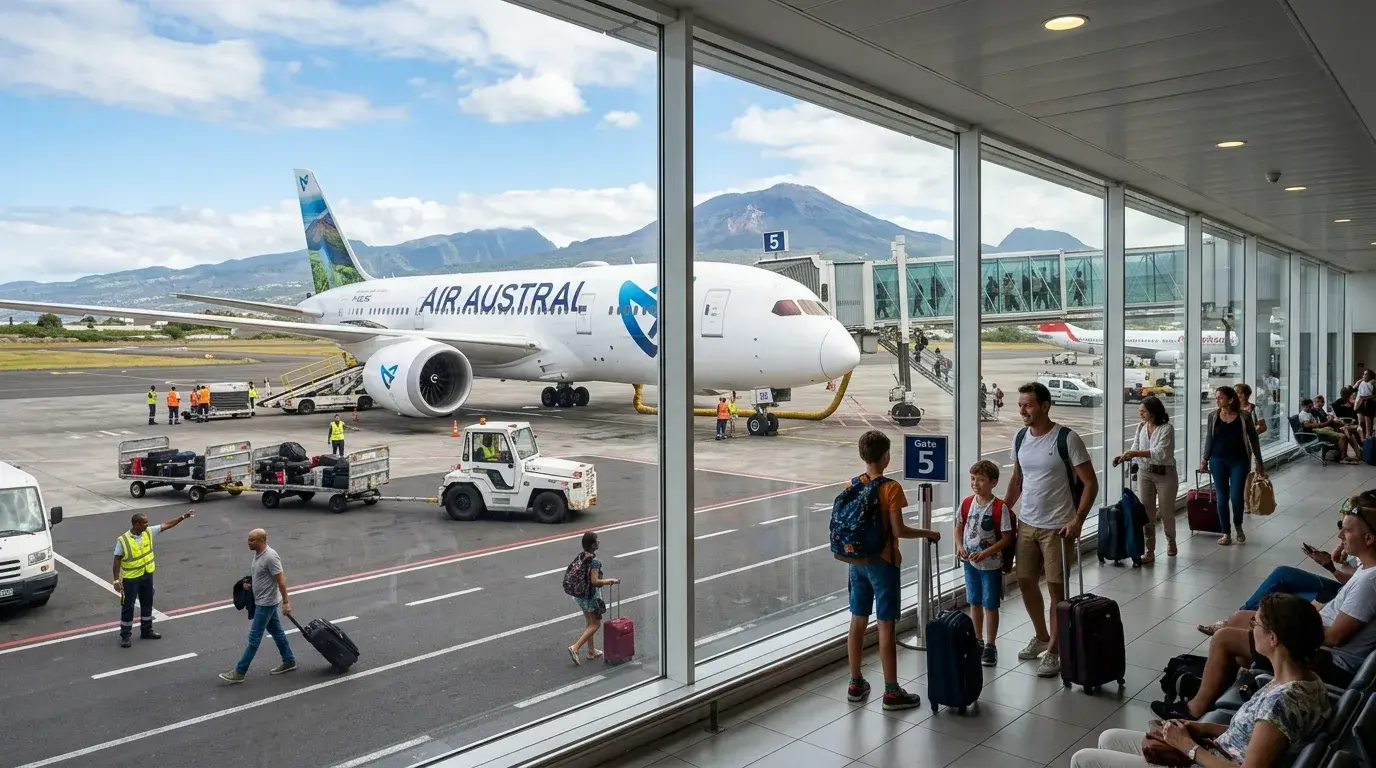
Air Austral has closed its 2025-2026 fiscal year with encouraging results: a return to net profitability, posting a net profit of €1.5 million. This milestone ends a prolonged period of restructuring and financial losses while paving the way for a new phase of growth focused on profitable expansion. Between debt reduction, fleet modernization, and network strengthening, the Reunion-based airline is reshaping its trajectory to appeal to both travelers and investors.
This shift toward profitability follows years of turbulence, including the pandemic crisis and operational challenges. Between 2023 and 2025, Air Austral reduced its operating losses by €40 million but remained in the red overall. The €1.5 million net profit for the fiscal year ending March 31, 2026, represents a symbolic milestone, validating the strategic choices made over the past two years. Hugues Marchessaux, Chairman of the Board, highlights this achievement, noting that “returning to positive results is a significant step for Air Austral, demonstrating the relevance of the strategic choices made.” This performance coincides with a 5% increase in revenue, reaching €464 million, and a record load factor of 92%—a rare achievement for a carrier combining long-haul and regional services.
A successful turnaround strategy: discipline, optimization, and refocusing
To achieve this recovery, Air Austral implemented a rigorous roadmap combining several key levers. The first involved optimizing its network by targeting the most lucrative routes. The airline notably strengthened its connections between La Réunion, Mayotte, and Paris, while expanding links to Asia via Bangkok. These strategic routes, representing the most dynamic traffic flows for the airline, received particular attention in terms of frequency and load factor. Air Austral recorded a 5% increase in passenger traffic, carrying 1,226,593 travelers during the fiscal year, while its cargo activity grew by 15%, reaching 16,729 tons.
The second pillar of this strategy was cost control, a critical challenge in an environment marked by volatile fuel prices and intense competition, particularly on the Réunion-Paris route. Like many carriers, the airline introduced a fuel surcharge while implementing a partial hedging strategy for its consumption. It also maintained strict control over operating costs, including simplifying its fleet. The retirement of older Boeing 737-800 and ATR 72-500 aircraft, initiated alongside the arrival of Airbus A220-300 jets, aligns with this refocusing and modernization effort. These measures helped reduce frequent groundings linked to Pratt & Whitney GTF engine issues, which had disrupted A220 operations.
The third component of this transformation was debt reduction. After benefiting from a rescue plan involving the state and local shareholders, Air Austral embarked on a debt-reduction trajectory essential for securing its financial sustainability. This financial discipline has been praised by observers, especially as the air transport market between Europe and the Indian Ocean remains highly competitive, with players like Air France-KLM, Corsair, French bee, as well as major Gulf and Asian carriers.
A transforming network: from A220 to A320neo, and toward Asia
In terms of fleet, Air Austral is preparing a major transition with the definitive retirement of its Airbus A220-300 aircraft in December 2026. These planes, introduced in 2021 to modernize its regional operations, were heavily impacted by Pratt & Whitney GTF engine issues, leading to frequent groundings. The airline has signed a letter of intent with lessor Macquarie AirFinance for the lease of two Airbus A320neo aircraft, expected in March and May 2027. These higher-capacity jets will support the dynamic regional market while improving flight economics.
In the meantime, Air Austral’s fleet consists of eight aircraft: three Airbus A220-300, three Boeing 777-300ER, and two Boeing 787-8, with an average age of about 8.6 years. The 777-300ER, configured for high capacity (up to 440+ seats), primarily serves Réunion-Paris and Mayotte-Paris routes, while the 787-8 handles long-haul missions to metropolitan France and select regional or international destinations. This streamlined fleet, centered around A320neo narrowbodies and Boeing widebodies, will simplify maintenance, crew training, and cost management.
On the network front, Air Austral is ramping up flight programs to meet growing demand. On the Réunion-Bangkok (RUN–BKK) route, the airline plans three weekly frequencies, supporting its expansion into Asia and connection flows via Thailand’s capital. On the Dzaoudzi-Paris (DZA–CDG) route, Air Austral will increase frequencies to nine weekly departures, reinforcing its ambition to solidify its leadership in Mayotte-to-metropolitan France services. The airline also plans to boost frequencies on its short-haul network and better structure flows between Indian Ocean regional routes and its long-haul services to optimize load factors and unit revenue.
To support this growth, Air Austral is expanding commercial partnerships, such as its recent agreement with Air India, designed to broaden its network and connection opportunities. By combining its own capacity with partner airlines across Asia and beyond, the Reunion-based carrier aims to better integrate its network into major international flows while maintaining La Réunion and Mayotte as gateways to the Indian Ocean.
An ambitious roadmap: toward sustainable profitability by 2030
This improvement in results is part of a broader roadmap for the FY27–FY30 period, with a goal of sustainable profitability. The company’s stated strategic priorities include maintaining and strengthening its position on the Réunion-Paris route, consolidating leadership on Mayotte-Paris, accelerating its expansion into Asia via Bangkok, developing regional/long-haul connection flows, increasing short-haul frequencies, structuring cargo and medical evacuation (EVASAN) activities, and continuing debt reduction.
This roadmap comes as the air transport market between Europe and the Indian Ocean remains fiercely competitive. Air Austral aims to position itself as a robust regional player capable of ensuring territorial continuity while generating sufficient margins to fund modernization. The airline is also betting on an enhanced customer experience, including a revamped MyCapricorne loyalty program—promoted as simpler and more rewarding—along with a new website and the upcoming integration of an AI assistant on air-austral.com.
Air Austral also emphasizes “the exceptional commitment of its teams,” which Hugues Marchessaux describes as “the foundation on which we will now build the next phase of our development.” For the airline based at Roland-Garros Airport in La Réunion, this return to profitability marks an important milestone—but not the finish line. Between the phased retirement of A220s, the gradual arrival of A320neos, fuel cost pressures, and competition on key routes, the resilience of its profitable growth model will be tested in the coming years. One thing is certain: Air Austral now has the means to match its ambitions, and its recovery could well inspire other regional carriers seeking stability.
Key takeaways
For travelers heading to La Réunion, Mayotte, or the Indian Ocean, Air Austral is becoming an increasingly attractive option. With a strengthened network, increased frequencies, and improved service quality, the Reunion-based airline is positioning itself as a key player for travel between France and this region of the world. Travelers can now rely on a more stable, modern, and connected airline capable of meeting their expectations in terms of comfort, reliability, and competitive pricing.
The airline is also expanding its commercial partnerships, including with Air India, to offer smoother connections to Asia. A winning strategy, as French travelers increasingly seek well-connected, diverse destinations. Whether for family getaways, business trips, or adventures in the Indian Ocean, Air Austral stands out as a smart choice for travelers prioritizing simplicity and performance.
Why choose Air Austral for your next vacation
If you’re planning a trip to La Réunion or Mayotte, here’s why Air Austral should be your top choice:
An optimized network with frequencies tailored to traveler needs, especially on Réunion-Paris and Mayotte-Paris routes.
Competitive fares thanks to rigorous cost management and commercial partnerships that enable attractive pricing.
An increasingly improved customer experience, featuring a revamped loyalty program, a new website, and modernized digital tools.
Expanded connectivity to Asia via Bangkok, offering unprecedented connection opportunities for travelers exploring the region.
With Air Austral, travel to the Indian Ocean becomes simpler, more reliable, and more enjoyable. A carrier to watch closely as it prepares to welcome its new Airbus A320neo aircraft and further strengthens its regional market presence.
Be the first to comment on this article