Madagascar Airlines resumes flights to Comoros and eyes Marseille and Canton in 2026
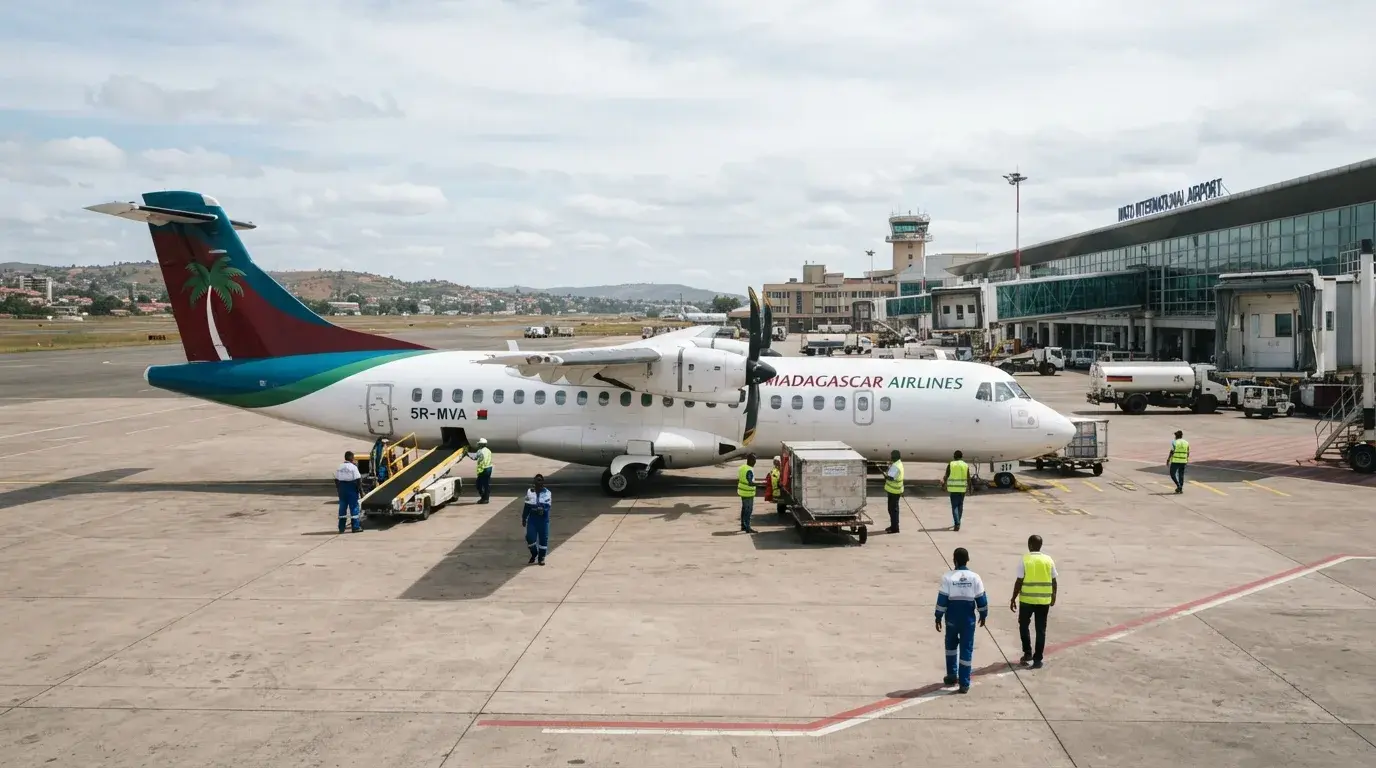
After a four-year hiatus, Madagascar Airlines has resumed direct flights to the Comoros, marking a turning point in exchanges between the two Indian Ocean archipelagos. This is the first such service since 2022, when the COVID-19 crisis and political tensions suspended the route. The Malagasy carrier now operates two weekly flights between Antananarivo and Moroni, with a stopover in Mahajanga, using an ATR 72-500. The move is eagerly awaited by travelers and local authorities, who see it as a catalyst to revive economic, family, and academic exchanges. Yet this regional relaunch is just the first step: the airline also dreams of reopening long-haul routes to Marseille and Canton, two strategic destinations for the Malagasy diaspora and international trade.
The reopening of the Antananarivo-Moroni-Mahajanga route comes at a time when Madagascar is seeking to strengthen its air connectivity, particularly with its immediate neighbors. For passengers, this means an end to costly and time-consuming detours via Addis Ababa or Nairobi, often the only options to link the two countries. The direct service aims to cut travel times and simplify connections. Comorian officials have welcomed the initiative, highlighting its importance for academic and economic exchanges between the islands. Royal Air Comores, the Comoros’ national carrier, is complementing this offer by launching a new Moroni-Mahajanga route, ensuring a local alternative.
A regional network in reconstruction
This relaunch is part of a broader effort to reposition Madagascar Airlines in the regional and international air market. Launched in 2021 to replace the former Air Madagascar, the airline is attempting to reinvent itself after years of financial and operational struggles. Its return to the Comoros is framed as a test to validate its ability to manage strategic routes before venturing into more demanding markets. “We want to show we can operate regular and reliable services,” a company spokesperson said. “The success of this route will send a strong signal for our future projects.”
Yet logistical hurdles remain. Madagascar Airlines does not yet own any wide-body aircraft and must rely on wet-lease agreements (with crew) for its long-haul routes. In the past, Ethiopian Airlines’ Boeing 787-8s and Air Belgium’s Airbus A330-200s were used to serve Paris and Marseille. To realize its ambitions toward Marseille and Canton, the airline will need to secure charter agreements with carriers capable of providing long-haul aircraft. A challenging path, especially as rising fuel costs and geopolitical tensions strain airline capacities.
Marseille and Canton: two key destinations for the diaspora
The proposed direct route to Marseille targets the Comorian and Malagasy diaspora settled in southern France. Such a service would meet long-standing demand, as travelers currently must transit via Nairobi, Dubai, or Paris to reach the French port city. “Many of our compatriots have been waiting for this route for years,” said a member of the Association of Malagasy in France. “It would make family travel and homecoming much easier.” The airline is studying the feasibility of a Mahajanga-Marseille route, with technical stops to optimize profitability.
In Asia, Canton (Guangzhou) represents another major opportunity. China has become a key economic partner for Madagascar, particularly in mining and agriculture. A direct route would strengthen trade ties and ease business travel. “Canton is our gateway to Asia,” said a Madagascar Airlines executive. “If we want to deepen our relations with China, we need a direct service.” However, competition is fierce: several African and Asian carriers already operate flights to China, and Madagascar will need to stand out with competitive fares and flawless service.
Challenges ahead
Despite the enthusiasm surrounding these projects, Madagascar Airlines faces significant obstacles. The first is financial: the airline must convince investors or public partners to fund the high costs of chartering and maintaining long-haul aircraft. Then there’s the regulatory hurdle. Chinese and French authorities impose strict safety and operational requirements. Additional certifications will be needed to launch these new routes.
Finally, competition in the African air market is fierce. Carriers like Ethiopian Airlines, Kenya Airways, and Air Seychelles already dominate international routes from Madagascar. To break through, Madagascar Airlines will need to adopt a differentiated positioning: attractive fares, flexible schedules, and a service tailored to the specific needs of diaspora travelers. “We’re not targeting the same customers as the major African groups,” said a company executive. “Our strength lies in our knowledge of local markets and our ability to offer a personalized experience.”
A future between hope and reality
While the Marseille and Canton routes remain in the study phase, the relaunch of services to the Comoros is a tangible reality. A first step that could serve as a showcase to attract new partners and investors. “We want to prove that Madagascar Airlines is back and ready to play an active role in regional air transport,” said a spokesperson. “The Comoros is just the beginning.”
In the coming months, the airline is expected to announce partnerships for long-haul aircraft charters and finalize the necessary approvals. If all goes as planned, the first flights to Marseille could launch as early as 2027, followed by a route to Canton a few months later. An ambitious timeline, but one that could mark the renewal of Malagasy aviation.
For travelers, this evolution is excellent news: fewer constraints, lower costs, and above all, better connectivity between Madagascar, the Indian Ocean, and the rest of the world. A development worth watching closely as Africa’s aviation industry enters a new era.
Be the first to comment on this article