Emirates restores 91% of pre-conflict capacity despite Middle East tensions: the secret recipe for resilience
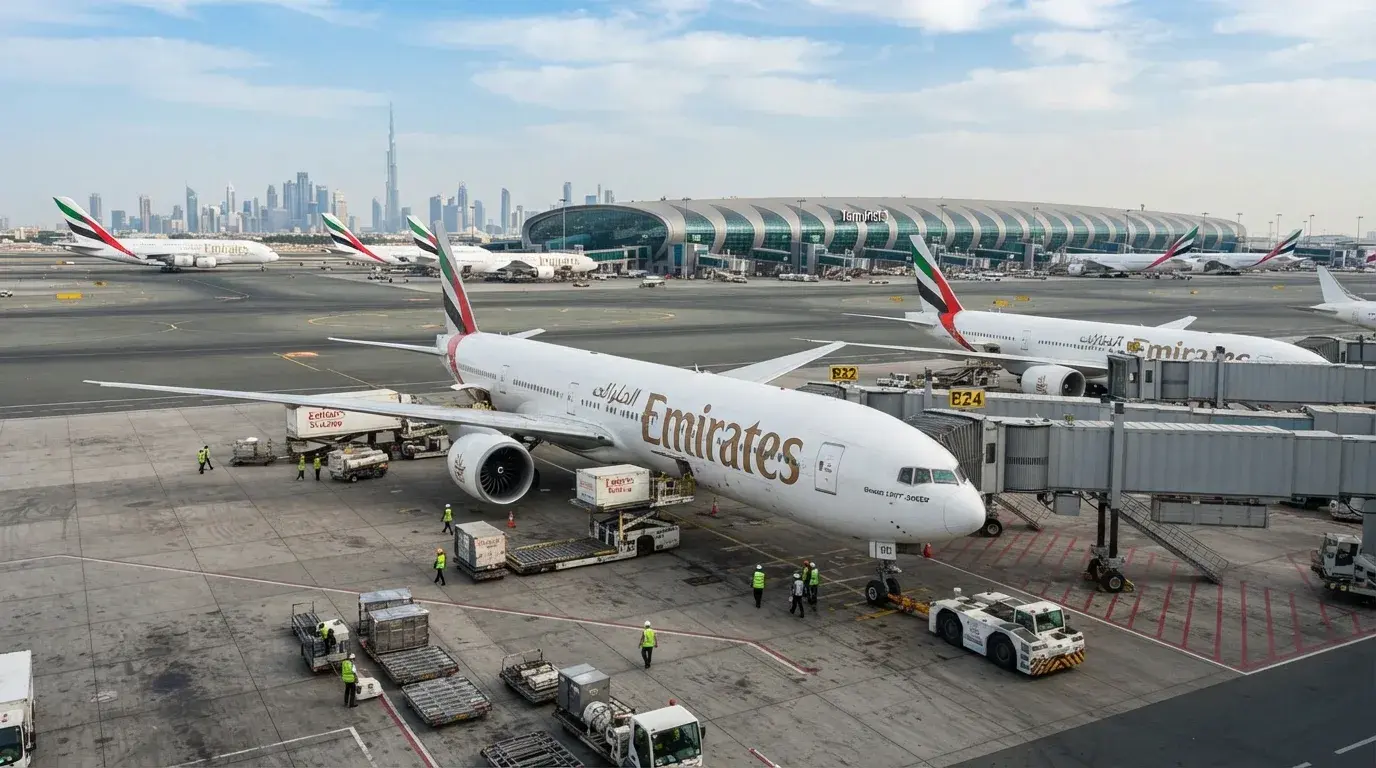
The Emirati giant Emirates has restored 91% of its pre-conflict operational capacity, a feat that stands out amid such a tense geopolitical context. At the Routes World 2026 conference in Frankfurt, Tim Clark, the airline’s president, shared the keys to this performance: sustained demand across its entire network and agile management of flight rotations. Yet behind these figures lies a more complex reality, where commercial resilience clashes with rising operational costs.
Revenue recorded the week before Tim Clark’s remarks exceeded those of the same period in 2025, a sign that demand remains robust despite regional tensions. The CEO cited Bangkok as an example of this resilience, where flights remain full. Yet this commercial health should not overshadow operational challenges: fuel costs, rerouted itineraries, and additional onboard reserves weigh heavily on expenses. “Without fuel, we would be ahead of last year,” Clark admitted, recalling that high oil prices remain a burden despite mitigation strategies.
To maintain this level of activity, Emirates relies on its Operations Control Centre, a key tool for repositioning aircraft, adjusting rotations, and managing airspace restrictions. A striking example: some flights from Paris to Dubai carried enough fuel for an immediate return in case of threat—a costly but non-negotiable safety measure for the CEO. “I need the aircraft to be safe. I need the passengers to be safe,” he stressed in an interview with AviationWeek.
These strategic choices are paying off financially. For the 2025-2026 fiscal year, Emirates reported revenue of 130.9 billion AED (35.7 billion USD), up 2%, and a pre-tax profit of 22.8 billion AED (6.2 billion USD), a 7% increase. These results highlight the airline’s ability to balance commercial growth with risk management.
A demand that withstands storms
Emirates’ resilience is not solely due to its size or modern fleet. It also relies on a targeted commercial strategy, where each market is analyzed to optimize rotations. Tim Clark emphasized that demand remains particularly strong on the group’s traditional destinations, such as Bangkok, as well as on emerging markets like Southeast Asia. This geographic diversification helps mitigate the impact of local crises on the entire network.
Yet this commercial stability comes with additional costs. Detoured routes, extra fuel reserves, and enhanced security measures inflate the bill. The airline has already weathered periods where oil prices hit $140 per barrel, and today’s experience serves as a lesson. Despite this, Emirates continues to invest in its offering, including the upcoming arrival of new Airbus A380neo aircraft, which should enhance its appeal on long-haul routes.
Operational challenges are far from over. Middle East tensions and rising fuel costs remain uncontrollable variables. But Dubai-based Emirates has proven it can navigate turbulent waters by focusing on rigorous management and a long-term vision. The question now is whether this resilience will be enough to absorb further disruptions.
Fuel: the anchor dragging down growth
Fuel costs remain the primary drag on even stronger performance. Despite capacity recovery, Emirates has not regained its pre-crisis margins. High oil prices, rerouted itineraries, and additional reserves weigh on operating accounts. “Revenue is there, but without fuel, we would be ahead of last year,” Clark summarized, highlighting the gap between commercial health and financial performance.
To limit the impact, Emirates has had to revise its routing strategies. Some flights must take longer air corridors to avoid high-risk zones, increasing kerosene consumption. Others must carry extra fuel reserves, reducing passenger or cargo capacity. These necessary choices, while costly, translate into additional expenses that erode profits.
Yet the airline has no choice. Passenger and crew safety takes precedence over financial considerations. This priority is reflected in continuous investments in fleet modernization and crew training—two essential levers for maintaining traveler confidence.
A future between expansion and caution
Despite these challenges, Emirates remains confident in its ability to rebound once Middle East tensions ease. The group is banking on the arrival of new aircraft, such as the A380neo, to strengthen its long-haul offering. These planes, more fuel-efficient and spacious, should improve the airline’s competitiveness against rivals.
Operationally, Emirates continues to invest in its Operations Control Centre, a critical tool for optimizing rotations and managing unforeseen events. This system enables rapid responses to disruptions, whether geopolitical, meteorological, or technical—a level of agility that makes all the difference in an industry as volatile as aviation.
For now, Emirates is displaying strong commercial health, but its future will depend on its ability to absorb external shocks. Fuel prices, regional tensions, and increased competition from low-cost carriers and new long-haul market entrants will all be tests to overcome. One thing is certain: Dubai’s airline has no intention of falling behind.
With rising revenue and resilient demand, Emirates proves that resilience is possible even in the most turbulent times. Yet the equation remains fragile: between expansion and caution, the Emirati giant must strike the right balance to preserve its leadership position.
Be the first to comment on this article
On the same topic
- Emirates reinvents its fleet: Why the 777X could replace 35 Dreamliners
- Emirates Weighs Swapping Boeing 787s for 777Xs: A Strategic Shift That Could Transform Long-Haul Travel
- China Finally Validates Its Order for 200 Boeing Aircraft: What This Means for Your Next International Flights
- Air France-KLM struggles amid fuel shock: How the airline withstands a 71% profit plunge
- Flybondi: March Salaries Unpaid as Argentine Low-Cost Airline Faces Pressure
- Rising Fuel Costs: Delta Air Lines Posts Loss, Cuts Capacity, and Raises Fares