Emirates Weighs Swapping Boeing 787s for 777Xs: A Strategic Shift That Could Transform Long-Haul Travel
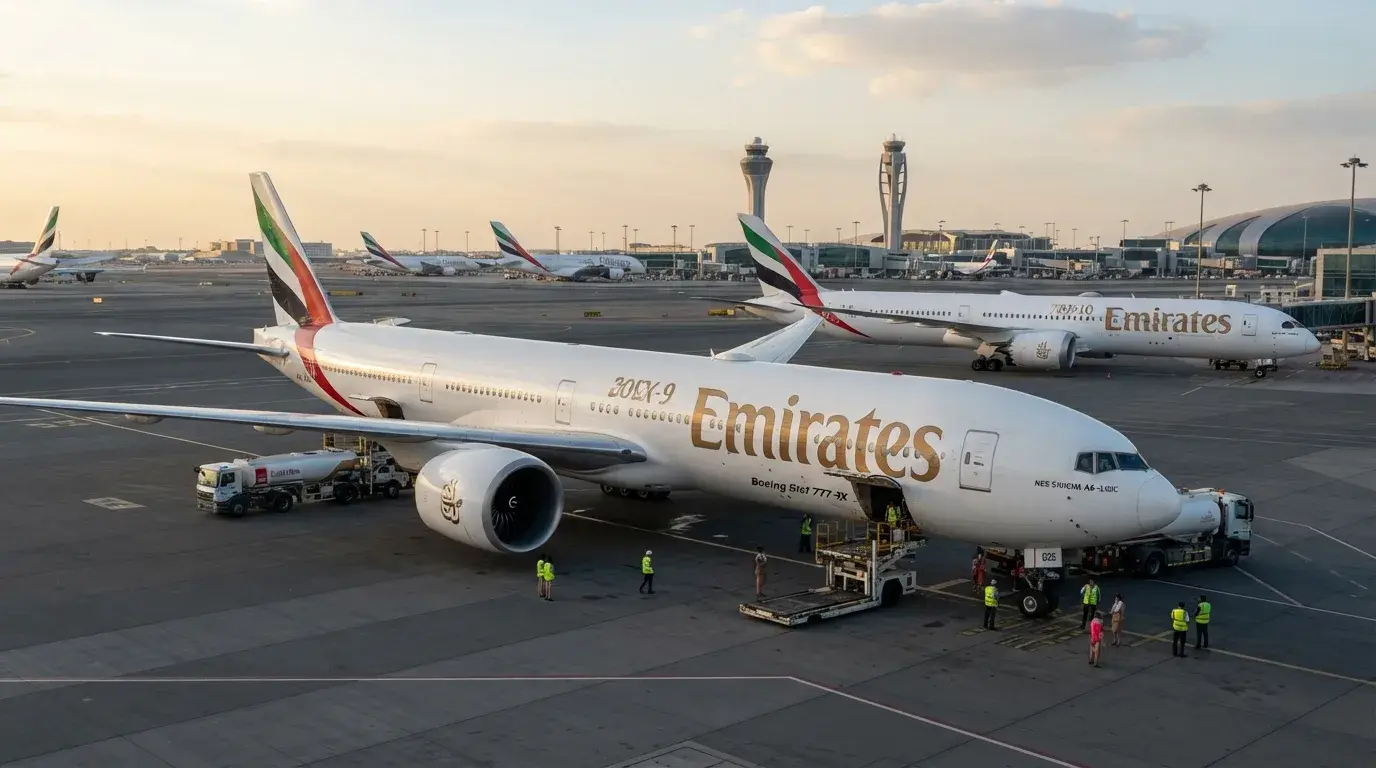
Emirates, one of the world’s leading airlines, stands at a pivotal crossroads in 2026. Facing persistent delays in Boeing’s delivery of its 787 Dreamliner, the Dubai-based carrier is exploring the possibility of converting part of its order to the Boeing 777X. A decision that could redefine long-haul fleet strategies and directly impact travelers’ access to high-demand destinations.
This option, still under discussion, comes at a time when Boeing’s industrial delays are disrupting fleet renewal strategies. The 787 Dreamliners were initially intended to bolster the airline’s capacity on routes where the existing Boeing 777-300ER aircraft might seem oversized. However, the arrival of Airbus A350 aircraft—already in service since early 2025—provides Emirates with a credible alternative to fill this gap. The dilemma now is whether the 787-8 or 787-10 remains essential or if the 777X, now in certification phase, can meet future needs.
Adel Al Redha, Emirates’ Deputy Group CEO and Chief Operating Officer, confirmed at the Arabian Travel Market 2026 that “the option to convert to the 777X remains on the table,” while noting that “everything is possible, and we will discuss all scenarios with the manufacturer.” His statement underscores the uncertainty surrounding this decision while highlighting its strategic importance for the airline.
Why This Conversion Could Transform Long-Haul Travel
If Emirates opts for a partial or full conversion of its 787 Dreamliner order to the 777X, the implications for passengers could be significant. The 777X is designed for ultra-long-haul, high-density routes, offering greater capacity and range than the 787. Here’s what this could mean for your next trips:
First, improved seat availability on the most popular routes. With a capacity of up to 426 passengers in a high-density configuration, the 777X would allow Emirates to transport more travelers per flight without increasing rotations—a major advantage for destinations like New York, London, or Sydney, where demand remains strong.
Second, a reimagined in-flight experience. The 777X is designed with enhanced comfort in mind, featuring more spacious cabins, improved pressurization, and better sound insulation. For business and first-class passengers, this could mean wider seats, redesigned communal spaces, and an overall superior experience. Emirates, renowned for its luxurious cabins, could further solidify its competitive edge against rivals like Qatar Airways or Singapore Airlines.
Finally, improved punctuality and reliability. Though the 777X has faced delays in its certification process, it incorporates Boeing’s latest technological innovations. Its entry into service, slated for Q2 2027, could reduce Emirates’ reliance on delayed aircraft deliveries—a critical factor in an industry where cancellations and delays significantly impact customer satisfaction.
A Decision Driven by Availability and Industrial Strategy
Timing is a key factor in this decision. Emirates had initially ordered 35 Boeing 787 Dreamliners, including 20 787-8s and 15 787-10s. However, deliveries of these aircraft are now estimated to begin no earlier than late 2029, due to Boeing’s industrial constraints. This timeline no longer aligns with the airline’s immediate needs, especially as its long-haul network expands and its Airbus A350 fleet has been in commercial operation for over a year.
The Boeing 777X, by contrast, is set for first deliveries in Q2 2027, pending certification—a much closer deadline that would allow Emirates to quickly address its backlog of orders. Additionally, the 777X is already a cornerstone of Emirates’ fleet renewal plan, with 270 aircraft on order. A partial conversion of the 787 order to the 777X would reinforce the airline’s strategic coherence while meeting growing demand at its hubs in Dubai and Abu Dhabi.
Adel Al Redha emphasized that the choice between the 787 and 777X will depend on ongoing discussions with Boeing. “We will examine all scenarios, including the possibility of converting part of the order or retaining some Dreamliners,” he stated. This flexibility underscores the complexity of the decision and its potential ripple effects across the aviation sector.
Consequences for the Long-Haul Market
A large-scale conversion of Emirates’ 787 order to the 777X could have a domino effect on the long-haul aircraft market. First, it would send a strong signal to Boeing, already under pressure to accelerate the 777X’s certification. Such a decision could incentivize the U.S. manufacturer to prioritize deliveries to Emirates, its most strategic customer, over other airlines awaiting aircraft.
Second, it could shift the competitive balance between Boeing and Airbus. The Boeing 777X directly competes with the Airbus A350-1000, an aircraft already in service and favored by airlines like Singapore Airlines and Cathay Pacific. If Emirates, a long-time Boeing customer, were to favor the 777X, it would strengthen the U.S. manufacturer’s position in the ultra-long-haul segment. While good news for Boeing, this could also push Airbus to reassess its commercial strategy, particularly in Asia and the Middle East.
Finally, for travelers, this could mean a broader and more diverse long-haul offering. With a modernized fleet, Emirates would be well-positioned to launch new routes or increase frequencies on existing ones. For passengers, this translates to more flight options, potentially more competitive fares due to better cost optimization, and an enhanced in-flight experience.
What This Means for Your Next Trips
Whether you’re a frequent flyer or an occasional traveler, the consequences of this decision could be felt soon. Here’s what might change in the coming months and years:
First, an increase in direct flights to destinations like New York, Los Angeles, Sydney, or Auckland. With a modernized fleet, Emirates could add more frequencies or launch new nonstop routes, catering to the growing demand for seamless travel.
Second, more competitive fares thanks to improved operational cost efficiency. The 777X, with its reduced fuel consumption and simplified maintenance, could enable Emirates to offer more attractive ticket prices, especially on routes with fierce competition. A boon for budget-conscious travelers seeking comfort and reliability.
Finally, a reimagined in-flight experience, with cutting-edge technological innovations and more modern interior designs. The 777X is engineered for superior comfort, featuring quieter cabins, wider seats, and redesigned communal spaces. For business and first-class passengers, this could mean an even more premium experience, with services aligned with the highest industry standards.
For travelers planning trips in the coming years, it will be crucial to monitor this decision closely. If Emirates confirms a partial or full conversion of its 787 order to the 777X, it could directly impact fares, frequencies, and destinations served by the airline. Another reason to stay tuned for official announcements from Emirates and Boeing in the coming weeks.
One thing is certain: the long-haul market is evolving rapidly, and Emirates’ decision could be the catalyst for change. For travelers, this means more choices, greater comfort, and potentially better fares—a shift worth watching closely, as it could redefine international air travel standards.
Be the first to comment on this article
On the same topic
- China Finally Validates Its Order for 200 Boeing Aircraft: What This Means for Your Next International Flights
- Air France-KLM struggles amid fuel shock: How the airline withstands a 71% profit plunge
- Flybondi: March Salaries Unpaid as Argentine Low-Cost Airline Faces Pressure
- Rising Fuel Costs: Delta Air Lines Posts Loss, Cuts Capacity, and Raises Fares
- Copa Airlines unveils its 2026 ambitions: 420 daily flights and 88 destinations
- The double life of the King of the Netherlands: co-pilot with KLM for almost 30 years