Air France-KLM struggles amid fuel shock: How the airline withstands a 71% profit plunge
The summer of 2026 is shaping up to be turbulent for airlines, and Air France-KLM is no exception. The Franco-Dutch group has just released a mixed second-quarter performance, marked by a dramatic 71% plunge in net profits to €190 million, down from €649 million a year earlier. Behind this headline figure lies a far more complex reality: an explosive fuel bill, partially offset by a bold upscaling strategy and unwavering pricing discipline. How is the aviation giant managing to limit the damage in a high-tension European sky?
The fuel crisis: public enemy number one
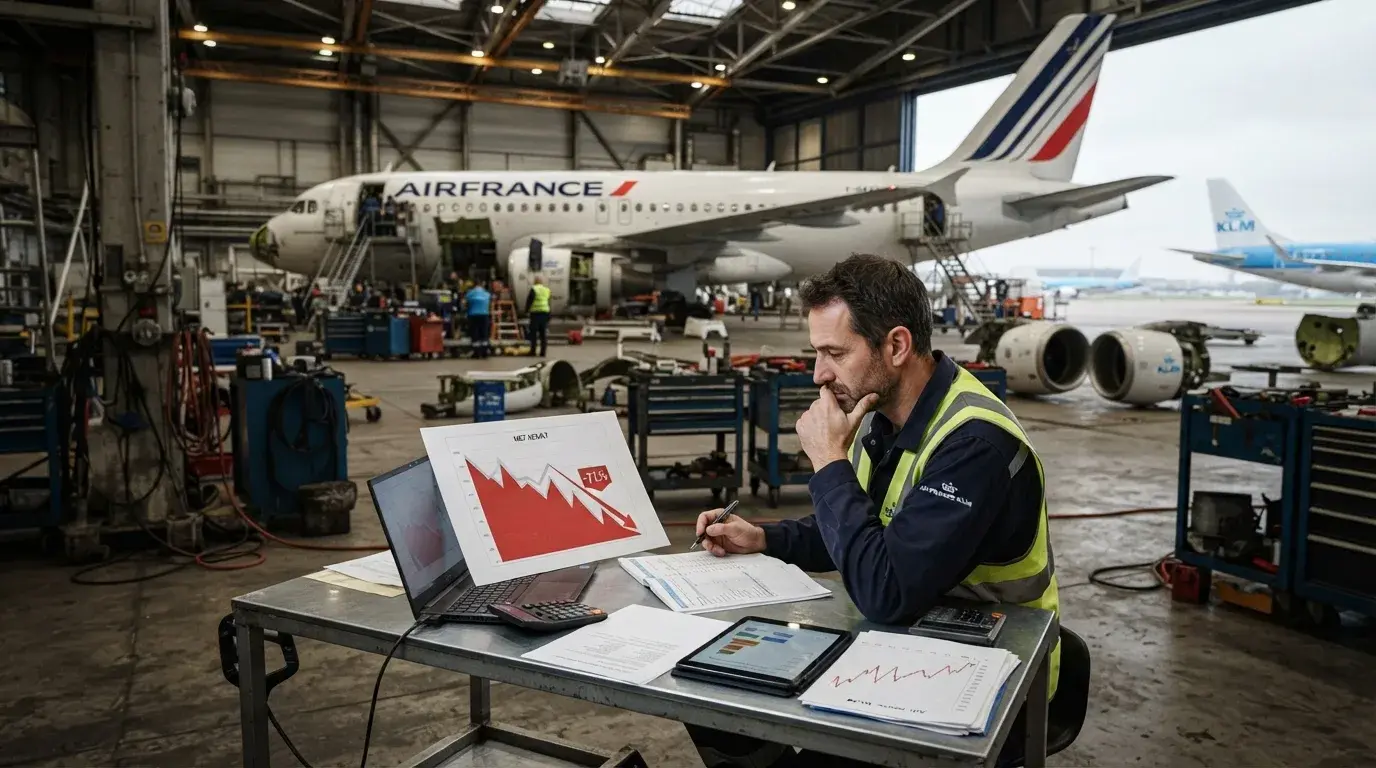
The group attributes this underperformance to a soaring energy bill. In Q2 2026, jet fuel prices generated an additional €804 million in costs compared to the same period in 2025—a colossal sum that could have plunged the entire sector into the red if Air France-KLM hadn’t reacted with agility. Benjamin Smith, CEO of the group, puts it bluntly: « We compensated around 85% of this increase through an aggressive pricing strategy and rigorous cost control. » A feat, as airlines compete fiercely to attract increasingly price-sensitive passengers.
This resilience is largely explained by the group’s upscaling efforts. The premium and long-haul segments delivered remarkable performances, driven by strong demand to Asia and North America. Cargo also performed well, benefiting from sustained demand amid a tense geopolitical backdrop. The equation is simple: the higher the fares, the more margins are preserved, despite soaring fuel costs.
Network adjustments and controlled growth
Facing these challenges, Air France-KLM has had to revise its strategy. The airline has lowered its 2026 capacity growth forecast from 2-4% to just 2-3%. A decision reflecting market uncertainties, from persistent geopolitical tensions to recurring weather disruptions. In Europe, where competition is fierce, frequency cuts are even being considered on certain routes, particularly in Düsseldorf and London. The goal? To preserve margins in an environment where every euro counts.
Yet despite this caution, the group boasts solid fundamentals. Quarterly revenue rose 9.9% year-on-year to €9.3 billion, while traffic increased by 3.9% with a stable load factor of 87.7%. Indicators showing robust demand, even in a tough economic climate. The first half of 2026 even recorded a net loss of €61 million, compared to a €401 million profit a year earlier, but adjusted operating cash flow grew by €148 million, signaling healthy financial management.
Premiumization: the key to survival?
One of the most visible levers of this strategy is the premiumization of the offering. Air France-KLM has significantly bolstered its business and premium economy classes—segments where price sensitivity is lower. Unit revenues rose by 8.7% at constant exchange rates, a record in an industry where airlines struggle to pass on cost increases to passengers. This upscaling is paired with accelerated fleet renewal: 38% of the group’s aircraft are now next-generation models, up from 30% a year ago. A modernization drive that delivers efficiency gains and reduces the carbon footprint—a growing deciding factor for travelers.
Regulatory and operational hurdles
But the battle isn’t won solely on the commercial front. Air France-KLM must also navigate increasingly heavy regulatory and operational constraints. The war in the Middle East has led to capacity reductions on certain routes, particularly those transiting through Gulf hubs. The group has had to adjust its network accordingly—a delicate exercise in an environment where demand is volatile. Meanwhile, the rollout of the European Entry-Exit System (EES), which came into force in April 2026, is beginning to impact border crossing times, especially for non-European travelers. An additional source of frustration for passengers already sensitive to delays and disruptions.
Outlook: resilience meets vigilance
In the short term, the question is no longer about demand but about the group’s ability to preserve margins in an unpredictable energy landscape. Air France-KLM has revised its 2026 fuel cost estimate downward from $9.3 billion to $8.9 billion—but this still represents €2 billion more than in 2025. The group is banking on operational agility and pricing discipline to weather the storm, but no one knows how long this respite will last.
A model to follow?
Despite the turbulence, Air France-KLM remains one of the most resilient players in the sector. Its approach—combining upscaling, financial discipline, and network adaptation—could well serve as an example to other airlines. The challenge now is to maintain this balance in skies where the clouds show no sign of clearing. For travelers, the message is clear: take advantage of the group’s efforts to secure bookings while staying alert to cancellations and delays, which are becoming increasingly common this summer.
The fuel crisis: a recurring nightmare for the industry
The surge in jet fuel prices is not a new phenomenon, but in 2026 it has reached unprecedented highs. Several factors explain this situation: geopolitical tensions in the Middle East, post-pandemic recovery, and speculation in commodity markets. For Air France-KLM, the response has been twofold: passing on part of the costs to premium fares and optimizing consumption through a modernized fleet.
The group is also exploring long-term alternatives, such as partial electrification of ground operations or the adoption of sustainable aviation fuels (SAF). But these solutions remain marginal in the short term. For now, the airline must continue navigating a sea of volatility, where every decision counts.
Premium: a shield against the crisis
Air France-KLM’s premiumization strategy aligns with a broader industry trend. Airlines are increasingly segmenting their offerings to attract passengers willing to pay more for superior service. Business and premium economy classes offer margins far superior to economy, helping offset losses in other segments.
This upscaling also comes with qualitative improvements: more spacious seats, revamped in-flight service, and an overall premium experience. A winning bet, provided demand remains robust.
A network in flux
In an uncertain environment, Air France-KLM has had to rethink its route map. Capacity cuts in Europe highlight the airline’s shift toward quality over quantity. The hubs in Paris, Amsterdam, and Lyon remain central to its strategy, but less profitable markets are gradually being scaled back or abandoned.
This approach allows the group to concentrate resources on the most lucrative routes while limiting exposure to risks. A strategy that has proven effective in the past but now faces heightened competition and evolving customer expectations.
For more on passenger rights in the event of delays or cancellations, visit the airline’s website or the services of the European Commission.
Be the first to comment on this article
On the same topic
- Flybondi: March Salaries Unpaid as Argentine Low-Cost Airline Faces Pressure
- Rising Fuel Costs: Delta Air Lines Posts Loss, Cuts Capacity, and Raises Fares
- Copa Airlines unveils its 2026 ambitions: 420 daily flights and 88 destinations
- The double life of the King of the Netherlands: co-pilot with KLM for almost 30 years
- Alaska Airlines revolutionizes its business class for long-haul flights
- British Airways deploys Starlink Wi-Fi for ultra-fast in-flight connectivity