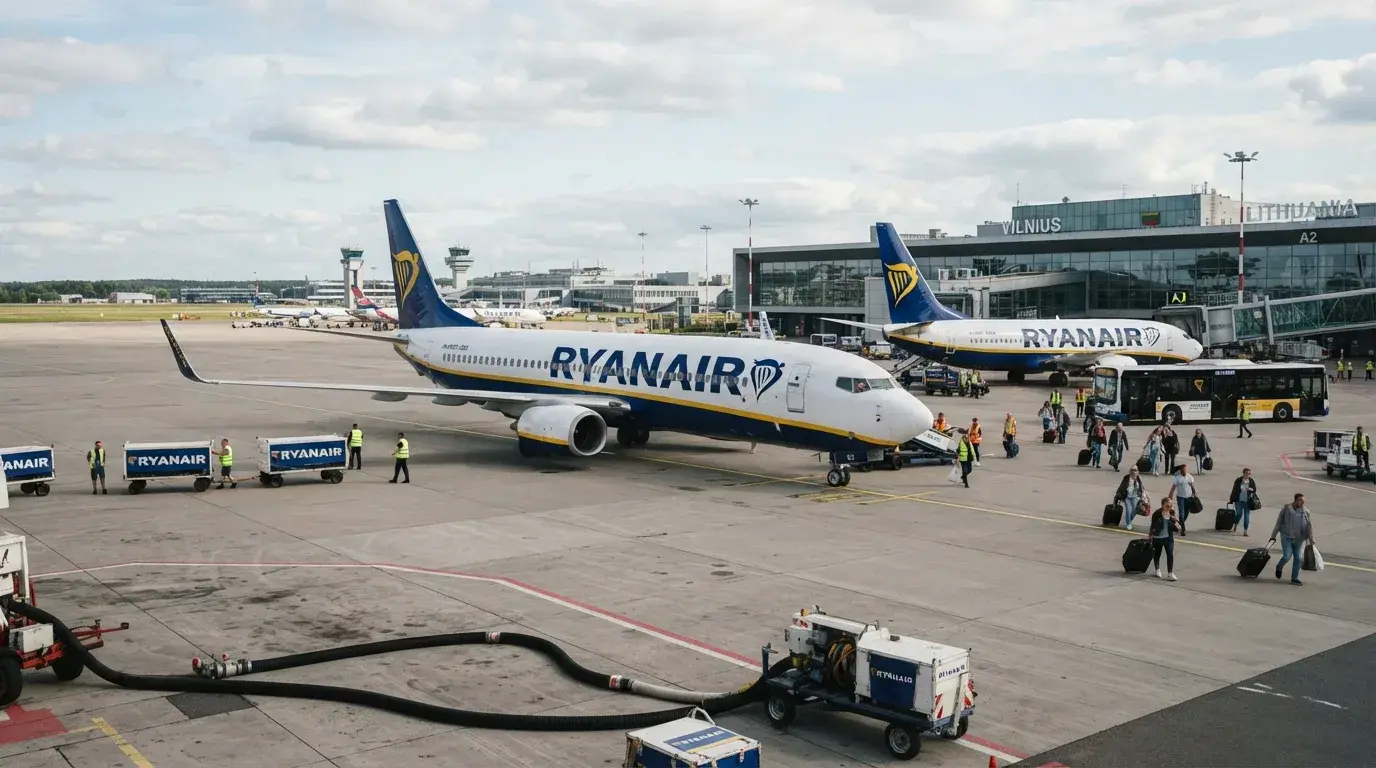
Irish low-cost carrier Ryanair has made a bold move by unveiling a massive investment plan for the Baltic states—provided the governments of Estonia, Latvia, and Lithuania drastically reduce airport fees and abolish aviation taxes. With a projected $1.6 billion investment over five years, the airline aims to double its traffic in Estonia, Latvia, and Lithuania while creating thousands of jobs in the region.
This strategic move comes as airBaltic, the region’s historic carrier, faces financial turbulence with a creditor protection procedure and a planned fleet reduction. Ryanair sees an opportunity to position itself as a credible alternative and revitalize a struggling Baltic aviation sector.
A conditional $1.6 billion investment
Ryanair’s proposal hinges on one critical condition: the reduction of airport fees and the elimination of aviation taxes. According to the airline, these measures would enable it to deploy 16 aircraft across the three Baltic countries by 2031, up from seven currently. The Irish low-cost carrier also promises to offer 11 million annual seats and generate “thousands of direct and indirect jobs.”
However, this plan remains conditional. It will depend entirely on the pricing and tax decisions made by Baltic authorities. Ryanair has previously employed this strategy elsewhere, such as in Belgium, where it withdrew five aircraft from Charleroi after an increase in the boarding tax.
The game-changing argument: doubling traffic against airBaltic
Ryanair justifies its offer by highlighting the financial difficulties faced by airBaltic, whose largest shareholder is the Latvian state. The Latvian carrier has entered a creditor protection procedure in the U.S. and plans to reduce its fleet from 54 to 36 aircraft. “Our growth proposal is even more significant following airBaltic’s announcement of a one-third fleet reduction,” Ryanair stated, even going so far as to label its competitor a “zombie airline” propped up by public funds.
In Latvia, Ryanair has already begun expanding its capacity at Riga Airport, where local authorities implemented an incentive-based pricing mechanism for airlines expanding their operations. As a result, the Irish low-cost carrier recorded a 6% increase in its winter 2026 capacity at Riga, with an additional 40,000 seats and two new aircraft based there. Conversely, it reduced its capacity in Estonia and Lithuania by 25%, cutting 550,000 seats to redeploy them to more competitive markets.
Airport fees deemed exorbitant
Ryanair has criticized the rising fees at Tallinn and Vilnius airports, calling them excessive. According to the airline, fees at Tallinn Airport surged by 70% in 2025, while those at Vilnius Airport have climbed over 30% since 2023. These increases, combined with high tax pressure, make the Baltic market less attractive for airlines.
The Irish low-cost carrier emphasizes that its proposal is not just empty promises. It points to its track record of negotiating with airports and public authorities to secure tax reductions or growth incentives. “We have already demonstrated our ability to relocate aircraft to more competitive markets when costs rise,” the airline noted.
A shifting market landscape
The Baltic states represent a strategic opportunity for Ryanair as it seeks to expand its influence in Northern Europe. Latvia, with its Riga Airport, remains the only Baltic country where the Irish carrier is growing. In contrast, Estonia and Lithuania are seeing their market shares shrink due to high costs.
The Baltic aviation market is currently dominated by airBaltic, which serves 100 destinations with a fleet of 54 aircraft. However, the Latvian carrier is struggling to recover from the pandemic’s aftermath and geopolitical tensions, creating an opening for Ryanair to establish a lasting presence.
If Baltic governments accept Ryanair’s conditions, the airline could not only double its traffic but also become a dominant player in the region. Such a shift could reshape the Baltic air transport map, offering travelers more options and competitive fares.
The question remains whether Estonian, Latvian, and Lithuanian authorities will seize this opportunity to revitalize their aviation sectors or prefer to maintain a more regulated and costly model.
What this means for travelers
If Ryanair successfully establishes a strong foothold in the Baltic states, travelers could benefit in several ways. First, a significant increase in flight frequencies with competitive fares thanks to the low-cost model. Second, a broader choice of destinations, particularly to Western and Southern Europe, where Ryanair already has a strong presence.
However, passengers should note that this scenario depends entirely on the political decisions of Baltic governments. In the meantime, the Irish airline has already adjusted its capacity, reducing flights in Estonia and Lithuania by 25% in favor of more profitable markets.
For travelers based in Latvia, the situation is already more favorable. With a 6% increase in capacity at Riga and attractive fares, Ryanair could become a compelling alternative to airBaltic, especially for trips to Western Europe.
In Estonia and Lithuania, travelers will need to wait and monitor local authorities’ decisions. If airport fees are lowered and aviation taxes abolished, Ryanair could quickly expand its network and offer new travel options.
A risky gamble for Baltic airports
Tallinn and Vilnius airports risk losing market share if Ryanair reduces its presence due to high costs. Conversely, Riga Airport, which has already introduced an incentive-based pricing mechanism, could attract more airlines and strengthen its position as a regional hub.
This situation underscores Ryanair’s aggressive negotiation tactics, which include threatening to reduce capacity or exit a market if conditions are unfavorable. A strategy that has proven effective across Europe but could also weaken less competitive airports.
In conclusion, Ryanair’s bold play in the Baltic states could reshape the region’s aviation landscape. If governments agree to lower costs, travelers stand to benefit from more destinations and lower fares. Otherwise, passengers may face limited choices and higher prices.
Be the first to comment on this article
On the same topic
- Syria: Saudi Arabia boosts air transport through investment
- London Heathrow unveils ambitious £49 billion expansion project
- Delta strengthens its investment at LAX with new routes to Hong Kong and Chicago
- IAG pledges to invest up to 200 million euros in promising innovations
- Australia approves Qatar Airways' investment in Virgin Australia
- ITA shareholders give the go-ahead for a capital increase ahead of Lufthansa's arrival