Turkish Airlines Revives Premium Economy in 2028: What Travelers Need to Know
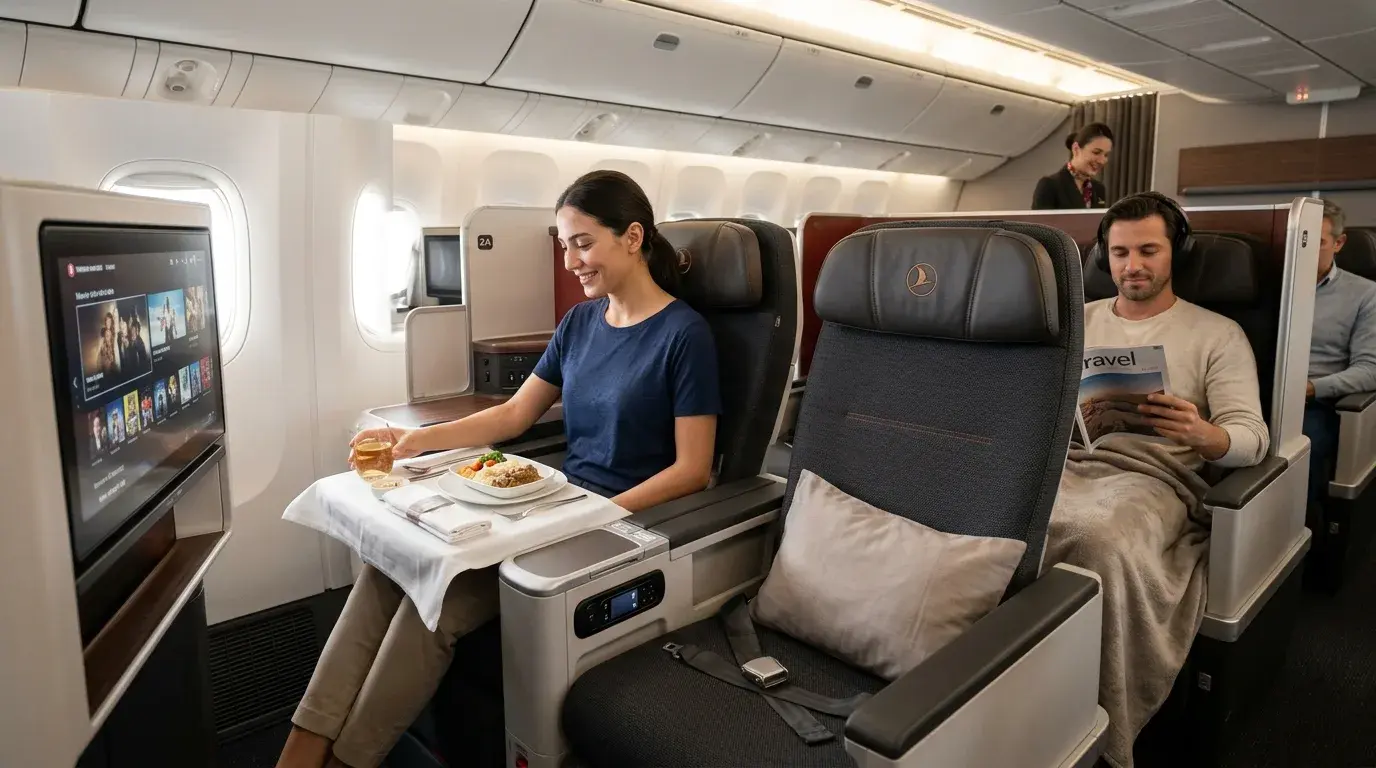
Premium Economy is making a comeback at Turkish Airlines, and it could transform your next long-haul trips. Twelve years after discontinuing its « Comfort Class », the Turkish carrier has announced the return of an intermediate cabin between Economy and Business Class starting in 2028. This decision aligns with a broader strategy to upgrade its offerings as the post-pandemic air transport market reshapes passenger expectations.
This announcement comes at a time when demand for enhanced comfort on long-haul flights has surged. Travelers, accustomed to the constraints of crowded Economy cabins, are now willing to pay extra for increased space and improved services. With plans to expand its network to nearly 350 destinations in the coming years, Turkish Airlines is banking on this new offering to stand out in a rapidly evolving sector.
In practical terms, the new Premium Economy is expected to replace between 8% and 9% of current Economy seats on wide-body aircraft. This shift reflects a global trend, driven by airlines like Air France-KLM, Lufthansa, and Emirates, which have already bolstered their intermediate offerings. For Turkish Airlines, the challenge is twofold: retaining demanding customers while optimizing the profitability of its long-haul flights.
A Bold Upgrade Strategy
Turkish Airlines isn’t just reviving a forgotten class—it’s overhauling its entire offering, with the introduction of Premium Economy prioritized on its newest aircraft. The first planes to feature this new cabin will likely be the Airbus A350-1000, with deliveries expected from the second half of 2027. The fleet of Boeing 787 Dreamliners, already on order, will also integrate this new configuration.
The choice of these aircraft is no coincidence. The A350-1000 and 787 are modern jets designed to deliver superior passenger comfort, particularly in terms of space, lighting, and noise levels. Turkish Airlines is leveraging these advantages to offer an attractive premium experience, positioned between Economy and Business Class.
Simultaneously, the airline is making significant investments in its premium classes. The new « Crystal Business Class » suite, set to debut in 2027 on the A350, embodies this modernization drive. An ambitious project aimed at repositioning Turkish Airlines as a key player in the high-end air transport market while meeting growing demand for differentiated products.
Why Now?
The return of Premium Economy at Turkish Airlines is driven by several factors. First, the post-pandemic recovery in air travel has revealed unmet demand for intermediate products. Passengers, accustomed to post-crisis savings, now seek a balance between price and comfort—a trend the Turkish carrier has clearly identified.
Second, Turkish Airlines aims to become one of the world’s leading airline hubs, with Istanbul as its central connecting point. To achieve this, it must offer a complete range of products capable of attracting different traveler segments. Premium Economy fits into this strategy, allowing the airline to appeal to a broader clientele while maintaining an attractive high-end offering.
Finally, the decision comes amid intensifying competition in the long-haul market. Airlines like Emirates, Qatar Airways, and Singapore Airlines have already invested in intermediate products to attract travelers. Turkish Airlines has no choice but to adapt to avoid losing market share to its rivals.
What Changes for Travelers
The introduction of Premium Economy at Turkish Airlines in 2028 is set to bring several significant improvements for passengers. First, seat space will be substantially greater than in Economy Class. Travelers can expect wider seats, increased legroom, adjustable headrests, and footrests.
In terms of services, the new cabin will offer additional perks, such as priority access to airport lounges, enhanced meals, and included beverages. Special attention will also be given to the in-flight experience, with larger individual screens and an improved entertainment system.
For business travelers, this intermediate offering represents an appealing alternative to Business Class, often too expensive for less urgent trips. For tourists, it provides added comfort without breaking the bank—a winning compromise for Turkish Airlines, which hopes to attract a more diverse clientele.
The airline emphasizes that this new class will be deployed uniformly across its entire long-haul fleet. This consistency should enhance the appeal of the offering and avoid the pitfalls encountered by its previous « Comfort Class », whose uneven deployment across aircraft was a drawback.
A Calculated but Necessary Gamble
The return of Premium Economy at Turkish Airlines is not without risks. The carrier must ensure that the surcharge for this class remains accessible while maintaining sufficient profitability. The challenge is significant, especially in an uncertain economic climate where fuel prices remain volatile.
Yet, the signs are encouraging. Turkish Airlines boasts a robust financial health, with a fleet in full modernization and an expanding network. The airline carried over 70 million passengers in 2025—a record—and aims for continued growth in the coming years. Premium Economy could become an additional profit lever, provided demand meets expectations.
For travelers, this innovation is all gain. By introducing this new class, Turkish Airlines is positioning itself in a modernization trend that could inspire other airlines. The question remains whether this strategy will pay off, but one thing is certain: the long-haul air transport market has never been more competitive.
Until 2028, passengers can look forward to the imminent arrival of the Airbus A350 and Boeing 787, which promise to significantly enhance onboard comfort. An evolution that, in time, could become the industry standard.
For Turkish Airlines, this is a bold but necessary wager. The return of Premium Economy could redefine air travel comfort standards and offer travelers a credible alternative to Economy and Business Class.
Be the first to comment on this article
On the same topic
- Istanbul Airport’s New East-West Runway Revolutionizes Global Air Traffic
- Singapore Airlines Tops 2026 Airline Rankings: Air France Wins Best First Class
- Istanbul overtakes Heathrow in July: Why Turkey is becoming the new star of air travel
- Turkish Airlines Suspends 18 Destinations Amid Soaring Jet Fuel Prices