Berlin-Brandenburg revolutionizes security checks: liquids and electronics stay in bags
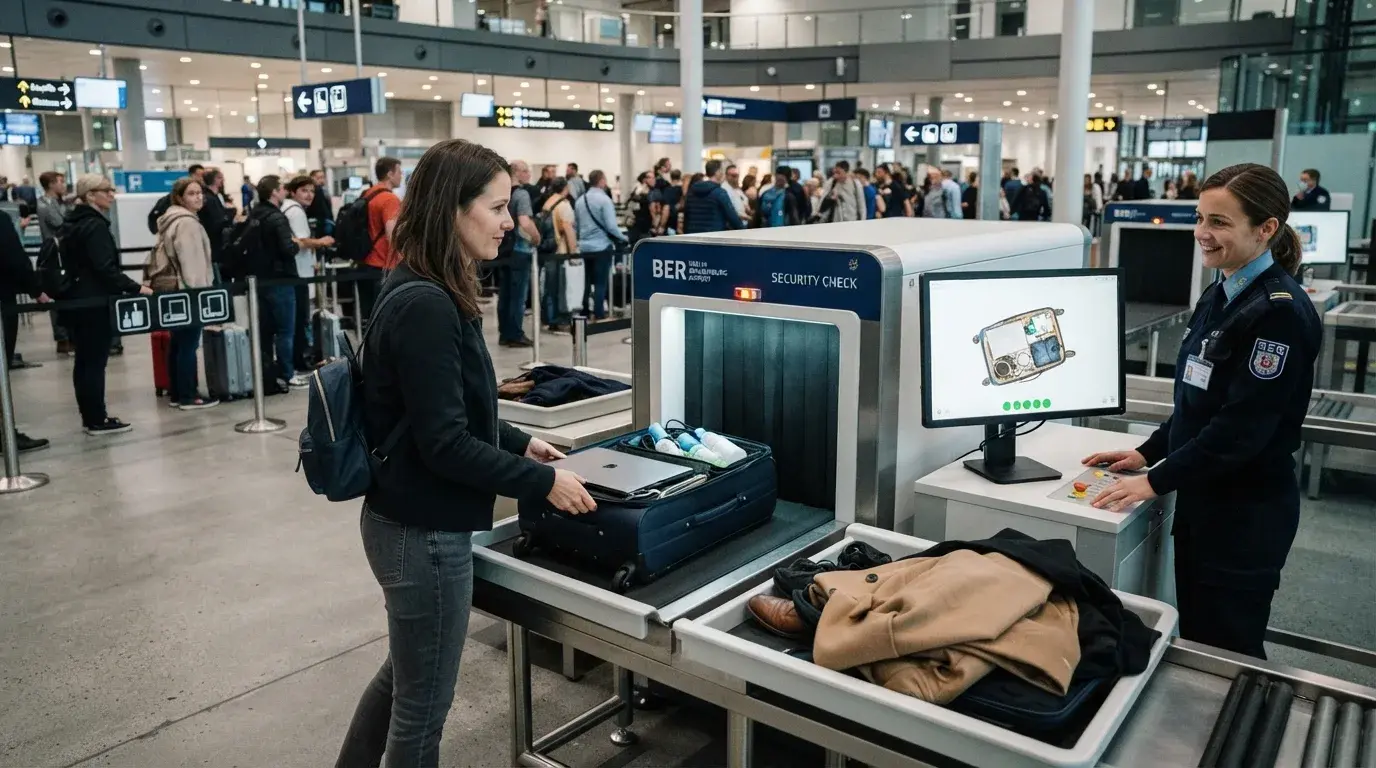
No more juggling liquids and laptops at airport security checkpoints. At Berlin-Brandenburg (BER), the travel experience is about to undergo a radical transformation. By the end of this year, the German airport will complete the modernization of its security facilities, allowing all passengers to pass through checks without removing liquids or electronic devices from their carry-on luggage. A major evolution that promises to streamline processes and reduce waiting times, in a context where flight punctuality remains a key concern for travelers.
This transformation is part of a project launched over a year ago. After equipping the northern and southern sectors of Terminal 1 and Terminal 2 with CT scanners capable of detecting liquids in luggage, Flughafen Berlin Brandenburg GmbH (FBB), the airport operator, is now focusing on the last two conventional control zones in the central hall of Terminal 1. Once these systems are replaced, all travelers will benefit from this new freedom, provided they follow the specific baggage preparation rules for CT scanners.
For passengers, the benefits are twofold. First, a simplified travel experience, eliminating the cumbersome step that consistently lengthened queue times. Second, a reduced risk of loss or theft of personal belongings, often mishandled during traditional checks. “With the new security controls, we are offering an even more comfortable travel experience and more efficient procedures at BER,” says Aletta von Massenbach, Chair of the FBB Executive Board. “The modernized controls will then be accessible to all BER passengers and will significantly improve the flow in the main hall of Terminal 1.”
This technological advancement goes beyond improved equipment. Individual baggage preparation stations will be replaced by longer, shared drop-off belts, providing travelers with more space to organize their belongings. This new setup allows a passenger ready to proceed through security to bypass another traveler still preparing their luggage, if necessary. The operator aims to better utilize available lines and create more regular flows, without setting a specific target for reducing wait times—a caution that contrasts with airports’ often unmet promises of smoother operations.
During this transition period, it’s important to note that baggage preparation rules still vary depending on the equipment used. At CT scanner checkpoints, liquids can be carried in containers up to two liters and remain in hand luggage, as can electronic devices. However, at conventional checkpoints, liquids must still be transported in containers of no more than 100 ml, grouped in a one-liter, resealable transparent bag, and presented separately. A nuance that could still confuse travelers despite the ongoing modernization.
To avoid any inconvenience, Aletta von Massenbach advises passengers to follow the rules for conventional checks until the modernization is fully completed. A reminder that the transition to a 100% CT scanner airport will take a few more weeks, or even months. Until then, caution remains essential to avoid being held up at an outdated control system.
CT scanners for enhanced security, not relaxed rules
The installation of CT scanners at Berlin-Brandenburg marks a major technological shift in how carry-on luggage is screened. Unlike traditional systems, which require separating liquids and electronic devices, CT scanners provide a three-dimensional view of the entire contents of luggage without needing to open containers. This technology, already deployed in several European airports, significantly reduces false positives and speeds up the screening process.
However, this innovation should not be seen as a relaxation of security rules. CT scanners offer better detection of suspicious objects, including liquids in large containers, while allowing passengers to keep their belongings in their luggage. An advancement that combines convenience and efficiency without compromising facility safety.
Additionally, the new shared drop-off belts improve passenger flow organization. Longer and better-sized, they allow travelers to prepare their luggage more smoothly, reducing bottlenecks in security zones. An improvement that, according to early feedback, is already noticeable in the Terminal 1 and Terminal 2 sectors equipped with CT scanners.
Could Berlin-Brandenburg set a model for other major European airports?
Berlin-Brandenburg could well serve as a reference for other major European hubs still using conventional screening systems. By modernizing its facilities, the German airport demonstrates that transitioning to CT scanners is not only feasible but also beneficial for all travel stakeholders: passengers, airlines, and airport authorities.
For travelers, the advantages are clear: faster checks, a simplified travel experience, and reduced risks of loss or theft of personal belongings. For airlines, this means more punctual flights and better connection management. Finally, for airport authorities, this modernization aligns with a strategy of enhanced security and operational efficiency—two absolute priorities in an ever-evolving sector.
If Berlin-Brandenburg successfully completes this transition by the end of the year, as planned, it could become one of the first major European airports to offer a fully modernized security screening experience. A model to follow, especially in a context where flight punctuality remains a critical issue for travelers and airline operators.
Key takeaways before traveling to Berlin-Brandenburg
Before heading to Berlin-Brandenburg, it’s essential to properly prepare your luggage to avoid any issues during security checks. Here are the key points to remember:
Liquids and electronic devices can remain in carry-on luggage only at CT scanner checkpoints. If you go through a conventional checkpoint, you’ll still need to follow the old rules: liquids in containers no larger than 100 ml, grouped in a one-liter, resealable transparent bag, and presented separately.
Allow plenty of time to prepare your luggage. While the new shared drop-off belts offer more space, this shouldn’t encourage haste. Good organization helps streamline flows and reduce wait times.
Finally, stay informed about the progress of the works. Although Berlin-Brandenburg aims to complete the modernization by the end of the year, adjustments may still occur. Check the airport’s website or social media for the latest updates before your departure.
With this modernization, Berlin-Brandenburg is taking a giant leap toward smoother, more pleasant air travel. An evolution that, if well executed, could inspire other airports across Europe.
Be the first to comment on this article
On the same topic
- US air traffic control outage: 15,000 flights canceled in 48 hours as airlines scramble to save Thanksgiving
- Airbus A330-900: Record 480-Passenger Capacity Set to Disrupt Long-Haul Flights
- Emirates restores 91% of pre-conflict capacity despite Middle East tensions: the secret recipe for resilience
- A380: FAA Mandates Urgent Engine Part Replacements After Uncontained Engine Failure
- 737 MAX Sets Delivery Record with 363 Aircraft in Nine Months as FAA Validates Safety Despite New Software Bug
- Kenya Airways in the spotlight after controversial death aboard Nairobi-Lagos flight