E-visa at boarding: Why airlines struggle to verify travelers' digital documents
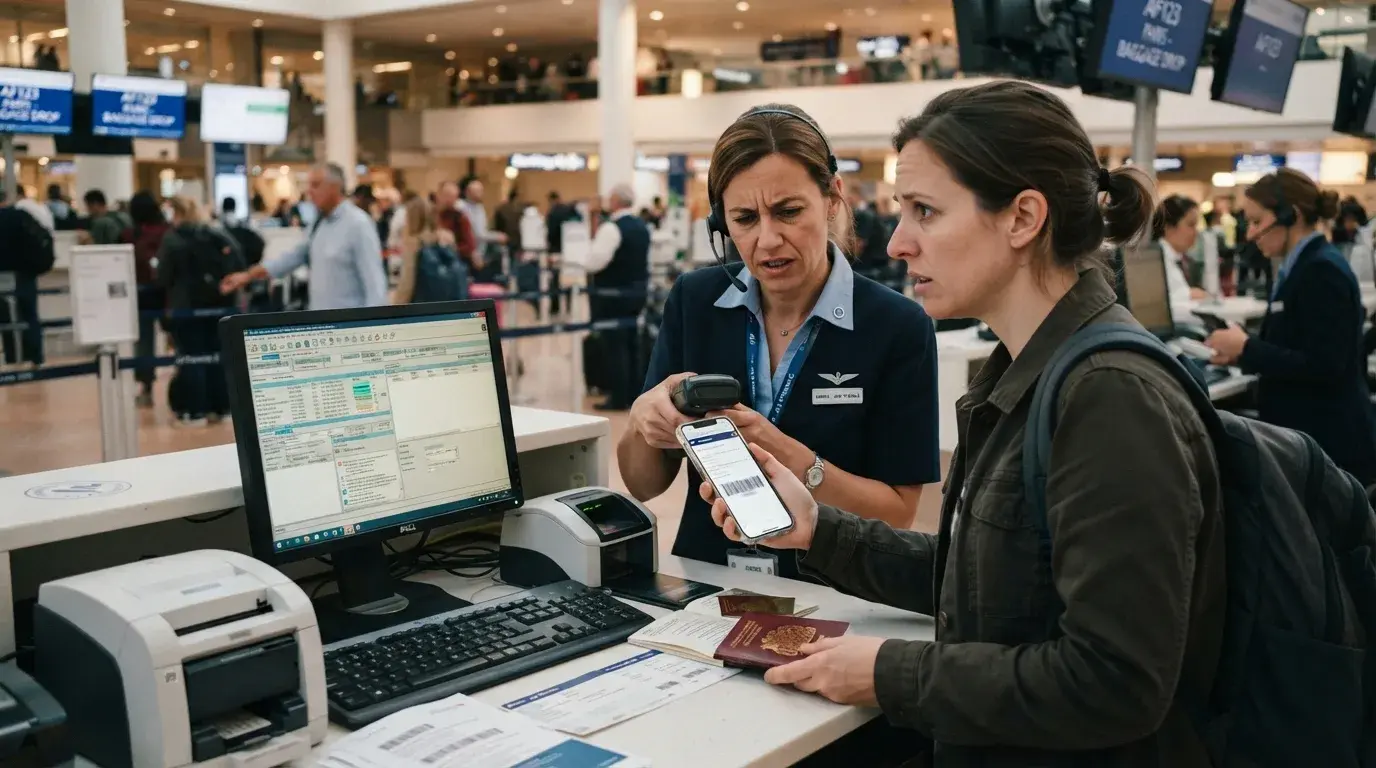
A passenger arrives at boarding with their passport, e-ticket, and a QR code or PDF supposedly proving the validity of their e-visa. The airline agent, tasked with verifying these documents, faces a daunting task: how to confirm that this proof was actually issued by the destination country’s authorities? The International Air Transport Association (IATA) has been warning for years about this major flaw in the pre-flight passenger verification process. While over 100 countries now offer electronic visas, carriers struggle to access a reliable tool to authenticate their validity in real time.
The challenge lies in the diversity of formats. Depending on the destination, proof of an e-visa can take the form of a simple email, a PDF file, or a QR code. Some countries even require manual verification via a government website, while others rely on secure databases accessible to airlines. This lack of standardization forces agents to perform multiple checks for each passenger, with inconsistent results. The IATA estimates the average cost of a verification error at $9,000 per affected passenger, including re-routing fees and potential fines imposed by local authorities.
For Alexandre Demaille, CEO of the specialized agency RapideVisa, the issue goes far beyond administrative verification. “An airline can easily check data on a document, such as the name or passport number, but it cannot authenticate the origin of the file presented. A fake e-visa, for example, is almost impossible to detect without a digital signature system or a centralized database.” This vulnerability exposes travelers to entry refusals, forcing airlines to arrange costly and logistically challenging repatriations.
Faced with this reality, IATA advocates for harmonized verification systems. Two main mechanisms are emerging as potential solutions. The first, the iAPI (interactive Advance Passenger Information) system, allows airlines to send passenger data to destination authorities at check-in, receiving an immediate response. “Carriers report up to 20 times fewer errors in countries with full iAPI systems compared to those relying on manual checks,” the association notes. Unfortunately, fewer than 30 countries currently have such a system in place.
The second mechanism, the DTA (Digital Travel Authorization), aims to provide a standardized and verifiable proof of an electronic authorization’s issuance. Unlike a simple QR code, the DTA relies on a digital signature to confirm the document’s authenticity. The International Civil Aviation Organization (ICAO) has integrated this standard into its recommendations, but adoption remains slow. “Without an international standard, airlines must adapt their procedures country by country, significantly increasing their operational burden,” Demaille explains.
The risks extend beyond the documents themselves. Fake online platforms can deceive travelers into purchasing illegitimate e-visas without their knowledge. These often short-lived sites disappear after processing payments, leaving passengers in legal trouble upon arrival. “We’re seeing a surge in these scams, particularly targeting rushed or administratively inexperienced travelers.” The expert emphasizes that specialized agencies like RapideVisa, while paid, offer compliance guarantees that fraudulent platforms cannot match.
For airlines, the widespread adoption of iAPI and DTA systems would represent a major gain in reliability and speed. Yet, structural realities hinder progress. The digitization of visas has outpaced the infrastructure needed to verify them. “Governments must understand that issuing an e-visa is not enough—they must also provide the means to validate it effectively.” IATA is calling on authorities to collaborate with carriers to integrate these new standards, particularly when launching electronic visa programs.
Until harmonization is achieved, travelers remain vulnerable. Airlines, in turn, must navigate a system where the risk of error looms with every boarding. To avoid unpleasant surprises, passengers are advised to verify the source of their e-visa and prioritize official or approved platforms. A vigilance that could spare them a ruined trip.
Verification systems still too fragmented
The absence of a unified standard forces airlines to juggle disparate procedures. Some countries, such as the United Arab Emirates or Saudi Arabia, have implemented databases accessible to carriers, enabling real-time verification. Others, like India or Kenya, rely on QR codes whose validity can be contested in cases of fraud. This disparity creates gray areas where passengers, despite being compliant, are blocked at boarding.
Low-cost carriers, often less equipped with human and technological resources, are particularly exposed. Ryanair, for example, has experienced multiple incidents involving e-visas deemed non-compliant by local authorities, leading to delays and additional costs. “We’ve had to train our agents to recognize fake documents, but it’s a Sisyphean task. As soon as a fraud model is identified, scammers develop a new one.” A company representative, who wished to remain anonymous, highlighted the difficulty of keeping up with evolving counterfeiting methods.
Gulf-based carriers, however, have learned from past incidents. Emirates and Qatar Airways have invested in automated verification systems integrated directly into their booking platforms. These tools cross-check passenger data with government databases before they even reach the airport. An approach that reduces error risks but remains out of reach for many European or African airlines.
Toward a universal solution? Exploring potential pathways
Several initiatives aim to break this fragmentation. The European Union, for example, is developing a pan-European system for verifying electronic visas, inspired by the model of biometric passports. This project, still under study, could allow airlines to validate documents via a single interface connected to the databases of all EU member states. A major step forward for travelers visiting multiple EU countries.
In the United States, the administration launched in 2025 a pilot program for e-visa verification via ESTA, the visa waiver system for eligible countries. Preliminary results are promising: verification errors dropped by 80% on tested flights. A clear indication, according to experts, that standardization is possible—provided governments commit to this path.
For travelers, the safest solution remains to contact embassies or official platforms directly before booking their flight. Airlines, for their part, are stepping up warnings in their transport conditions, reminding passengers that the ultimate responsibility for document validity lies with them. A stance that, in practice, does not resolve the core issue: how to ensure reliable verification at boarding?
In the meantime, passengers must exercise extreme caution. An e-visa obtained in a few clicks may seem convenient, but it also represents a source of stress and unexpected expenses if its authenticity is challenged. In a world where travel accelerates, the security of digital documents has become as critical as flight punctuality.
Be the first to comment on this article
On the same topic
- Air Freight: Why This 4.4% Surge in August 2026 Will Drive Up Delivery Prices
- AnimaWings in Crisis: Six A220s Grounded, Judicial Restructuring Underway
- Etihad Revives Its Last Airbus A380 After Six Years Grounded: Why the Giant of the Skies is Back
- Azores Airlines soon to change hands: five bidders vie for privatization
- Turkish Airlines makes bold move: 150 Boeing 737 MAX ordered, a daring bet to reshape European skies
- Emirates Weighs Swapping Boeing 787s for 777Xs: A Strategic Shift That Could Transform Long-Haul Travel