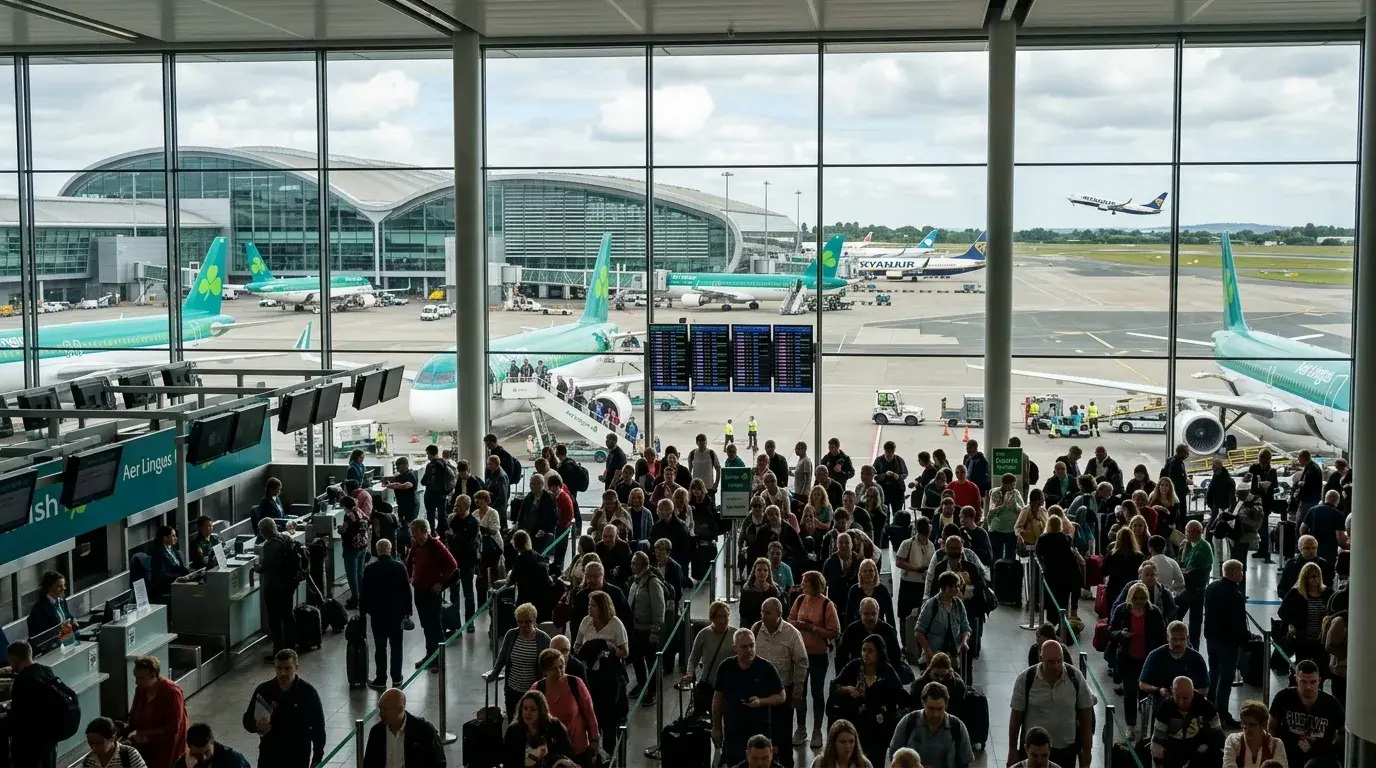
Ireland is poised to take a decisive step for its aviation sector by removing the annual cap of 32 million passengers at Dublin Airport. A legislative reform expected by summer could finally unlock growth for the country’s main hub, as airlines and authorities warn of possible flight slot restrictions due to ongoing European legal proceedings. The decision could reshape transatlantic and European connectivity from the island.
The Irish government is accelerating efforts to align its primary airport with current air traffic realities. According to the Irish Times, Transport Minister Darragh O’Brien is set to introduce legislation in the coming weeks—the Dublin Airport Passenger Capacity Bill 2026—aimed at amending or abolishing the 32-million annual passenger limit at Dublin Airport (DUB). This constraint, introduced in 2007, was established when traffic growth was far lower and concerns focused more on the local impact of airport development.
If passed, the bill would grant the minister the power to adjust or repeal the cap, allowing Dublin to catch up with rival hubs such as Amsterdam, Frankfurt, or Paris. However, the timeline is tight: authorities hope for adoption before the mid-July parliamentary recess, or the vote risks slipping to September. The stakes extend beyond administrative measures. Several airlines have warned of immediate capacity restrictions, as Dublin is already operating de facto beyond its regulatory limits.
In 2025, Dublin Airport handled over 36 million passengers—about 4 million above the regulatory threshold. This legally precarious situation creates constant pressure on takeoff and landing slot allocations. A pending legal challenge could force the Irish Aviation Authority (IAA) to strictly enforce the cap in its capacity calculations. If that occurs, the consequences would be immediate: fewer flights, frozen new routes, and constraints on airline expansion.
Growth at Risk Due to Legal Proceedings
The dispute dates back to 2024, when airlines challenged the Irish regulator’s decision to include the cap in capacity calculations. The High Court suspended this approach in November 2024 and referred questions to the Court of Justice of the European Union (CJEU) on matters of EU law. A ruling is expected in the coming months. If the CJEU upholds the cap, pressure on Dublin could become critical in the short term. Carriers, particularly Ryanair and Aer Lingus, are actively advocating for its removal.
Ryanair has already highlighted in 2024 that over one million seasonal seats were blocked at Dublin due to the limit, arguing it “no longer reflects real market demand.” Aer Lingus, for its part, relies heavily on Dublin as a strategic hub, especially for transatlantic connections. Any capacity restrictions would directly impact its Europe–North America connecting model. Dublin Airport plays a key role in transatlantic traffic, bolstered by U.S. preclearance facilities that make it a particularly attractive platform for Europe–U.S. flows.
The 32-million passenger cap was introduced when traffic growth was far lower. Since then, the aviation landscape has evolved dramatically, driven by the expansion of low-cost carriers—especially Ryanair at Dublin—the rise of long-haul routes, and the rapid post-Covid recovery of European and transatlantic traffic. In this context, Dublin is already operating beyond its regulatory constraints, creating a legally fragile situation.
Dublin: A Strategic Hub for Europe and North America
Dublin Airport is more than a regional airport—it is a major gateway for transatlantic travelers thanks to its U.S. preclearance facilities. This advantage attracts airlines like Delta Air Lines, United Airlines, and American Airlines, which use it as a key stopover for flights between Europe and the United States. Without the ability to accommodate more passengers, Dublin risks losing ground to competitors such as Amsterdam, Frankfurt, or Paris, all engaged in a growth race.
Removing the cap would allow Dublin to better meet rising demand for direct routes to destinations in the Americas, Asia, and Africa. For airlines, this means greater flexibility in slot allocation and the opportunity to launch new routes. For passengers, it promises more competitive fares and improved connectivity. But time is running out: each week of delay in passing the reform translates into lost opportunities for Ireland’s economic development.
Ongoing discussions in the Irish Parliament and at the European level will be pivotal for Dublin’s future. If the reform is adopted, Ireland could finally remove a major obstacle to its aviation appeal and strengthen its position in the global air transport network.
An Economic and Geopolitical Imperative
Beyond passenger traffic, Dublin Airport is an economic engine for Ireland, generating thousands of direct and indirect jobs in tourism, logistics, and services. Limited airport growth also means limited growth for the Irish economy. Local and national authorities are acutely aware of the link between air connectivity and economic development.
The cap crisis highlights a broader challenge in the European aviation sector: balancing regulation, growth, and profitability. Airlines, particularly low-cost carriers, are pushing for greater liberalization of slots and capacity. Regulators, meanwhile, must prevent congestion and ensure operational safety. In Dublin’s case, the question is straightforward: should an artificial cap be maintained, or should infrastructure adapt to market realities?
For Ireland, the answer is clear. The country is banking on its hub to attract investment and tourists, and to strengthen its position in the global aviation network. Removing the passenger cap at Dublin Airport could mark the first step toward a new era of growth for Irish aviation.
Be the first to comment on this article
On the same topic
- Ryanair and Google Cloud Partner to Revolutionize Flights with AI by 2026
- Charleroi-Brussels South closed for 11 weeks in 2028: how to organize your trips stress-free
- How Ryanair Prepares for Its Biggest 2026/27 Winter with 80 Million Seats and 1,700 Routes
- easyJet soon in Apollo’s hands? What the fund battle means for your European flights
- EES checks in French airports: Why Ryanair is calling for a summer pause
- Ryanair tightens check-in deadlines from November 2026