The WindRunner: This Giant Cargo Plane Set to Revolutionize Wind Turbine Component Transport
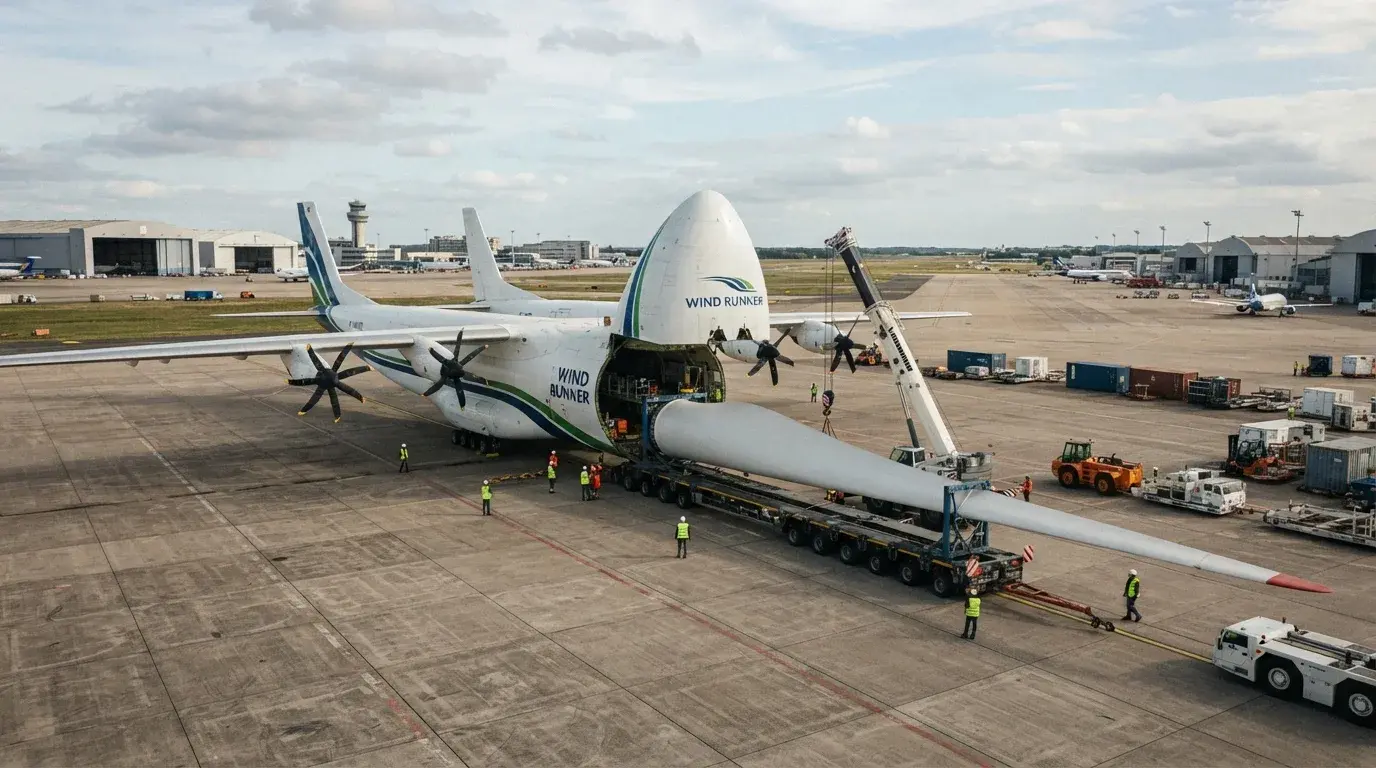
Imagine an aircraft capable of carrying 105-meter-long wind turbine blades, 10-meter-wide tower sections, and 9-meter-high components, all in a hold with a volume of nearly 7,700 m³. That’s exactly what the WindRunner promises as the world’s largest cargo plane, developed by U.S. start-up Radia. And it’s not just a theoretical promise: French equipment manufacturer Latécoère has just been selected to design the complete electrical system for this groundbreaking aircraft.
This collaboration, announced on July 18, 2026, marks a key milestone in the development of the WindRunner. Latécoère, renowned for its expertise in aeronautical electrical systems, will work from its Toulouse design office and on-site at Radia in the United States to define the electrical architecture, integrate systems, and establish a technical base tailored to the specific constraints of this exceptional program. The stakes are high: the aircraft boasts unprecedented dimensions—109 meters long, 80 meters wingspan—and can transport payloads of up to 72.6 tonnes, but above all, components that cannot be shipped by road or sea.
The first synthetic images of the WindRunner give an idea of the scale of the project. With a hold designed to accommodate elements far exceeding current standards, such as giant wind turbine blades or tower sections, the aircraft positions itself as a strategic transport solution for the wind energy industry. Radia emphasizes that « these components are too large to be transported by truck or ship, which currently limits the construction of wind farms in remote or hard-to-reach areas ». The WindRunner could therefore become an essential link in accelerating the deployment of renewable energies by simplifying logistics.
A Plane Designed for XXL Components, Not Standard Freight
Unlike existing cargo planes such as the Boeing 747-400F or Boeing 777F, which prioritize standardized pallets and containerized freight, the WindRunner is optimized for oversized loads. Its hold, with a volume of up to 7,700 m³, is designed for components measuring 105 meters long, 10 meters wide, and 9 meters high. For comparison, a Boeing 747-400F, with a maximum payload of 110 tonnes, offers a hold far less suited to these dimensions. The WindRunner, however, focuses on applications where size takes precedence over weight: wind turbine blades, tower sections, or even oversized commercial loads for defense or aerospace.
The aircraft is designed to operate from 1,800-meter runways, including unpaved ones, with a cruising speed of around Mach 0.6 and a range of 2,000 km at maximum payload. These features make it a versatile tool, capable of serving isolated industrial sites or wind farms under construction where road or maritime infrastructure is insufficient. Radia points out that « the WindRunner will enable the direct delivery of the largest and most efficient turbines to wind farms », bypassing current logistical constraints.
A Growing Industrial Ecosystem
The selection of Latécoère is just one piece of the WindRunner’s industrial puzzle. The U.S. start-up has also chosen Stirling Dynamics for flight control systems and is working with other European partners to strengthen the program’s industrial base. According to Aviation Week, this strategy allows Radia to « highlight European suppliers » while positioning the WindRunner as a response to NATO’s strategic transport needs. For Latécoère, this contract is an opportunity to consolidate its position as a partner of choice for major aeronautical programs. The French equipment manufacturer believes this project demonstrates its teams’ ability to support entirely new aircraft architectures—a crucial asset in a sector where innovation is key.
First flights of the WindRunner are scheduled for the second half of the decade, with commercial service expected around 2030, pending certifications and technical development. Radia and its partners emphasize that this project could become a standard for transporting exceptional loads, both in wind energy and other industrial sectors. Latécoère’s involvement in developing the electrical system is therefore a vote of confidence for an aircraft that could redefine the rules of air transport for years to come.
Why the WindRunner Could Be a Game-Changer for Wind Energy
The development of the WindRunner comes at a time when the wind energy industry is seeking to optimize costs and access increasingly complex sites. Today, transporting wind turbine blades or tower sections often relies on costly exceptional convoys limited by road infrastructure. The WindRunner could provide an airborne solution, more flexible and less restrictive. With the ability to transport 105-meter blades, it paves the way for even larger and more powerful turbines—a key lever for reducing the cost of wind energy.
The aircraft could also play a role in defense and aerospace, where transporting oversized loads is a recurring challenge. Radia mentions applications for military components or XXL commercial structures, further enhancing the WindRunner’s versatility. Finally, with the first phase of development underway and strong industrial partnerships, the project appears well-positioned to deliver on its promises. If all goes as planned, this aircraft could enter commercial service by 2030, marking a new era for air transport of exceptional loads.
For players in the wind energy, defense, or aerospace industries, the WindRunner represents a unique opportunity to rethink logistics. And with partners like Latécoère at the helm of the electrical system, the project gains credibility and international visibility. One thing is certain: if the WindRunner lives up to its promises, it could well become the new benchmark for air transport of oversized loads.
Be the first to comment on this article
On the same topic
- Airbus A350-2000 and A220-500: End of Twin-Aisle Monopoly?
- Emirates reinvents its fleet: Why the 777X could replace 35 Dreamliners
- JetBlue Acquires Spirit Airlines' Slots at New York LaGuardia: What It Means for Your 2027 Flights
- Biman Bangladesh Airlines bets on Airbus to conquer Europe and North America with A350 and A321neo
- Air Freight: Why This 4.4% Surge in August 2026 Will Drive Up Delivery Prices
- AnimaWings in Crisis: Six A220s Grounded, Judicial Restructuring Underway