Etihad poised to order 10 Boeing 787s at Farnborough: a strategic move to watch
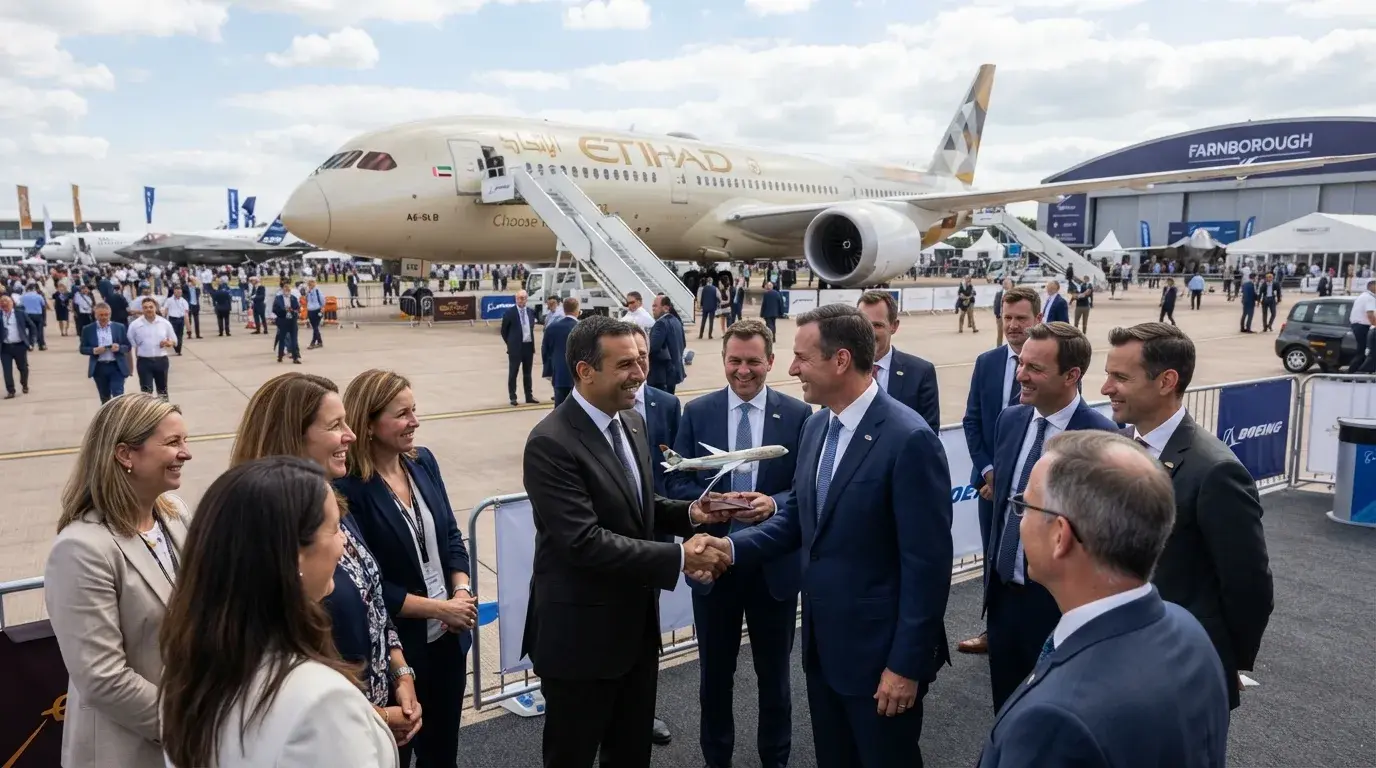
The Farnborough Airshow, opening in a few days, is shaping up to be a pivotal moment for long-haul aircraft orders. Etihad Airways is reportedly set to finalize an agreement for around ten Boeing 787 Dreamliners, an announcement that would underscore its commitment to strengthening its fleet and intercontinental network. This decision is one to watch for travelers and industry professionals alike, particularly as demand for fuel-efficient, high-performance aircraft has never been higher.
According to multiple industry sources cited by Reuters, Etihad Airways is close to finalizing a deal for ten Boeing 787s, with a possible announcement as early as this July during the UK airshow. While neither Etihad nor Boeing has confirmed the reports, the rumor has quickly become one of the key events to monitor at the 2026 edition. A deal of this scale would reflect a measured but targeted growth strategy, far removed from headline-grabbing mega-orders but precisely aligned with the airline’s operational needs.
This potential order comes at a time when Etihad Airways is experiencing steady growth. By late 2025, the airline was already operating 37 Boeing 787-9s and 10 787-10s, alongside nine 777-300ERs and a long-haul Airbus fleet including A350-1000s and reactivated A380s. The 787 Dreamliner remains the backbone of its long-haul operations, providing Etihad with flexibility across markets in Europe, Asia, and North America. The airline has also announced new route launches, including Luxembourg and Calgary, with the latter to be served by 787-9s starting November 2026. A fleet composed of a single type not only streamlines training, maintenance, and operating costs but also delivers significant fuel savings.
A measured yet ambitious growth strategy
Etihad’s Group CEO, Antonoaldo Neves, hinted in June that the airline was considering ordering “a double-digit number of widebody aircraft,” without specifying the exact type or manufacturer. This comment signaled a targeted expansion of its long-haul fleet, consistent with the growth plan driven from Abu Dhabi. With an operational fleet of 127 aircraft in early 2026, up from 101 a year earlier, Etihad aims to grow its fleet to between 200 and 220 aircraft by 2030, with around 20 deliveries per year, to carry up to nearly 40 million passengers annually.
A potential order for ten additional 787s would fit squarely into this trajectory, giving the airline the tools to fine-tune capacity on its most profitable routes. The Boeing 787 is a cornerstone for Gulf carriers, thanks to its range, reduced fuel consumption, and versatility on medium- and long-haul routes. For Etihad, maintaining a homogeneous 787 fleet allows it to benefit from economies of scale, while meeting growing passenger demand for more direct, less energy-intensive travel.
With long-haul delivery slots in high demand, Etihad is also in discussions with Boeing to secure early delivery positions, with some aircraft potentially sourced from slots initially held by other carriers such as Air India. This negotiation highlights the intense competition for access to long-haul assembly lines, especially as both manufacturers’ order books remain heavily backlogged. A significant challenge for Gulf carriers seeking to secure their positions before the end of the decade.
Farnborough 2026: a strategic stage for global orders
The decision to potentially announce the order at the Farnborough Airshow, running from July 20 to 24, 2026, is far from coincidental. This UK event, alternating with Paris-Le Bourget, is one of the premier stages for Boeing and Airbus order announcements. In a context where both manufacturers’ order books are already heavily committed and long-haul production slots are becoming scarcer, every major order announced at the show sends a strong signal to the market about a carrier’s ability to secure deliveries through the late 2020s and early 2030s.
For Etihad, such an order would reinforce its position in the fiercely competitive long-haul segment. The airline has recently expanded its route network with new destinations like Luxembourg and Calgary, continuing to refine its network to capture demand from both business and leisure travelers. This strategy relies on modern, fuel-efficient aircraft—essential to maintaining competitiveness against rivals such as Emirates, Qatar Airways, and Turkish Airlines.
The potential order of ten additional 787s also fits into a broader strategy of gradual fleet renewal, with newer, more environmentally friendly aircraft. This is a critical consideration for airlines balancing growth, profitability, and environmental constraints. The 787 Dreamliner, with its composite structure and next-generation GEnx engines, delivers up to 20% lower fuel consumption compared to previous-generation aircraft, while offering enhanced passenger comfort.
What this means for travelers
For passengers, an order of this kind could translate into improved service on key routes, with newer aircraft and modernized onboard amenities. The 787 Dreamliner is renowned for its comfort, featuring higher cabin pressurization, optimized humidity levels, and larger windows. These attributes make a significant difference on long-haul flights, where passenger well-being is an increasingly decisive factor in airline choice.
Moreover, a modernized fleet enables Etihad to offer more competitive fares and increased frequencies on high-demand routes. The airline has confirmed that the new 787-9s delivered from November 2026 will be dedicated to the Calgary route—a growing destination for French and European travelers. An opportunity to explore North America nonstop with an optimized onboard experience.
Finally, an order of this scale could also influence the air cargo market, as Etihad SkyCargo is a major player in this segment. The 787 Dreamliner, with its spacious cargo hold and ability to transport sensitive goods, is particularly well-suited to modern logistics needs. A synergy between passenger and cargo operations could benefit travelers through improved services and pricing.
A bet on the future in a challenging economic climate
This potential order comes at a time of economic volatility, with high fuel prices and intense competition in the long-haul market. Airlines must manage elevated operational costs while meeting sustained demand, particularly on routes connecting Europe, Asia, and North America. Ordering 787s allows Etihad to secure delivery slots and benefit from favorable pricing, while modernizing its fleet.
The Farnborough Airshow will thus serve as the stage for a quiet but strategic battle between manufacturers and airlines. Boeing, locked in a fierce competition with Airbus for Dreamliner and A350 orders, stands to gain significantly if Etihad finalizes this deal. A success that could give its sales a much-needed boost, especially as demand for long-haul aircraft remains robust despite economic uncertainties.
For travelers, this announcement could signal increased competition on certain routes, as Etihad seeks to capture a larger market share. A positive development that may lead to more competitive fares and improved services—critical differentiators in an industry where every detail matters.
All eyes will now be on Farnborough to see if Etihad makes the order official. One thing is certain: in such a competitive environment, every strategic decision counts—and this one could reshape the long-haul landscape for years to come.
Be the first to comment on this article
On the same topic
- British Airways Revives East Africa Routes: Kilimanjaro and Zanzibar from London
- RwandAir bets on long-haul with four additional Airbus A330-200s: here are the targeted destinations
- Emirates Weighs Swapping Boeing 787s for 777Xs: A Strategic Shift That Could Transform Long-Haul Travel
- Air Canada Launches A321XLR on Lyon Route: The Long-Haul Revolution Transforming Travel
- Lufthansa Challenges Boeing with Shark Skin on A330: A Green Revolution Reshaping Air Travel
- Emirates Revolutionizes Premium Economy with Electric Seats and Adjustable Partitions on A350