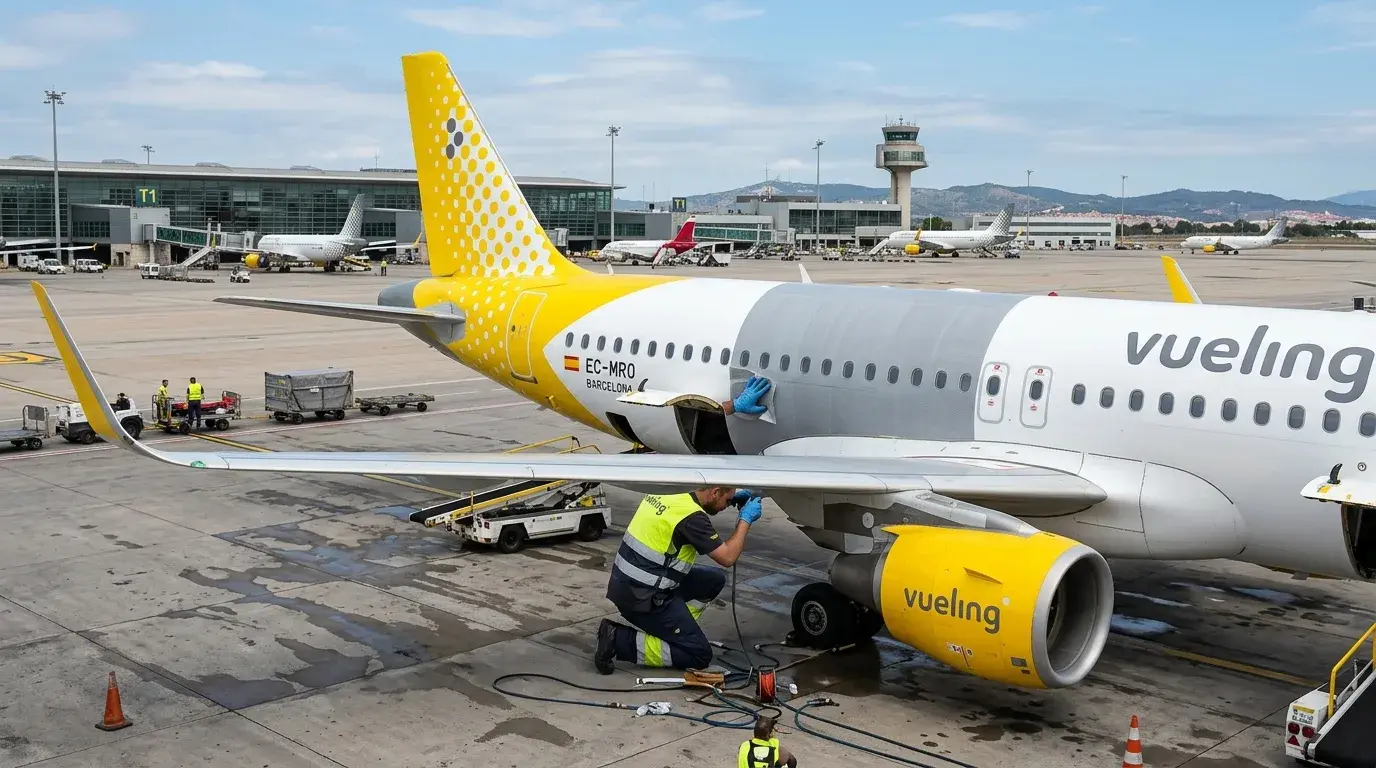
Imagine a coating so thin it fits in an envelope, yet capable of slashing your flight’s fuel bill. That’s exactly what Flightfilm, a biomimetic innovation inspired by shark skin, promises—and Vueling plans to roll it out on its Airbus A320s next year.
The International Airlines Group (IAG), Vueling’s parent company, has just taken a major step by injecting $20 million into the Australian start-up MAKO to fast-track certification of this technology. The goal? To become the first European airline to equip part of its fleet with this revolutionary film, promising fuel savings of 1-2%—a significant gain in an era where jet fuel remains airlines’ second-largest cost, just behind salaries.
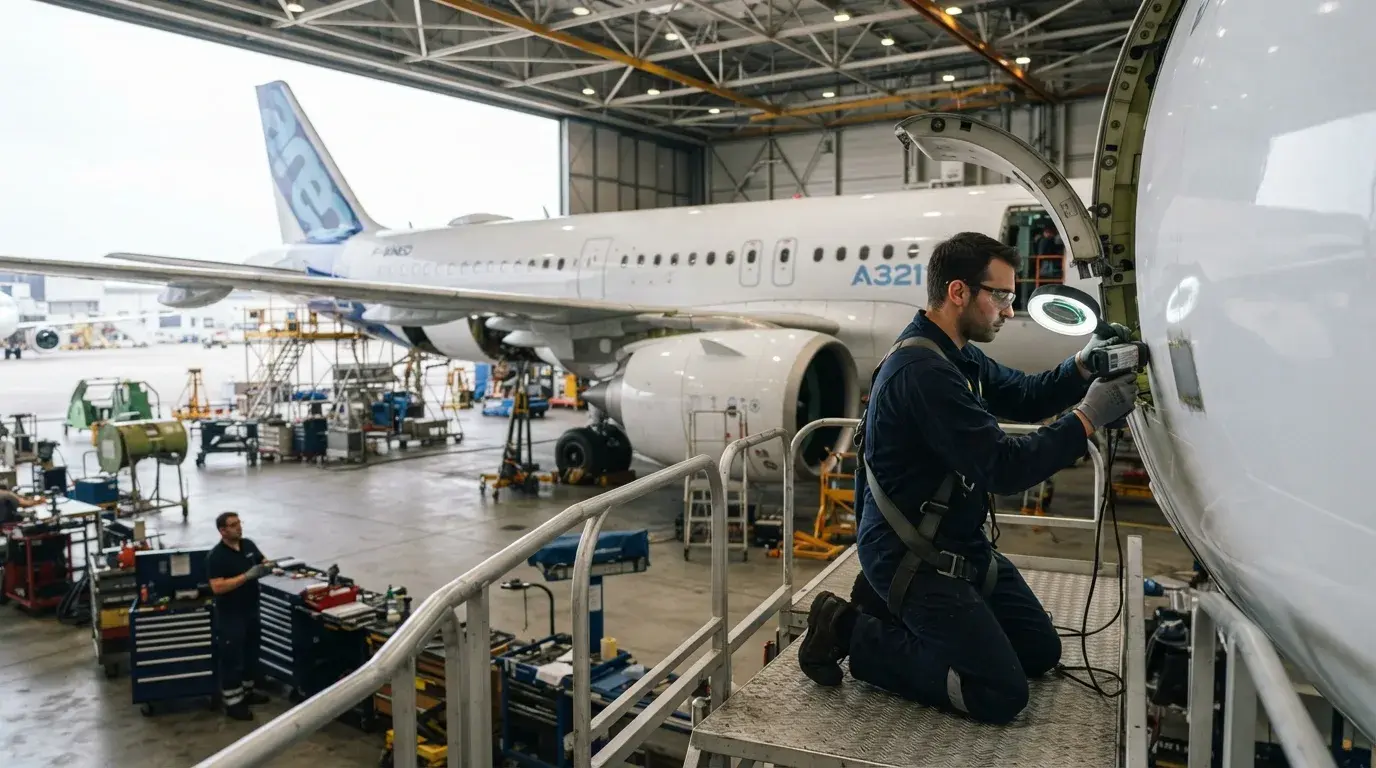
The principle is simple, but its potential impact is enormous. Flightfilm replicates the microscopic texture of shark skin, composed of fine grooves (riblets) that minimize turbulence at the aircraft’s surface. Applied as an adhesive film to the fuselage, it reduces frictional drag—and thus fuel consumption—without requiring any structural modifications to the aircraft. A plug-and-play solution that integrates seamlessly into existing maintenance cycles.
“This innovation supports our goal of improving energy efficiency and strengthens our commitment to reducing CO₂ emissions,” Vueling’s Director of Sustainability, Franc Sanmartí, stated in 2025. Three years after initial tests, the technology has reached a milestone: EASA (European Union Aviation Safety Agency) certification is now expected within the next twelve months, paving the way for deployment across Europe’s fleet.
A mature, tested, and approved technology
Flightfilm isn’t a new idea, but its development was slowed by certification challenges. MAKO, formerly known as MicroTau, worked closely with aerodynamics experts to adapt the riblet texture to the surface of Airbus A320s. Wind tunnel and real-world test results have confirmed the promise: a measurable reduction in drag, with no impact on the aircraft’s structure.
Tests showed that the coating, applied in a single layer, could be installed in under eight hours during a standard maintenance visit. A non-intrusive operation that minimizes aircraft downtime. “Turbulence near the surface is lifted to the tops of the microstructures, reducing direct interaction with the wall and minimizing friction,” MAKO explains in its technical sheet. The result? Immediate fuel savings, without heavy infrastructure investments.
Data from test campaigns suggest gains could reach 1.5% on short-to-medium-haul flights, where frictional drag accounts for a larger share of total fuel consumption. For a carrier like Vueling, operating a fleet of over 100 Airbus A320s, the financial impact runs into millions of euros annually—a compelling argument for investors and regulators alike.
A strategic bet for IAG—and beyond
IAG’s support for this technology aligns with a broader strategy to reduce its subsidiaries’ carbon footprint. The group, which also owns British Airways, Iberia, and Aer Lingus, could extend Flightfilm deployment across its entire European fleet if results meet expectations. “We believe this technology can enhance operational efficiency, generate substantial savings, and reduce emissions while aligning with our innovation strategy,” says Raza Ali, Managing Partner at IAGi Ventures.
The Flightfilm’s business model is particularly appealing to airlines. Unlike solutions such as winglets or more efficient engines, which require massive investments, the shark-skin coating installs at a fraction of the cost. Priced between $50,000 and $70,000 per aircraft, the film pays for itself quickly through fuel savings. For an Airbus A320, the return on investment typically occurs within two years of operation.
Industry experts also highlight the environmental benefits. A 1.5% reduction in fuel consumption on a short-haul route like Barcelona-Milan equates to 150 kg of CO₂ saved per aircraft. Across a fleet of 100 planes, that’s a daily reduction of 15 tonnes of CO₂—a concrete step toward the EU’s 2050 carbon neutrality goals.
The aerodynamic coating market is booming
Vueling isn’t the only airline eyeing biomimicry for aviation. Several players, including Lufthansa Technik and BASF, have tested similar solutions in recent years. While less publicized than Flightfilm, their results confirm the potential of such coatings: fuel savings of 1-2% have been observed on aircraft like the Boeing 737 and Airbus A320.
The aerodynamic coatings market is projected to exceed $500 million by 2030, driven by soaring fuel costs and tightening emissions regulations. Low-cost carriers like Vueling are particularly drawn to these innovations, as they operate standardized fleets and high-frequency rotations, maximizing per-aircraft gains.
MAKO, which raised AUD 28 million in June 2026, is already planning to expand certification of its technology to other markets, including the U.S. and Australia. The company is collaborating with major players like Airbus and Boeing to adapt Flightfilm to other aircraft families, including the A350 and 787. “Our goal is to become the standard for aerodynamic coatings in commercial aviation,” a MAKO spokesperson states.
For passengers, the impact of this technology is invisible. There’s no change in cabin comfort or flight performance. However, it could translate into more stable fares—or even price reductions—if airlines pass on their savings. A welcome development for travelers and the planet alike.
What’s next for European passengers?
If Flightfilm certification is confirmed in 2026, Vueling could be the first airline to equip part of its fleet as early as Q1 2027. The aircraft involved will likely be Airbus A320s operating on high-frequency European routes like Madrid-Barcelona or Rome-Milan.
Travelers can track the deployment’s progress through airlines’ sustainability reports. Greater transparency is expected, particularly on fuel savings and associated emission reductions. For tech enthusiasts, maintenance visits could even be organized at certain hubs, offering a rare glimpse at an innovation that may well revolutionize tomorrow’s aviation.
One thing is certain: biomimicry still has surprises in store. After inspiring robots, medicines, and construction materials, nature may just hold the key to cleaner—and cheaper—travel.
Be the first to comment on this article